

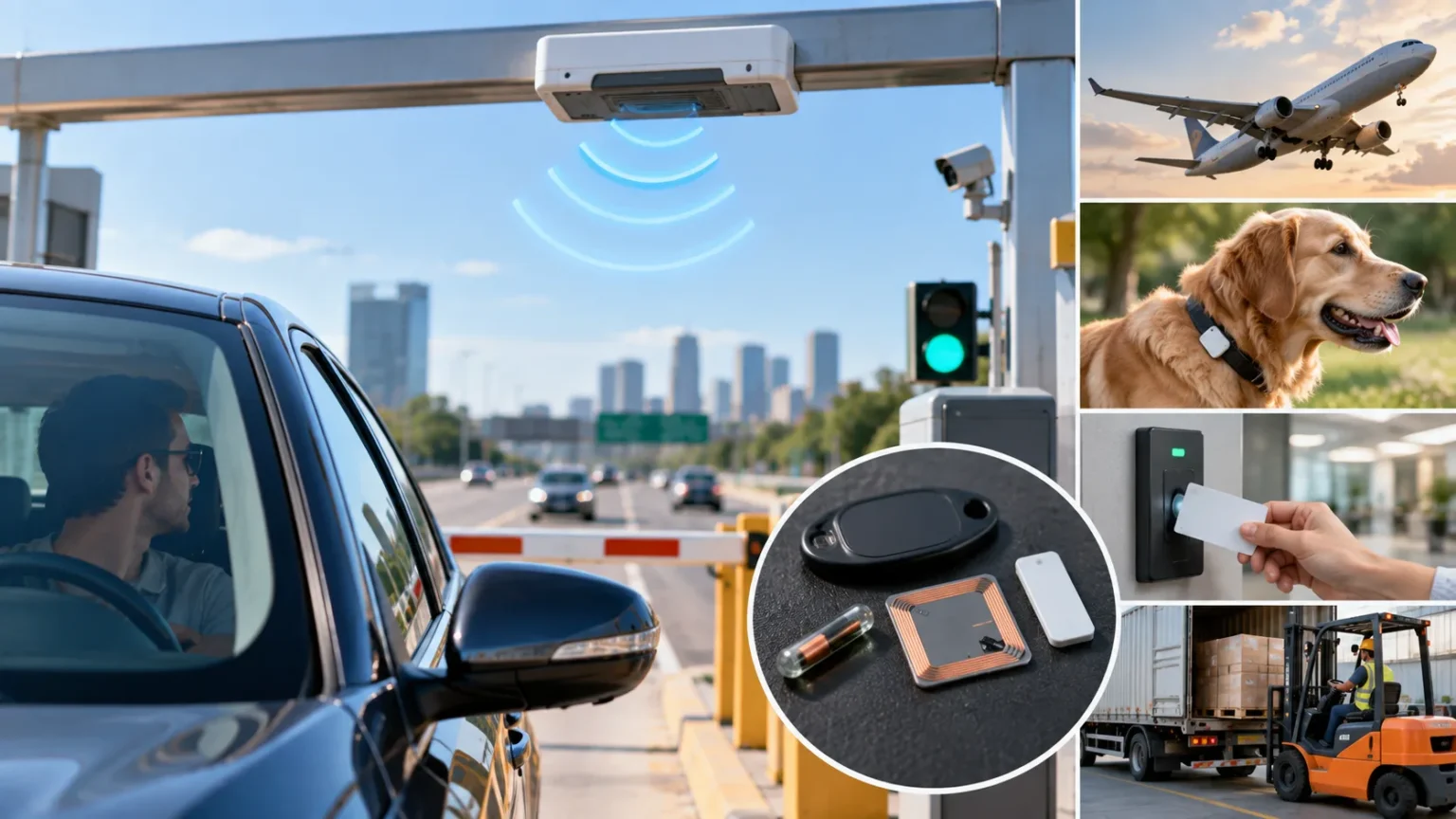

Transponder: Types, Uses & How It Works
A transponder is an electronic device that receives a signal and automatically sends back a response, usually containing information that helps another system identify, locate, authenticate, or communicate with it. The word comes from combining the ideas of a transmitter and a responder, which describes the device’s basic purpose surprisingly well. Transponders are used in aircraft, satellites, toll systems, vehicle keys, RFID systems, access control, tracking applications, and many other technologies. Some transponders operate continuously, while others remain inactive until they receive an appropriate interrogation signal. Their size can range from tiny electronic chips to sophisticated equipment installed aboard aircraft or communications satellites. Despite these differences, the fundamental idea remains the same: receive information or energy, process it, and provide a recognizable response.
Many people first encounter a transponder while driving through an electronic toll lane or hearing an air traffic controller tell a pilot to enter a particular transponder code. Others use a transponder every day without realizing it because a small chip inside a vehicle key communicates with the car’s immobilizer system. Communications satellites also rely on transponders to receive radio signals from Earth, process or shift those signals, and transmit them back toward another location. These applications may look unrelated, but they all depend on controlled electronic responses. Understanding the transponder definition therefore provides a useful foundation for understanding identification, tracking, wireless communication, aviation surveillance, RFID technology, and electronic security systems.
The way a transponder works depends heavily on the technology in which it is installed. An aircraft transponder responds to surveillance systems and helps air traffic control identify and track an aircraft, while an RFID transponder may respond to radio-frequency energy from a nearby reader. A satellite transponder deals with signals traveling thousands of kilometers between Earth and orbit, requiring substantially different equipment. Automotive transponder keys use coded communication to help prevent unauthorized engine operation. Some devices require their own power supply, while passive transponders can obtain enough energy from a reader’s radio signal to produce a response. This guide explains the major transponder types, how they work, and where they are used in everyday and specialized technology.
What Is a Transponder?
A transponder is an electronic device designed to respond automatically when it receives a suitable incoming signal. Depending on the system, that response may contain identification information, position-related data, an authentication code, altitude information, or another type of electronic message. The initiating signal is often called an interrogation because one device is effectively asking another device for information. The transponder detects that request, processes it according to its design, and sends an appropriate reply. Some technologies instead use automatic broadcasting rather than waiting for every individual interrogation. The defining feature is that the device participates in a controlled communication process that allows another system to recognize or obtain information from it.
The term transponder should not be limited to one particular shape or type of hardware. In an aircraft, the transponder is part of the avionics system and communicates through radio-frequency signals with surveillance equipment. Inside a car key, the transponder may be a tiny chip that performs electronic authentication without any visible screen or battery. An electronic toll tag can contain a transponder that communicates with roadside equipment as the vehicle passes through a tolling point. In a satellite, transponders are far more sophisticated systems responsible for receiving and retransmitting communication signals. These examples show that “transponder” describes a function more than a particular physical object.
A transponder usually communicates according to an established protocol so that both the transmitter and receiver understand what the exchanged signals mean. The receiving system needs to know what frequency, data format, timing, coding, and response behavior to expect. Without common standards, one manufacturer’s equipment might not be able to understand another device even if both could transmit radio signals. Aviation systems are especially dependent on standardized communication because aircraft and surveillance infrastructure need to exchange information reliably across operators and equipment manufacturers. RFID and electronic toll systems similarly rely on compatible technologies. Communication standards turn individual transponders into useful parts of larger networks rather than isolated radio devices.
Identification is one of the most common functions provided by transponder technology. An aircraft may transmit information that allows surveillance systems to distinguish it from other aircraft operating nearby. A toll transponder is associated with a particular customer account so that the system can record a vehicle’s passage and process the appropriate charge. An automotive immobilizer recognizes whether the transponder inside a key contains an authorized electronic credential. RFID tags can identify products, equipment, access cards, animals, or other items. In each situation, an electronic identity is communicated much faster and more automatically than a person could provide the same information manually.
Not all transponders simply return a fixed identification number. Advanced systems can transmit changing or additional information depending on their purpose. An aviation transponder may provide altitude or aircraft-specific data, while modern aircraft surveillance equipment can broadcast position, velocity, and other flight information through related technologies. Satellite transponders receive one group of radio-frequency signals and retransmit them after amplification and frequency conversion. Security transponders may participate in challenge-response authentication instead of sending the same code repeatedly. The general transponder definition therefore covers a wide range of complexity, from simple identification devices to highly sophisticated communication systems operating continuously across enormous distances.
How Does a Transponder Work?
The basic transponder process begins when the device receives an incoming radio-frequency or electronic signal. An antenna or receiving circuit detects the signal and passes it to internal electronics that determine whether the transmission is intended for that device or system. If the signal matches the required characteristics, the transponder prepares the appropriate response. The response may contain stored information, data collected from another onboard system, or information created through an authentication process. A transmitter then sends the response back through an antenna or connected communication system. Although this process sounds lengthy when described step by step, electronic transponders can perform it extremely quickly.
Active transponders have their own power source or receive continuous power from the equipment in which they are installed. Aircraft transponders and satellite communication equipment are obvious examples because they need sufficient electrical power to send signals across substantial distances. Active devices can generally support stronger transmissions, longer communication ranges, and more complex processing than tiny passive tags. A vehicle toll tag may also use an internal battery depending on the technology and tolling system involved. Having a power source does not eliminate the need for an incoming communication protocol. It simply means the transponder does not depend entirely on energy supplied by the reader to create its response.
Passive transponders operate differently because they may not contain a conventional internal battery. Many RFID tags receive radio-frequency energy from a nearby reader and use part of that energy to power their electronics briefly. The tag can then communicate its stored information back to the reader, often using a technique in which the tag changes how it reflects or interacts with the incoming radio signal. Because passive tags require little hardware and no replaceable battery, they can be small, inexpensive, and long-lasting. Their communication range is generally more limited than that of powerful active systems. Nevertheless, passive RFID transponders are extremely useful for identification, inventory, access control, and many other everyday applications.
Signal processing is another important part of transponder operation. The device needs to distinguish valid communication from background radio noise and may need to decode digital information before determining how to respond. More advanced transponders can verify addresses, interpret commands, retrieve stored data, or obtain information from other connected systems. Aircraft equipment may communicate with navigation or altitude-reporting systems, while a satellite transponder may filter, amplify, and shift frequencies before retransmitting information. Security-focused devices can perform cryptographic calculations. These processing capabilities explain why a transponder can be far more than a simple transmitter that automatically repeats whatever signal reaches its antenna.
The communication distance between a reader and transponder varies dramatically according to power, frequency, antennas, environment, and system design. A passive access card may need to be held very close to a reader, while aviation surveillance signals operate across much greater distances. Satellite communication spans the enormous distance between ground stations and spacecraft in orbit. Buildings, metal, weather, interference, antenna orientation, and competing radio signals can also affect performance. Engineers therefore design each transponder system around a specific operating environment rather than expecting one technology to work equally well everywhere. Understanding range is important because the word transponder alone does not tell you how far a particular device can communicate.
Main Types of Transponders
Aircraft transponders are among the most recognizable types because they play an essential role in aviation surveillance and air traffic management. Installed in an aircraft’s avionics system, a transponder can respond to interrogation from secondary surveillance equipment with information used to identify and track the aircraft. Traditional aviation systems include Mode A, Mode C, and Mode S capabilities, which provide increasingly useful information. Modern aircraft may also use transponder-related equipment as part of ADS-B surveillance. Pilots interact with these systems through cockpit controls and may enter a code assigned by air traffic control. Reliable transponder operation helps controllers maintain a clearer picture of traffic moving through controlled airspace.
Satellite transponders are another major category, but their role is primarily communication rather than aircraft identification. A communications satellite receives an uplink signal sent from Earth and passes it through onboard equipment that can filter, amplify, convert, and retransmit the signal toward another part of Earth. Satellites may contain multiple transponders so they can handle different channels, frequencies, or communication services simultaneously. Television distribution, telecommunications, data connections, and other satellite services have historically depended heavily on transponder capacity. Modern satellite architectures can become more sophisticated than the classic fixed transponder model, but the concept remains fundamental. The spacecraft acts as an electronic relay positioned high above the planet.
RFID transponders are usually much smaller and are used for automatic identification. RFID stands for radio-frequency identification, a technology in which a reader communicates wirelessly with a tag or transponder attached to an object, card, animal, or other item. Passive RFID tags may operate without a conventional battery, while active RFID devices use their own power source. Applications include inventory tracking, asset management, access badges, supply chains, libraries, manufacturing, and animal identification. The information stored on the transponder varies according to the application. Some tags provide little more than an identifier, while more advanced systems can store additional information or support stronger authentication.
Electronic toll transponders represent a specialized form of vehicle identification technology. A tag mounted inside or on a vehicle communicates with tolling infrastructure as the vehicle passes through an equipped road, bridge, tunnel, or toll point. The toll system connects the recognized identifier with an account and records the transaction without requiring the driver to stop and hand over cash. Different countries and toll operators use different radio technologies and interoperability arrangements, so a toll transponder accepted in one region may not automatically work everywhere. Modern tolling systems may also combine transponder data with license-plate recognition. The main goal is to identify vehicles accurately while allowing traffic to move with minimal interruption.
Automotive key transponders form another important category and are designed primarily for vehicle security. A chip inside the key or key fob communicates with the vehicle’s immobilizer system when someone attempts to start the engine. If the vehicle recognizes the expected electronic credential, the immobilizer allows engine operation. If the transponder is missing, damaged, or not properly programmed, the mechanical key may turn while the engine still refuses to start. Modern key systems can use more sophisticated authentication than early fixed-code transponders. This technology makes simple mechanical key duplication less useful to a thief because possessing the correct physical key shape alone may not provide the electronic authorization required by the vehicle.
Aircraft Transponders: Mode A, Mode C, Mode S and ADS-B
Mode A is one of the traditional aircraft transponder modes used for identification within secondary surveillance systems. The pilot selects a four-digit transponder code, commonly called a squawk code, according to air traffic control instructions or applicable operating procedures. When appropriately interrogated, the transponder replies with that code, allowing surveillance systems to associate the radar return with a particular aircraft or flight. The available digits use a limited range, producing thousands of possible codes rather than an unlimited identifier space. Certain codes also have recognized special purposes in aviation. Mode A helps answer the basic question of which aircraft a surveillance return represents but does not independently provide all information modern controllers may need.
Mode C builds on identification capability by adding pressure-altitude information. The aircraft’s altitude-reporting equipment supplies encoded altitude data that the transponder can send when receiving the appropriate interrogation. Air traffic control can then see not only where a target appears horizontally but also the altitude being reported by the aircraft. This dramatically improves surveillance usefulness because safe traffic separation depends on understanding the three-dimensional relationship between aircraft. Pilots need to ensure that relevant altitude-reporting equipment functions correctly because incorrect data can create surveillance problems. Mode C technology became an important step between basic identification transponders and more sophisticated addressed surveillance systems.
Mode S introduces selective or addressed communication capabilities and supports a larger range of aircraft-specific information. Rather than treating every aircraft response in exactly the same way, Mode S systems can interrogate individual aircraft using assigned addresses. A unique 24-bit aircraft address helps surveillance systems distinguish aircraft more reliably, while different Mode S implementations can support identification, altitude, and additional data capabilities. Mode S also interacts with other aviation safety and surveillance technologies. The increased information capacity makes it better suited to busy airspace containing many aircraft. Its name reflects “select” communication, highlighting the ability to address particular transponders instead of relying only on broad interrogation and simple responses.
ADS-B, or Automatic Dependent Surveillance–Broadcast, represents a major development in aircraft surveillance and is closely connected with modern transponder discussions. ADS-B Out periodically broadcasts aircraft information such as position, altitude, velocity, and identification without requiring traditional radar interrogation for each broadcast. The position information is derived from an onboard navigation source such as GPS, which is why the technology is described as “dependent.” In U.S. operations, one ADS-B Out solution uses 1090 MHz Extended Squitter associated with Mode S transponder equipment, while another uses Universal Access Transceiver technology on 978 MHz. Equipment requirements depend on operating circumstances and airspace. ADS-B therefore complements and extends the broader evolution of aircraft surveillance beyond traditional radar responses.
Pilots may hear terms such as squawk, ident, standby, altitude reporting, Mode S, or ADS-B during normal aircraft operations. These controls should be used according to aircraft procedures, air traffic instructions, and applicable aviation regulations rather than treated like ordinary consumer electronics settings. A transponder that sends incorrect identification or altitude information can create confusion for surveillance systems and controllers. Modern ADS-B systems also depend on correct aircraft configuration and position-source data. For this reason, avionics installation and maintenance need to follow aviation standards rather than improvised modification. To the passenger, the transponder may be invisible, but to air traffic management it is an important source of aircraft identity and surveillance information.
Satellite Transponders and Communication Systems
A satellite transponder functions as part of a communication relay between Earth stations or other communication points. A transmitting station sends an uplink signal toward the satellite on an assigned frequency. The satellite receives that weak signal through its antenna system and routes it through communication electronics aboard the spacecraft. The transponder can filter the desired frequency range, amplify the received signal, and convert it to a different frequency before retransmission. The new signal travels down toward the intended coverage area as a downlink. Frequency conversion helps reduce interference between powerful outgoing transmissions and sensitive receivers operating aboard the same satellite.
Communications satellites may carry numerous transponders rather than one device handling all traffic. Each transponder can be allocated a defined amount of radio-frequency bandwidth and may support one or more communication channels depending on the system design. Satellite operators manage this limited capacity because available bandwidth and spacecraft power are valuable resources. Television broadcasters historically leased satellite transponder capacity to distribute programming over wide geographic areas. Telecommunications companies have also used satellite capacity for voice, data, internet connectivity, and remote communications. Although modern digital processing can make satellite payload architecture more flexible, the idea of dividing communication capacity into managed transponder resources remains widely understood.
A traditional satellite transponder does not necessarily understand the meaning of every television program, phone call, or data packet passing through it. Its primary role may simply be to receive an assigned frequency range and relay the communication reliably after appropriate signal processing. This arrangement is sometimes described as a transparent or bent-pipe approach because the satellite acts mainly as a radio relay. More advanced satellites can include onboard digital processing that routes or reshapes traffic more intelligently. The distinction matters because “satellite transponder” can describe both a familiar communications concept and part of a much more complex modern payload. In every case, reliable signal reception and retransmission remain central requirements.
Satellite transponders are particularly useful because one spacecraft can cover an enormous geographic area. Ground infrastructure separated by hundreds or thousands of kilometers can communicate through the same satellite without requiring a direct terrestrial cable between locations. This capability has supported television broadcasting, communications at sea, remote-area connectivity, disaster communications, aviation links, and other services where terrestrial infrastructure may be difficult or expensive. Satellite communication also introduces challenges such as propagation delay, signal attenuation, limited spectrum, power constraints, and interference. Transponder design needs to balance these technical limitations. The spacecraft must provide useful communication performance while operating remotely in an environment where physical repair may be impossible.
The satellite meaning of transponder is therefore different from the identification-focused meaning familiar in aircraft, toll tags, or vehicle keys. A toll transponder primarily helps a system recognize a vehicle, while a communications satellite transponder primarily helps relay information from one communication link to another. Both still fit the broader transponder concept because electronic equipment responds to incoming radio signals with outgoing transmission. The content, range, power, and complexity simply differ enormously. Recognizing this difference is useful when reading technical documents because the surrounding words usually reveal the intended meaning. Terms such as uplink, downlink, bandwidth, frequency, satellite channel, and ground station almost always indicate the satellite communication context.
RFID, Toll, Access and Tracking Transponders
RFID technology uses radio waves to identify tagged objects without requiring direct physical contact between the tag and reader. An RFID transponder typically includes an integrated circuit and an antenna, although its exact construction depends on operating frequency, range, durability, and application. The circuit can store identification information and control communication with the RFID reader. When an appropriate radio signal reaches the tag, the transponder responds with information the reader can process. The reader then sends the captured data to a software system that decides what the identifier means. This separation between radio identification and application software allows RFID to support everything from warehouse inventory to building access.
Passive RFID transponders are popular because they can be inexpensive and require no replaceable internal battery. Energy transmitted by the reader activates the tag long enough for communication to occur. This allows manufacturers to embed RFID transponders in labels, cards, product packaging, identification devices, and other compact formats. The tradeoff is that passive communication range is limited by available energy, antenna design, radio frequency, and environmental conditions. Metal and liquids can also affect certain RFID systems significantly. Engineers choose specific tag designs and frequencies according to what needs to be identified and where the reader will operate.
Active RFID transponders contain a power source and can generally support greater range or additional functions. They may be attached to valuable equipment, shipping containers, vehicles, or assets that need more capable tracking than a simple passive label can provide. Some systems periodically transmit information, while others respond when readers or network equipment communicate with them. Internal power also makes it possible to integrate sensors or store more extensive data depending on the device. The disadvantage is greater cost, size, and eventual battery maintenance. Active and passive RFID should therefore be viewed as complementary technologies designed for different identification and tracking requirements rather than direct substitutes.
Electronic toll collection demonstrates RFID-style transponder concepts on a transportation scale. A compatible vehicle tag allows roadside systems to recognize a passing account holder without requiring the vehicle to stop at a staffed booth. The recognized transaction can then be associated with the appropriate road, bridge, distance, vehicle class, or account according to the toll operator’s system. Faster processing can reduce queues and eliminate much of the cash handling involved in conventional toll plazas. However, interoperability varies because different operators may use different technical standards or administrative networks. Drivers should therefore confirm where a particular toll tag works instead of assuming every device is universally compatible.
Access-control transponders use similar identification concepts to determine whether a person or object should be permitted through a controlled point. Employee badges, building entry cards, parking credentials, hotel access systems, and other identification devices may use radio-frequency communication with nearby readers. The reader checks the transponder’s credential against an access-control database and makes or requests an authorization decision. More secure systems avoid relying solely on easily copied static identifiers and may incorporate cryptographic authentication. Lost access credentials can often be disabled centrally, providing an advantage over traditional mechanical keys in managed facilities. Nevertheless, security depends on the complete system, including reader design, credential technology, software, network protection, and administrative practices.
Car Key Transponders and Vehicle Immobilizer Systems
A transponder key contains an electronic chip that communicates with a vehicle’s security system during the starting process. The mechanical portion of the key may still operate the lock or ignition cylinder in vehicles that use traditional key shapes, but the electronic transponder provides a separate layer of authorization. When the driver attempts to start the vehicle, the immobilizer system checks for an expected electronic response. If the response is accepted, the system allows necessary engine functions to continue. If the credential is missing or incorrect, the engine may crank without starting or may be prevented from operating altogether. This makes simple mechanical duplication less effective for stealing many transponder-equipped vehicles.
Early automotive transponder systems sometimes relied on relatively simple identification codes, while newer immobilizer designs can use more advanced challenge-response authentication. In a challenge-response system, the vehicle sends information to the transponder and expects a mathematically related answer that depends on a protected secret. This is more secure than repeatedly transmitting one unchanged identifier that could potentially be captured and copied. Vehicle manufacturers use different security architectures, so transponder keys are not interchangeable across brands or even necessarily across models from the same manufacturer. Programming a replacement key may require vehicle-specific equipment, authorized procedures, or possession of an already registered credential.
The transponder chip itself may not need the same type of battery used by remote keyless-entry buttons. In many designs, the immobilizer system energizes a passive chip through a short-range electromagnetic field when the key is near the ignition or designated reader. This explains why a traditional transponder key may still start the vehicle even if a separate remote-control battery used for door locking becomes weak. Modern smart keys can combine several wireless technologies in one device, making the situation more complex. Passive immobilizer authentication, remote locking, and proximity-based keyless entry may involve different circuits or operating methods within the same key fob.
A damaged or incorrectly programmed transponder can create a confusing situation because the mechanical parts of the key may appear completely normal. The key may physically fit and turn, yet the vehicle can refuse to authorize engine operation. Security indicators on the dashboard may flash or remain illuminated depending on the vehicle. Replacing the metal key blade alone may therefore fail to solve the problem. Automotive locksmiths and vehicle service professionals can often diagnose whether the issue involves the transponder, immobilizer antenna, key programming, vehicle control module, or another component. Guessing by repeatedly replacing unrelated parts can make a straightforward electronic issue unnecessarily expensive.
Vehicle transponders should not be confused with toll transponders even though both may be found in the same car. The immobilizer transponder is part of the vehicle’s anti-theft system and communicates over a very short range with the vehicle itself. A toll transponder communicates with roadside infrastructure and is associated with transportation payment or vehicle identification. Some vehicles also contain additional radio systems for tire monitoring, keyless entry, garage access, telematics, and other functions. These technologies may all involve wireless identification, but their frequencies, protocols, security requirements, and purposes differ. Understanding the particular system involved is essential before troubleshooting or replacing any device described simply as a transponder.
Why Transponders Matter and Where Problems Occur
Transponders make automated identification possible in environments where manual identification would be slow, expensive, or unsafe. Air traffic surveillance would be much more difficult if controllers depended only on uncooperative radar returns without electronic aircraft identification and altitude information. Toll roads would require more stopping and human processing without electronic vehicle credentials. Warehouses would need additional manual scanning and data entry without RFID systems, while automotive theft prevention would rely more heavily on mechanical locks alone. Satellite networks depend on transponder-like communication payloads to relay signals over enormous areas. The value of transponders therefore comes largely from making electronic systems aware of which device, object, or communication channel they are interacting with.
Reliability is especially important because incorrect transponder information can sometimes be more problematic than no information at all. An aircraft transmitting an incorrect altitude or identity can confuse surveillance data and require corrective action. A damaged RFID tag may cause an inventory system to believe an item is missing, while an incorrectly associated toll tag may result in billing problems. A faulty vehicle transponder can leave an authorized driver unable to start the car. Satellite transponder failures can reduce available communication capacity. Systems therefore need error detection, monitoring, maintenance procedures, and fallback methods appropriate to the consequences of failure.
Radio interference can affect transponder performance because many systems depend on carefully controlled electromagnetic communication. Multiple devices operating nearby, metal obstructions, poorly positioned antennas, excessive distance, damaged cables, or incompatible frequencies can reduce reliability. RFID installations often require practical testing because the surrounding products and building materials influence how radio waves behave. Aviation and satellite systems use detailed frequency planning to minimize harmful interference with other radio services. Consumer transponder systems may seem simpler, but they still depend on correct reader placement and compatible equipment. When a transponder stops working, the cause may therefore be the surrounding communication environment rather than the transponder chip itself.
Privacy and security also deserve consideration because electronic identification can create records about people, vehicles, objects, or movements. Toll systems may record where and when a compatible tag was detected, while access-control systems can maintain logs showing when credentials were used at specific doors. Aircraft surveillance broadcasts can be received by appropriately equipped systems, and RFID deployments may create privacy concerns if identifiers are accessible beyond their intended use. Security technology can reduce some risks through encryption, access controls, credential rotation, and careful data governance. However, the transponder itself is only one part of the privacy equation. Organizations also need responsible policies governing how collected information is stored, accessed, shared, and retained.
The future of transponder technology is increasingly connected with smarter networks, automation, digital identity, and real-time tracking. Transportation systems are adopting more automated tolling and traffic-management technologies, while supply chains use increasingly connected identification systems to improve visibility. Aircraft surveillance continues to rely on digital data exchange, and satellite payloads are becoming more flexible through advanced onboard processing. Vehicles combine immobilizer authentication with sophisticated wireless key and connectivity features. The word “transponder” may therefore describe technologies of very different ages and capabilities for many years to come. What connects them is the ability to receive a relevant signal and provide a meaningful electronic response that another system can recognize and use.
Frequently Asked Questions About Transponders
What is a transponder in simple terms?
A transponder is an electronic device that receives a particular signal and sends back a response. The response may provide identification, altitude, authentication, communication data, or other information depending on the system.
What does an aircraft transponder do?
An aircraft transponder helps surveillance systems identify and track an aircraft by responding with information such as an assigned code and, with appropriate equipment, altitude or other aircraft data. Modern aviation surveillance can also combine transponder technology with ADS-B broadcasting.
What is the difference between Mode A, Mode C, and Mode S?
Mode A primarily provides an identification or squawk code, while Mode C adds pressure-altitude information. Mode S supports selective aircraft addressing and additional data capabilities used in more advanced surveillance systems.
What is a transponder in a car key?
A car key transponder is a small electronic chip that communicates with the vehicle’s immobilizer system. If the vehicle does not recognize an authorized transponder response, it can prevent the engine from starting even when the mechanical key fits.
Is an RFID tag a transponder?
Yes, an RFID tag can be described as a radio-frequency transponder because it responds to communication from an RFID reader. Passive RFID transponders can operate without a conventional battery by obtaining energy from the reader’s radio-frequency field.