

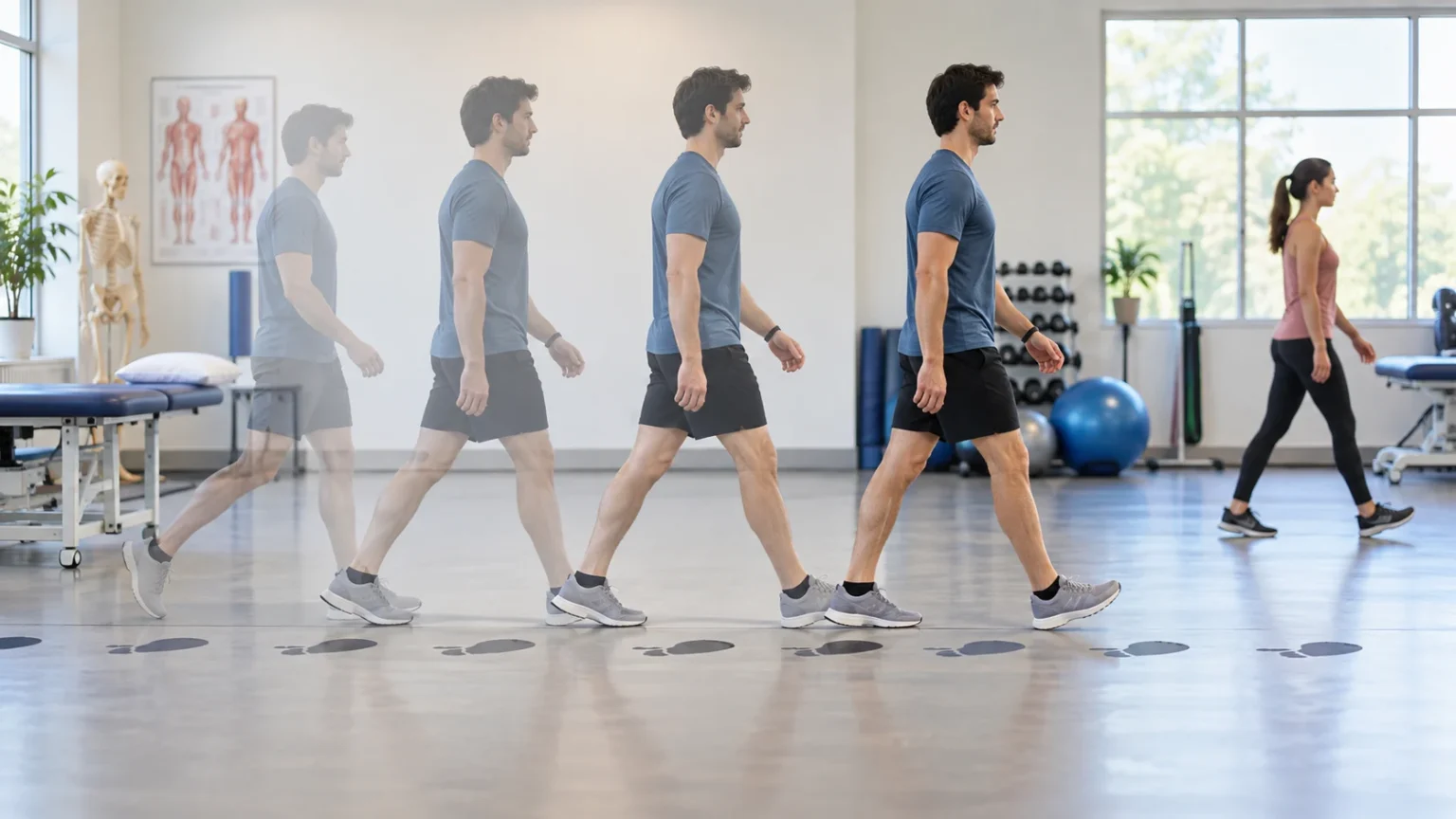

Gait is the way a person walks or moves from one place to another using their legs. Although walking may seem automatic, it requires coordination between the brain, nerves, muscles, joints, balance system, and senses. Healthcare professionals often observe gait because changes in walking patterns can provide useful information about strength, mobility, pain, balance, or neurological function.
Everyone has a slightly different walking style, but a healthy gait generally follows a predictable sequence of steps. Problems with the feet, knees, hips, spine, muscles, or nervous system can change that pattern. Understanding the basic gait definition, common phases, examples, and abnormal patterns can make medical and fitness terminology much easier to understand.
What Is Gait?
Gait simply means the pattern or manner in which a person walks. It describes how the feet contact the ground, how the legs move, how body weight shifts, and how the rest of the body stays balanced during movement. Gait can be described as normal, altered, slow, unsteady, limping, or using more specific clinical terms.
Walking requires repeated coordination between both sides of the body. While one foot supports your weight, the opposite leg moves forward to prepare for the next step. Your arms usually swing in the opposite direction of your legs, while your trunk and pelvis make small adjustments that help maintain balance and forward movement.
Healthcare professionals may evaluate gait when someone has pain, weakness, dizziness, an injury, or difficulty walking. Physical therapists, doctors, and other specialists can observe stride length, speed, balance, foot placement, and joint movement. These details can help identify which part of the movement pattern may need further assessment.
What Does Normal Gait Look Like?
A normal gait is generally smooth, controlled, and relatively symmetrical from one side to the other. Each foot alternates between supporting the body and swinging forward. The person can usually maintain a steady walking speed without excessive side-to-side movement, dragging a foot, or repeatedly losing balance.
During normal walking, the heel commonly contacts the ground first before weight moves through the foot toward the toes. The knee bends and straightens at different points, while the hip extends behind the body and then swings forward. The ankle also changes position to absorb impact and help push the body into the next step.
Normal does not mean everyone’s gait must look identical. Height, leg length, age, footwear, fitness, and individual anatomy can all affect walking style. Clinicians are usually more interested in whether the pattern is efficient, stable, comfortable, and appropriate for the individual than whether it matches one perfectly standardized appearance.
What Are the Main Phases of Gait?
The gait cycle is often divided into two major phases: stance and swing. The stance phase occurs while the foot is in contact with the ground and supporting some or all of the body’s weight. The swing phase begins when that foot leaves the ground and travels forward for the next step.
Stance takes up more of the walking cycle than swing during normal walking. It includes initial contact, weight acceptance, mid-stance, heel rise, and push-off. During these stages, the lower limb absorbs impact, supports body weight, maintains balance, and generates force to continue forward.
The swing phase includes the period when the leg moves through the air. The hip and knee flex enough to clear the foot from the floor, while the ankle helps keep the toes from dragging. The leg then extends in preparation for the next heel contact, beginning another gait cycle.
Common Examples of Gait
A relaxed everyday walk is the easiest example of normal gait. The person moves at a comfortable speed with alternating steps, natural arm swing, and relatively even weight distribution. This pattern may change slightly when walking uphill, downhill, quickly, or over uneven ground without necessarily becoming abnormal.
Running is another type of gait, although it differs from walking because both feet can briefly leave the ground at the same time. A faster walking gait still maintains at least one foot in contact with the ground. Athletic gait patterns also change according to sport, speed, terrain, and the movement being performed.
Other examples include walking with a limp after an ankle injury or taking shorter steps when experiencing knee pain. Someone recovering from surgery may temporarily use a walker or cane and adopt a different pattern. These examples show that gait often changes as the body adapts to pain, weakness, balance demands, or environmental conditions.
What Is an Abnormal Gait?
An abnormal gait is a walking pattern that differs noticeably from a person’s expected movement because of pain, weakness, neurological problems, joint restrictions, balance difficulties, or another condition. Examples may include limping, dragging one foot, unusually wide steps, very short steps, or excessive movement of the trunk.
Not every temporary gait change indicates a serious problem. Someone with a blister, sore muscle, or minor ankle sprain may walk differently for several days because they are protecting the painful area. The pattern becomes more concerning when it persists, worsens, affects balance, or appears without an obvious temporary reason.
Abnormal gait should be considered a sign rather than a diagnosis by itself. Clinicians need to determine why the person’s walking pattern changed. Examining strength, sensation, joint mobility, pain, coordination, balance, and medical history can help identify the underlying issue instead of focusing only on the appearance of the walk.
Common Types of Abnormal Gait
An antalgic gait develops when someone changes the way they walk to reduce pain. The person often spends less time standing on the painful leg and may take shorter steps. This pattern can occur with problems involving the foot, ankle, knee, hip, or other weight-bearing structures.
A steppage gait may occur when someone has difficulty lifting the front of the foot. The knee may rise higher than usual so the toes do not drag along the ground. Other patterns include a wide-based gait for balance, a shuffling gait with short steps, or a circumduction pattern where the leg swings outward.
Different abnormal gait patterns can have many possible causes, so they should not be diagnosed from appearance alone. Muscle weakness, joint disease, pain, nerve problems, medication effects, or neurological conditions may all influence walking. A professional assessment is particularly important when the change is sudden or accompanied by other symptoms.
What Can Cause Gait Problems?
Pain is one of the most common reasons people change the way they walk. Foot injuries, ankle problems, knee pain, hip arthritis, or lower-back discomfort can cause someone to shift weight away from the affected area. Over time, these compensations may place additional stress on other muscles and joints.
Weakness or reduced mobility can also affect gait. Limited ankle movement may shorten a step, while weak hip muscles can make it harder to stabilize the pelvis. Muscle tightness, previous injuries, surgery, and prolonged inactivity may also change how the lower body coordinates during walking.
Nerve and spinal problems can influence gait as well because walking depends on accurate communication between the nervous system and muscles. Conditions causing weakness, altered sensation, or poor coordination can change foot placement and balance. Problems such as a pinched nerve in the neck and shoulder mainly affect the upper body, but broader neurological symptoms can sometimes influence overall movement and should be properly assessed.
How Is Gait Assessed?
A basic gait assessment often begins with simply watching someone walk. The clinician may observe the person from the front, back, and side while noting step length, walking speed, arm movement, posture, balance, and whether one side behaves differently from the other. Walking may also be tested at different speeds.
The examiner may then assess joint range of motion, muscle strength, sensation, reflexes, and balance. They can check the feet, ankles, knees, hips, and spine to see whether pain or restricted movement could explain the altered gait. Additional neurological testing may be included when coordination or nerve function appears involved.
More detailed gait analysis can use pressure sensors, video, force plates, or motion-capture technology. These tools measure timing, joint angles, ground forces, and other movement characteristics. Advanced testing is usually reserved for situations where detailed information is needed for rehabilitation, sports performance, surgery planning, or complex neurological and orthopedic conditions.
Can Exercises Improve Gait?
Exercises can improve gait when weakness, limited mobility, balance, or poor movement control contributes to the problem. Strengthening the glutes, quadriceps, calves, and core may help support more stable walking. Mobility exercises can also be useful when stiffness prevents the hip, knee, or ankle from moving through a comfortable range.
Balance training may help people who feel unsteady while walking. Exercises can gradually challenge standing stability, weight shifting, and controlled stepping in safe conditions. Physical therapists often combine balance work with strengthening and walking practice so improvements transfer more directly into everyday movement.
The correct exercise depends on the cause of the gait problem. Someone compensating for a painful knee requires a different program from someone with foot weakness or a neurological condition. Persistent gait changes are best assessed before beginning a demanding exercise routine so training addresses the actual limitation rather than reinforcing compensation.
When Should a Gait Change Be Checked?
Seek professional advice when a new walking problem lasts more than a short period, causes repeated falls, or makes normal daily movement difficult. Persistent limping, foot dragging, increasing weakness, or worsening balance can indicate a problem that deserves assessment. Early evaluation may also prevent secondary pain from repeated compensation.
Sudden gait changes require more caution, especially when accompanied by dizziness, confusion, facial weakness, speech difficulty, severe headache, or weakness on one side of the body. These symptoms can indicate a medical emergency. Sudden inability to walk normally after a major injury also requires prompt evaluation.
Children, older adults, and people recovering from surgery may sometimes develop temporary gait changes, but persistent changes should still be discussed with an appropriate professional. Walking ability is closely connected to independence and safety. Identifying the reason for an abnormal gait can help guide treatment, rehabilitation, or supportive equipment when necessary.
Conclusion
Gait is simply the pattern a person uses to walk. A normal gait involves coordinated movement between the feet, ankles, knees, hips, trunk, arms, and nervous system. Each step alternates between stance and swing phases while the body continuously adjusts its balance and position.
Changes in gait can happen because of pain, injury, muscle weakness, restricted mobility, balance problems, or neurological conditions. Some changes are temporary and harmless, while others require professional assessment. Observing stride length, symmetry, foot placement, and balance can provide useful clues about what may be affecting movement.
If your gait suddenly changes or you develop persistent limping, weakness, foot dragging, or repeated balance problems, consider seeking medical or physical therapy guidance. The goal is not simply to make walking look more normal but to identify and address the reason the movement pattern has changed.
FAQs About Gait
What is gait in simple words?
Gait means the way a person walks. It describes how the legs, feet, arms, and body coordinate as someone moves forward from one step to the next.
What are the two main phases of gait?
The two main phases are stance and swing. Stance occurs while the foot touches the ground, while swing occurs when the foot leaves the floor and moves forward.
What is an abnormal gait?
An abnormal gait is a walking pattern changed by pain, weakness, stiffness, poor balance, nerve problems, or another condition. Examples include limping, shuffling, foot dragging, and unusually wide steps.
Can pain change the way you walk?
Yes. People often shorten steps or shift weight away from a painful foot, ankle, knee, or hip. This protective walking pattern is commonly called an antalgic gait.
Can physical therapy help improve gait?
Yes. Physical therapy can address strength, balance, mobility, coordination, and walking mechanics when these factors contribute to an abnormal gait. The treatment plan should match the underlying cause.