

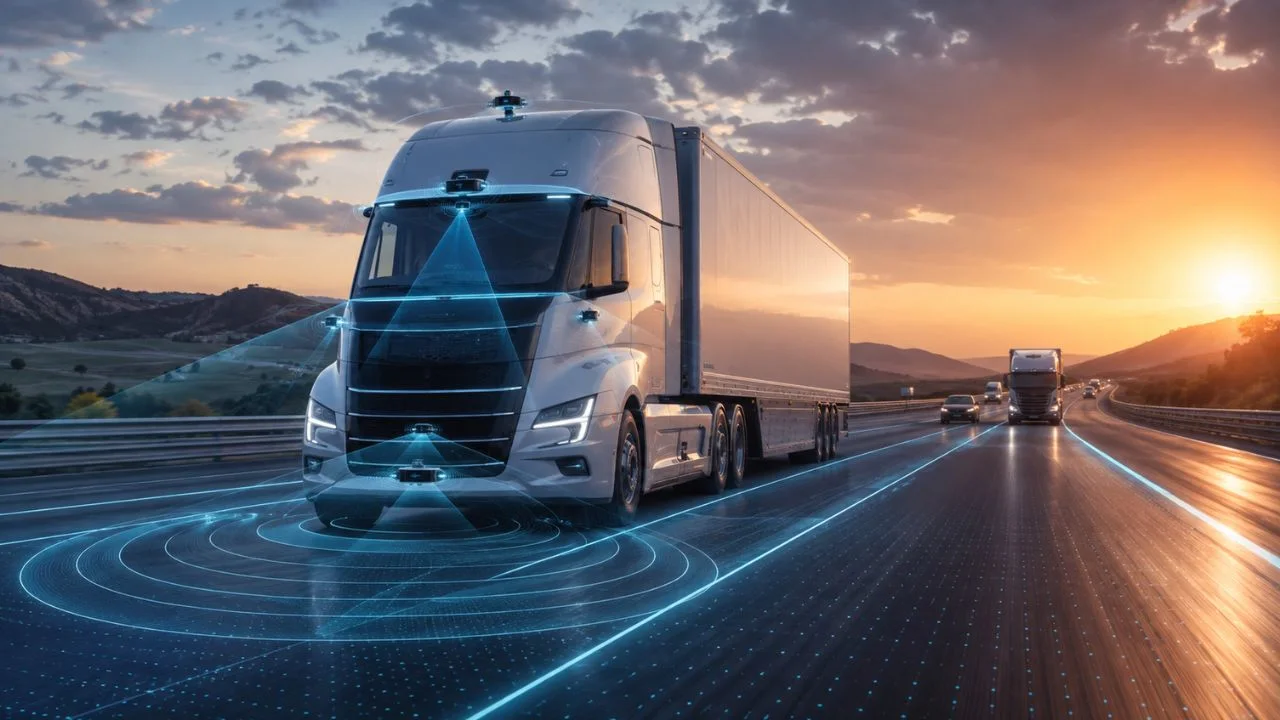

Self-Driving Trucks: Understand How They Are Changing Freight
Self-driving trucks are moving from controlled experiments into limited commercial freight operations. These vehicles combine artificial intelligence, cameras, radar, lidar and powerful computers to handle parts of the driving task. Although fully autonomous trucking is not yet available everywhere, recent deployments show that driverless freight is becoming a real part of selected logistics networks.
The technology attracts attention because trucking companies constantly look for safer, faster and more reliable ways to move goods. Autonomous systems may eventually operate for longer periods, reduce delays and improve vehicle use. However, their performance depends on road conditions, weather, regulations, digital maps and the specific routes for which each system has been designed.
Not every truck described as autonomous can operate without human support. Some vehicles only provide lane assistance or adaptive cruise control, while others can drive without a person behind the wheel inside a defined operating area. Understanding this difference is essential when evaluating claims about self-driving trucks and their readiness for public roads.
This guide explains how autonomous trucks work, where driverless operations are happening and what the technology could mean for businesses and professional drivers. It also examines safety, employment, regulations, costs and leading autonomous trucking companies. The goal is to provide a balanced view rather than presenting truck automation as either a perfect solution or an immediate threat.
What Are Self-Driving Trucks?
Self-driving trucks are commercial vehicles equipped with technology that can perform some or all driving tasks. Depending on the automation level, the system may control acceleration, braking, steering, lane positioning and responses to surrounding traffic. NHTSA commonly uses the term “automated driving system” because “self-driving” can incorrectly suggest that every automated vehicle works independently in all situations.
An autonomous truck does not simply follow a fixed line painted on the road. It continuously collects information from sensors, identifies objects and predicts how other road users may behave. Its software must decide when to maintain speed, change lanes, create more following distance, stop for an obstacle or move into a safe position when normal operation becomes impossible.
Many developers are initially concentrating on long-haul freight corridors rather than complex door-to-door deliveries. Highway routes generally contain fewer pedestrians, cyclists, intersections and unpredictable movements than crowded city streets. A human driver may therefore move the trailer through local areas, while an autonomous truck handles a carefully mapped section between transfer points or logistics terminals.
Some driverless trucks also operate in industrial locations such as mines, energy sites and private freight routes. These environments can be easier to control because access, speed, traffic patterns and operating boundaries are more predictable. Kodiak reported deploying customer-owned autonomous trucks for commercial industrial deliveries in the Permian Basin before pursuing broader driverless long-haul operations.
How Self-Driving Trucks Work
Autonomous trucks use several types of sensors to understand their surroundings. Cameras recognise lane markings, signs, traffic lights and visible objects, while radar measures the position and movement of nearby vehicles. Lidar can build a detailed three-dimensional view by sending light pulses toward objects and measuring how quickly those signals return.
The information from these sensors is combined through a process commonly called sensor fusion. Instead of trusting one camera or radar unit, the driving system compares several sources before making a decision. This redundancy is important because rain, dust, darkness, glare or a damaged sensor can reduce the quality of information available from one part of the vehicle.
High-definition maps can provide additional details about road geometry, lane boundaries, exits and expected driving conditions. The system compares its real-time observations with stored mapping information to determine its position. Some companies are also developing faster mapping systems so new freight routes and customer facilities can be added without requiring lengthy manual preparation.
Powerful onboard computers process the information and control the truck within fractions of a second. Important components may have backups so braking, steering, computing and electrical functions can continue after a failure. Kodiak, for example, describes its commercial platform as including redundant components and modular sensor units intended to support operation without a safety driver.
Levels of Truck Automation
Driving automation is commonly divided into six levels, beginning at Level 0 and ending at Level 5. SAE International created this classification to explain which tasks are performed by the driver and which are performed by the automated system. The level applies to the driving feature being used rather than simply describing the truck as a whole.
At Levels 0, 1 and 2, a human remains responsible for driving and supervising the road. Level 1 may control either steering or speed, while Level 2 can control both under certain conditions. However, the driver must remain attentive because the system does not accept full responsibility for completing the journey.
Level 3 allows the system to perform the complete driving task under limited conditions, but a human must be prepared to take over when requested. This transition creates practical concerns because a distracted driver may need time to understand the situation. For this reason, many commercial developers have focused more strongly on Level 4 systems than conditional Level 3 operations.
Level 4 automation can operate without a human driver inside a defined operational design domain. That domain may specify approved roads, weather conditions, speeds and geographic boundaries. Level 5 would operate under all conditions in which a human could drive, but today’s commercial driverless truck projects remain limited to specific routes and environments rather than universal Level 5 operation.
Where Driverless Trucks Operate
As of August 2026, driverless trucking remains concentrated in selected routes and operating environments rather than the entire road network. Aurora began commercial driverless freight operations in Texas in 2025 and later expanded its network. In July 2026, the company said its commercial network included ten driverless routes across the United States Sun Belt.
Aurora reported launching second-generation autonomous trucks in July 2026 after closing its internal safety case for the new platform. The company stated that its system had completed nearly 440,000 driverless miles by the end of June. These figures come from Aurora and should be understood as company-reported operational milestones rather than independent industry-wide safety conclusions.
Kodiak has taken a different commercial path by deploying autonomous trucks in industrial operations and working toward driverless long-haul routes. The company reported that 20 self-driving trucks were operating for Atlas Energy Solutions in the Permian Basin by the end of 2025. It also continued supervised freight movement between several major southern and central cities.
Other developers remain in testing and validation stages. Torc expanded public-road testing to Michigan in February 2026 using an autonomous-ready Freightliner Cascadia platform, adding to its work in Texas and Virginia. These different approaches show that autonomous trucking includes commercial service, customer-owned industrial trucks and supervised development programmes operating at different levels of maturity.
Benefits of Autonomous Trucks
One potential benefit of autonomous trucks is improved vehicle utilisation. A traditional long-haul driver must follow working-hour and rest requirements, while a driverless system could potentially keep a truck moving for longer periods. This may reduce delivery times on suitable routes, although trucks would still need stops for fuel, charging, maintenance, loading and inspections.
Autonomous driving may also make freight schedules more predictable. The system does not become distracted, use a phone or make emotional driving decisions. It can maintain planned speeds and following distances consistently when operating correctly. NHTSA believes mature automated driving systems could eventually reduce crashes by responding quickly to hazards and reducing some forms of human error.
Businesses could use autonomous highway transport alongside human-led local delivery. Professional drivers would collect and deliver trailers in cities, while driverless vehicles handled repetitive hub-to-hub routes. This model could keep human expertise focused on customer interactions, loading areas and difficult urban environments where judgement and communication remain particularly valuable.
The technology may also support freight movement in dangerous or uncomfortable environments. Industrial routes can expose workers to dust, heat, repetitive travel or remote locations. Driverless vehicles could reduce human exposure to some of these conditions, although trained teams would still be needed to inspect equipment, manage operations and respond when the system encounters an unusual situation.
Are Self-Driving Trucks Safe?
Safety is the most important question surrounding self-driving semi trucks. Automated systems do not become tired or intoxicated, and they can monitor several directions continuously. However, those advantages do not automatically prove that every autonomous truck is safer than a human driver in every environment, weather condition or traffic situation.
Developers use simulation, closed-course testing and supervised public-road driving before removing the safety driver. They may create a safety case containing evidence that the system can recognise hazards, perform expected driving tasks and enter a safe condition after a failure. Company safety cases are useful, but the methods and operating boundaries can differ between developers.
NHTSA requires specified companies and operators to report certain crashes involving automated driving systems. The agency uses these reports to identify possible safety defects and can investigate or require corrective action. NHTSA has also stated that its broad defect authority applies to automated systems that create an unreasonable safety risk.
Evaluating safety requires more than counting crashes. Analysts must consider mileage, road type, weather, traffic density, system responsibility and whether another road user caused the event. Transparent reporting and comparable performance measures will become increasingly important as autonomous fleets grow and begin operating across more varied routes and conditions.
Challenges Facing Autonomous Trucks
Weather remains a major technical challenge. Heavy rain, fog, snow, dust and direct sunlight can affect cameras, lidar and road visibility. Developers can train systems for difficult conditions, but they may still restrict driverless service when sensor confidence becomes too low. Expanding the operational design domain safely requires extensive testing across seasons and geographic regions.
Construction zones and unexpected road behaviour can also create difficulty. Temporary lane markings, police instructions, damaged signs and objects falling from vehicles may not match digital maps. A trained human can sometimes interpret gestures or informal instructions immediately, while an autonomous system must recognise the situation and determine a safe, legally appropriate response.
Cybersecurity is another essential concern because autonomous trucks rely on software, communications and electronic control systems. NHTSA identifies cybersecurity as a critical part of automated vehicle deployment. Developers must protect vehicles from unauthorised access while maintaining secure software updates, incident response procedures and reliable communication with operational support teams.
Public trust may develop more slowly than the underlying technology. People may feel uncomfortable driving beside an 80,000-pound truck without anyone in the cab, particularly after a widely reported malfunction. Companies and regulators will need transparent safety evidence, clear emergency procedures and effective communication with police, firefighters, road workers and other drivers.
Impact on Truck Drivers
Self-driving trucks are unlikely to remove every professional driving role at the same time. Early commercial systems concentrate on defined long-haul or industrial routes, leaving local streets, loading areas and customer locations to human workers. The effect will therefore depend on how quickly the technology expands and which parts of the freight journey become automated.
Some jobs could change rather than disappear. Fleets may need remote assistance specialists, autonomous vehicle technicians, mapping teams, terminal workers and employees who inspect trucks before departure. Drivers may also move trailers between customers and autonomous transfer hubs, creating more regional or local roles instead of multi-day long-haul assignments.
Workforce researchers have considered more than one possible outcome. A GAO review described scenarios ranging from fewer long-haul driving jobs to a future in which operators remain necessary but require different skills. The report stressed that employment effects depend on deployment speed, business models and the role humans continue to perform.
Workers and businesses should prepare before large-scale adoption rather than waiting for roles to change suddenly. Training in vehicle diagnostics, logistics software, fleet supervision and advanced safety systems may create new opportunities. Companies should also involve drivers in deployment planning because experienced professionals understand road conditions, customer needs and operational problems that may not appear in technical simulations.
Rules for Autonomous Trucking
Autonomous trucks in the United States must comply with applicable federal vehicle safety requirements unless a specific exemption is granted. NHTSA has explained that the country does not yet have a single competency standard designed specifically for automated driving systems. However, automated vehicles remain subject to existing standards, defect investigations and recall authority.
FMCSA is responsible for commercial motor vehicle operations, including carrier safety, driver requirements and interstate trucking rules. The agency has requested input on how existing regulations should be changed for autonomous commercial vehicles. Important questions include inspections, warning devices, remote operators, hours-of-service rules and responsibilities when no driver is physically present.
State rules also affect testing and commercial deployment. A truck may be allowed to operate without a driver in one state but face different permits, reporting duties or restrictions after crossing another border. This uneven legal environment can make nationwide freight expansion more complicated than operating within a small number of supportive states.
Liability will depend on the facts surrounding each incident. Responsibility could involve the carrier, vehicle owner, technology developer, manufacturer, maintenance provider or another road user. Insurance policies and commercial contracts will need to define who controls the vehicle, who monitors operations and who is responsible when software, hardware or human decisions contribute to damage.
Autonomous Trucking Companies
Aurora is one of the most visible autonomous trucking companies because it is operating commercial driverless routes on public roads. Its system is designed for Class 8 trucks, and the company currently operates the vehicles as a transportation service for customers. Aurora has said it expects to offer customer ownership and operation after expanding its service model.
Kodiak develops autonomous technology for long-haul, industrial and defence applications. Its early commercial operations have included customer-owned driverless trucks transporting material in the Permian Basin. The company is also working with freight carriers on supervised routes as it prepares its system and safety case for driverless highway operations.
Torc Robotics is an independent Daimler Truck subsidiary developing autonomous technology around the Freightliner Cascadia. Its testing programme includes public-road operations in multiple regions, including the Dallas–Fort Worth area and Michigan. Torc’s strategy connects autonomous software development with a major commercial truck manufacturer and a production-intended vehicle platform.
The market also includes companies working on middle-mile delivery, mining, ports, logistics yards and specialised industrial routes. Their products should not be compared only by the number of vehicles deployed. Buyers must examine the operating domain, safety evidence, maintenance model, customer responsibilities, route availability and level of human support required.
Costs and Business Value
The initial cost of a self-driving truck can be higher than that of a conventional vehicle because it requires sensors, computers, redundant controls and specialised software. Fleets may also pay for mapping, operational support, maintenance and technology subscriptions. The business case therefore depends on whether improved utilisation and delivery speed can offset the additional expense.
A carrier does not always need to purchase an autonomous truck directly. Some developers use a service model in which the technology company owns and operates the vehicle while the customer buys freight capacity. This approach allows carriers to test autonomous transport without immediately accepting the full cost and operational responsibility of vehicle ownership.
Maintenance can become more technical because a damaged camera or misaligned lidar unit may affect driving capability. Fleets will need trained technicians, calibration procedures and reliable replacement parts. Cleaning sensors and checking software may become as important as inspecting tyres, brakes, lights and mechanical systems before a driverless truck begins a route.
The strongest early use cases are likely to be routes with high freight demand, repeated journeys and predictable operating conditions. Autonomous trucks may offer less value on irregular routes requiring frequent manual handling or complicated urban access. Companies should calculate the complete cost per load instead of focusing only on removing the driver from the cab.
Future of Self-Driving Trucks
The future of autonomous trucking will probably develop route by route rather than through an immediate nationwide transformation. Companies are first proving performance on high-volume corridors and controlled industrial sites. As their systems handle more weather, road layouts and customer endpoints, the networks may gradually connect into larger regional freight operations.
Remote assistance will remain important even when no driver sits inside the truck. A support specialist may confirm information, provide guidance or help the vehicle understand an unusual situation without continuously controlling it. NHTSA’s 2026 safety forum highlighted remote assistance as an important function as automated vehicle operations move toward broader commercial scale.
Hardware production will also influence expansion. Building a few development trucks is different from manufacturing hundreds of reliable commercial vehicles with serviceable components. Aurora announced second-generation trucks in July 2026 and said its manufacturing partner was targeting an annual production run rate of 1,000 trucks by the end of the year.
Successful deployment will depend on more than technical progress. Regulators, insurers, carriers, manufacturers, drivers and the public must understand how the vehicles operate and respond when something fails. Self-driving trucks are likely to become an important freight tool, but human expertise will continue shaping their routes, maintenance, supervision and integration into the wider supply chain.
FAQs
Are self-driving trucks already on the road?
Yes. Driverless trucks operate commercially on selected public and industrial routes, particularly in parts of Texas and the United States Sun Belt. Their operations remain limited to defined routes and conditions.
Do autonomous trucks still need drivers?
Some do, while higher-level systems can operate without a driver inside a defined area. Human workers may still handle local deliveries, vehicle inspections, maintenance and remote operational support.
How do self-driving trucks see the road?
They use cameras, radar, lidar, GPS, digital maps and onboard computers. The system combines information from these tools to recognise lanes, vehicles, signs and potential hazards.
Are self-driving trucks safer than human drivers?
They may reduce fatigue, distraction and some human errors, but current evidence does not prove that every system is safer in every condition. Safety depends on design, testing, routes and operating limits.
Will self-driving trucks replace truck drivers?
Some long-haul roles could change, but complete replacement is unlikely in the near term. Local driving, customer service, inspections, maintenance and specialised transport will continue requiring human skills.
Self-Driving Trucks: Final Takeaways
Self-driving trucks combine advanced sensors, artificial intelligence, maps and redundant vehicle controls to move freight with less direct human driving. The most advanced systems can operate without a person in the cab, but only within approved routes, weather conditions and other clearly defined operating limits.
Commercial adoption has already begun in selected locations, while many other projects remain in supervised testing. Aurora, Kodiak and Torc demonstrate different approaches involving public highways, industrial routes, freight partnerships and production-intended trucks. Their progress shows momentum, but it does not mean autonomous freight is ready for every road.
The technology could improve delivery speed, vehicle utilisation and consistency while reducing exposure to fatigue and dangerous environments. At the same time, weather, cybersecurity, public trust, regulations and complex road situations remain significant challenges. Businesses must judge autonomous trucking through measurable operational value rather than excitement alone.
The most realistic future combines automated highway movement with human-led logistics, maintenance, supervision and local delivery. Self-driving trucks are likely to reshape professional roles instead of eliminating human involvement entirely. Companies and workers that prepare early will be better positioned to benefit as autonomous freight expands.