

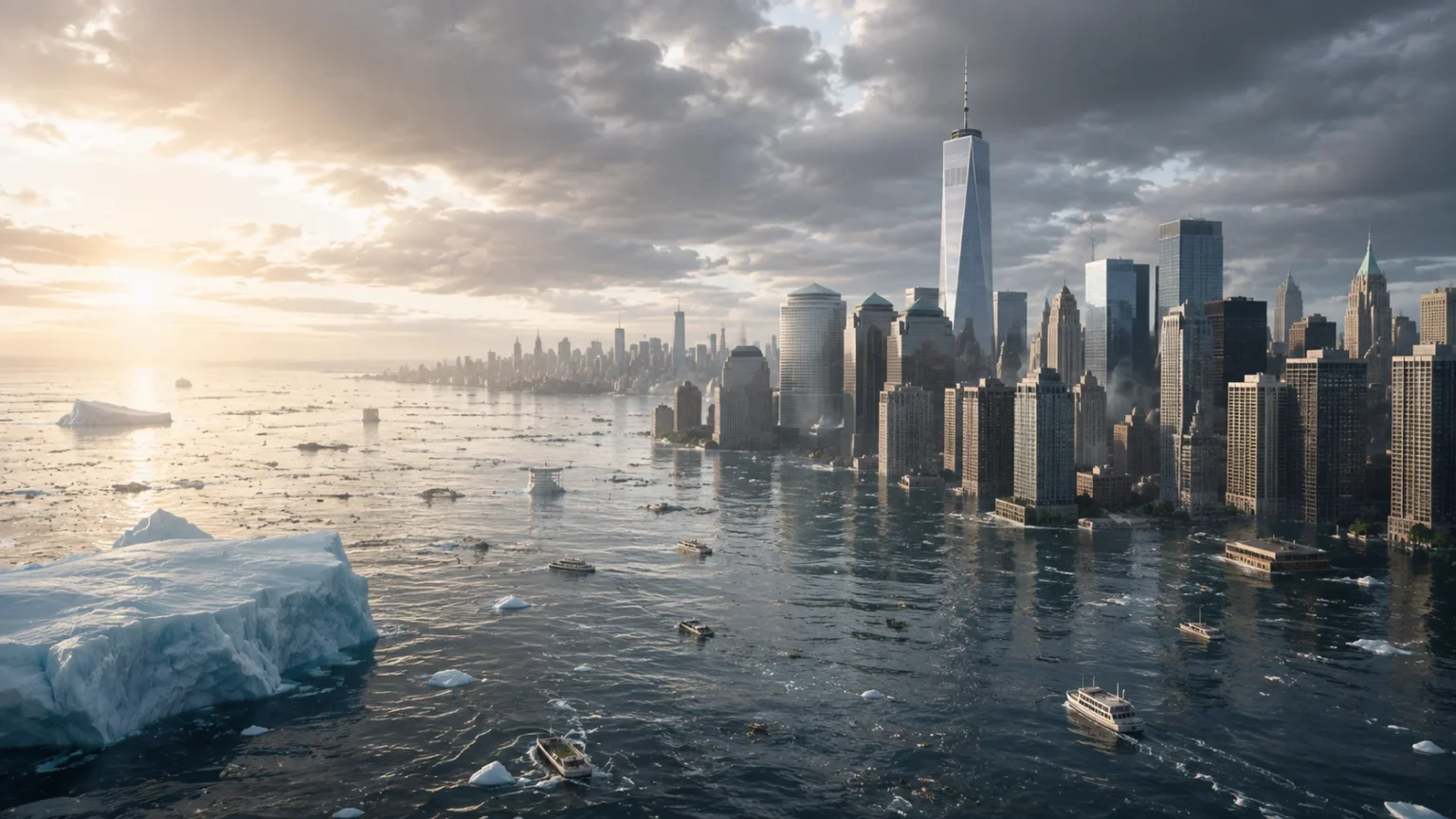

What Would Happen If All Polar Ice Melted?
If all of Earth’s polar ice melted, the planet would look dramatically different from the one we know today. Coastlines would shift far inland, many major cities would be partly or completely submerged, low-lying island nations would face existential threats, and ecosystems from the Arctic to Antarctica would be transformed. The most important distinction is that not all polar ice contributes equally to sea-level rise. Floating sea ice already displaces water, so melting it has relatively little direct effect on sea level. Land-based ice, especially the Greenland and Antarctic ice sheets, is what holds enough frozen water to raise global sea level by many tens of meters if it were eventually lost.
This scenario would not happen overnight, and under realistic climate conditions the complete melting of all major polar land ice would take an extremely long time, likely many centuries to millennia. Even so, the question is useful because it reveals how deeply human civilization depends on stable coastlines and a functioning cryosphere. Polar ice does more than store water. It reflects sunlight, influences ocean circulation, supports unique ecosystems, helps regulate temperature, and interacts with weather systems around the world. Understanding what would happen if all polar ice melted therefore means looking far beyond flooded beaches. It would represent a profound reorganization of Earth’s climate, oceans, habitats, economies, and human settlement patterns.
How Much Would Sea Level Rise If All Polar Ice Melted?
The biggest global effect would be an enormous rise in sea level. If the Greenland Ice Sheet and the Antarctic Ice Sheet completely melted, along with the world’s remaining land-based glaciers and ice caps, global mean sea level would rise by roughly several dozen meters, commonly estimated at around 65 to 70 meters overall. That is more than 200 feet of additional ocean height. The exact figure varies depending on which ice reserves are included and how scientists define complete melt, but the basic conclusion is clear: the world’s present-day coastlines would be almost unrecognizable.
Greenland alone contains enough land ice to raise global sea level by roughly seven meters if fully melted. Antarctica holds far more, with enough ice to contribute close to sixty meters of sea-level rise depending on how the calculation is made. Smaller glaciers and ice caps around the world would add additional water. These numbers explain why attention focuses so strongly on Greenland and Antarctica. They are not simply scenic frozen regions; they function as massive long-term reservoirs of freshwater stored above sea level.
Floating Arctic sea ice is different. Because it already floats in the ocean, it displaces roughly its own weight in seawater. When it melts, the direct increase in global sea level is relatively small compared with melting land ice. The familiar analogy is an ice cube melting in a glass of water. The water level barely changes because the floating ice was already displacing water before melting. This does not mean sea-ice loss is harmless, however, because it has major effects on climate, ecosystems, and heat absorption.
Sea-level rise would also not be perfectly even across the planet. Gravity, ocean circulation, land movement, and the redistribution of ice mass affect regional sea level. Large ice sheets exert gravitational attraction on nearby ocean water, so as they lose mass, water can actually migrate away from their surrounding regions. Farther-away coastlines may experience greater-than-average sea-level rise. Local land subsidence or uplift would further change what communities actually experience. A global average therefore cannot fully describe local outcomes.
A rise of tens of meters would redraw every continent. Vast coastal plains, river deltas, ports, wetlands, and low-lying agricultural regions would disappear beneath the ocean. Humanity would not simply need higher sea walls. Entire metropolitan regions and national infrastructures would have to relocate. Even long before complete melting occurred, smaller increments of sea-level rise would already create severe adaptation challenges, meaning the consequences would unfold progressively rather than appearing only at the final extreme.
Which Polar Ice Matters Most for Sea-Level Rise?
The Antarctic Ice Sheet matters most because it contains by far the largest volume of frozen freshwater on Earth. Antarctica is covered by an ice sheet that can be several kilometers thick in places. Most of that ice sits on land, meaning that when it melts or flows into the sea, it increases ocean volume. East Antarctica contains the majority of Antarctic ice, while West Antarctica is smaller but particularly important because much of its ice rests on bedrock below sea level and may be more vulnerable to ocean-driven instability.
The Greenland Ice Sheet is the second major contributor. Greenland’s ice covers most of the island and has accumulated over very long periods. Warming air melts its surface, while warming ocean waters can affect outlet glaciers where they meet the sea. Meltwater can also travel through cracks and channels, influencing how ice moves. Complete loss would take a very long time, but even partial melting can contribute substantially to future sea-level rise.
Mountain glaciers and smaller ice caps are much smaller than Greenland and Antarctica but still matter, especially over the coming decades and centuries. Glaciers in Alaska, the Himalayas, the Andes, the European Alps, and other regions are already important freshwater sources for many communities. Their complete loss would add less to global sea level than the major ice sheets, but regional consequences could be severe. Mountain glaciers also respond more quickly to warming because they are much smaller.
Arctic sea ice receives a great deal of public attention because its seasonal decline is highly visible. Although its melting contributes little directly to sea-level rise, it plays a major climate role by reflecting sunlight. Bright ice reflects more solar energy back toward space, whereas dark ocean water absorbs more heat. As sea ice disappears, the Arctic absorbs more solar energy, creating a feedback that contributes to additional regional warming. This process is one reason the Arctic is warming faster than the global average.
Ice shelves around Antarctica are another important category. These shelves float on seawater, so their direct melting contributes relatively little sea-level rise. Their major importance lies in the support they provide to inland glaciers. Ice shelves can act like barriers that slow the flow of land-based ice toward the ocean. When shelves thin or collapse, glaciers behind them may accelerate. In this way, floating ice can indirectly influence sea level by controlling how quickly land ice escapes into the sea.
What Would Happen to Coastal Cities?
Coastal cities would face some of the most dramatic impacts. Many of today’s largest urban centers grew around natural harbors, river mouths, and coastlines because those locations supported shipping, trade, fishing, and transportation. With tens of meters of sea-level rise, enormous portions of cities such as Miami, New York, London, Shanghai, Mumbai, Bangkok, Lagos, Alexandria, and countless others would be submerged or transformed. Some inland sections could remain above water, but their existing urban layouts would no longer function as designed.
Flooding would begin long before a city was permanently underwater. Higher baseline sea levels make storm surges more damaging because storms start from an already elevated ocean. Roads, subway systems, airports, wastewater treatment plants, power infrastructure, ports, and drinking-water systems can fail repeatedly before permanent inundation occurs. Insurance costs rise, property values shift, and governments face difficult decisions about where to defend and where to retreat. The social disruption would therefore begin well before the final coastline moved inland.
Some cities could build major protective infrastructure, including sea walls, storm-surge barriers, raised roads, and pumping systems. Wealthy urban regions may protect critical areas for a time, particularly against moderate sea-level rise. But engineering defenses become increasingly difficult and expensive as water rises by many meters. A sea wall cannot solve every problem when groundwater rises beneath a city, rivers cannot drain properly, or coastal erosion undermines structures. At extreme levels, relocation becomes more realistic than defending the existing coastline indefinitely.
Ports would be especially vulnerable. Global trade depends heavily on coastal terminals, warehouses, refineries, and transportation corridors located at current sea level. Moving an entire port is far more complicated than relocating individual buildings because it requires deep water, rail and road connections, industrial land, and years of investment. Supply chains could be disrupted repeatedly as infrastructure is rebuilt. Coastal energy facilities and industrial sites could also create pollution risks when flooded.
Historic and cultural sites would be lost as well. Many ancient cities, monuments, religious sites, archaeological landscapes, and culturally important neighborhoods are located near the sea. Unlike modern warehouses, these places cannot simply be reconstructed elsewhere without losing part of their meaning. Extreme sea-level rise would therefore involve not only economic losses but also irreversible cultural change. Future generations would inherit a world in which many famous coastal places survived only through maps, photographs, and historical records.
Which Countries Would Be Most Affected?
Low-lying island nations would face some of the most severe threats. Countries made up largely of coral atolls or low coastal islands may have only a few meters of elevation above present sea level. Even relatively modest sea-level rise can increase flooding, erosion, and saltwater contamination of groundwater. Long before the islands disappear physically, freshwater shortages and infrastructure damage can make them difficult to inhabit. Complete melting of polar land ice would overwhelm nearly all such low-lying territories.
Countries with large river deltas would also be highly exposed. The Ganges-Brahmaputra, Mekong, Nile, Mississippi, Yangtze, and other deltas support millions of people because their soils are fertile and access to water and transportation is excellent. Deltas are naturally low and often continue sinking because of sediment compaction, groundwater extraction, and reduced sediment delivery from dams. Sea-level rise therefore combines with local subsidence, making effective relative rise much greater in some regions.
Bangladesh is a frequently discussed example because a substantial population lives in low-lying delta regions. Higher sea levels would push saltwater farther inland and increase the severity of storm surges. Agricultural land could become less productive as soils and water sources become saltier. Large-scale relocation would place pressure on already densely populated inland areas. Similar challenges would affect parts of Vietnam, Egypt, China, India, and many other countries with concentrated coastal populations.
Large countries would not necessarily be safe simply because they have substantial inland territory. The United States, China, India, Brazil, Australia, and European countries all have major cities, industrial regions, ports, and agricultural areas near coastlines. Losing coastal territory can cause enormous economic disruption even if plenty of land remains elsewhere. Relocating population also requires housing, water, transportation, schools, healthcare, and employment in receiving regions.
Some northern countries might gain access to new ice-free shipping routes or longer growing seasons in certain areas, but these benefits would not balance the scale of disruption associated with major climate change. Permafrost thaw, infrastructure damage, ecosystem shifts, and altered rainfall could create new problems. Climate impacts are not a simple map where some countries win and others lose. Extreme polar melting would reshape environmental conditions globally, including regions far from any coastline.
How Would Coastlines and World Maps Change?
The world map would change dramatically because today’s coastline is defined partly by the enormous amount of water currently locked in glaciers and ice sheets. With tens of meters of sea-level rise, shallow coastal areas would be flooded and many bays would expand far inland. River valleys could become estuaries, while low-lying plains might transform into new inland seas. Some existing islands would disappear entirely, while hills within flooded regions could become new islands.
Florida provides an intuitive example. Much of southern Florida is low and flat, making it exceptionally vulnerable to sea-level rise. At extreme levels, large portions of the peninsula would be submerged. Coastal areas along the Gulf of Mexico and Atlantic seaboard would also retreat inland. Similar transformations would occur around the Mediterranean, northern Europe, East Asia, and river deltas worldwide. Familiar national outlines from school maps would become outdated.
The flooding pattern would depend on topography rather than distance from the present coast alone. A low river valley can allow ocean water to travel far inland, while steep mountains near a coastline may limit horizontal retreat even when sea level rises dramatically. Some coastal communities built against cliffs might lose only a narrow strip of land, whereas flat plains could lose hundreds of kilometers. Elevation maps therefore provide a much better picture of future vulnerability than current coastlines alone.
New coastlines would continue eroding after the first flooding. Waves, tides, and storms would attack soils and rock formations that had not previously been exposed to marine conditions. Beaches and barrier islands would migrate where sediment supplies allowed, while other areas would lose land permanently. Ecosystems such as salt marshes and mangroves would also try to move inland but could be blocked by roads, cities, or steep terrain.
Political maps could become complicated as well. Maritime boundaries, fishing rights, ports, and exclusive economic zones are partly tied to coastlines and islands. If islands disappear or coastlines retreat dramatically, international legal questions could arise about whether existing boundaries remain in force. Countries may try to preserve legal claims even after physical geography changes. A planet with radically altered coastlines would therefore create geopolitical challenges in addition to environmental ones.
What Would Happen to the Arctic?
The Arctic would lose one of its defining physical features: extensive seasonal and long-term sea ice. Arctic sea ice naturally grows during winter and shrinks during summer, but in a fully ice-free scenario, large areas of ocean would remain open for much more of the year. This would fundamentally change the region’s energy balance because dark seawater absorbs much more sunlight than bright ice. The resulting additional warming would reinforce broader Arctic temperature increases.
Species that rely on sea ice would face severe challenges. Polar bears use sea ice as a platform for hunting seals, while seals themselves use ice for resting, breeding, and raising young. Walruses, seabirds, algae, and microorganisms are also connected to the sea-ice ecosystem. Losing the ice would not simply remove one habitat feature; it would restructure food webs from microscopic organisms upward. Some species might adapt or shift ranges, while others could decline dramatically.
Indigenous communities across the Arctic would also face major cultural and practical changes. Hunting routes, travel over ice, fishing conditions, coastal settlements, and traditional knowledge are closely connected to seasonal ice and frozen landscapes. Rapid environmental transformation can undermine food systems and cultural practices developed over generations. Coastal erosion is already a serious concern in areas where sea ice previously protected shorelines from waves for much of the year.
Permafrost thaw would likely accompany severe Arctic warming. Permafrost is ground that remains frozen for at least two consecutive years, and in some regions it has remained frozen for thousands of years. When it thaws, roads, pipelines, buildings, and other infrastructure can become unstable. Organic material preserved in frozen soil can also decompose and release carbon dioxide and methane, adding further greenhouse gases to the atmosphere.
New economic activity could expand as ice-free waters make shipping and resource access easier. Arctic shipping routes might shorten travel between parts of Europe and Asia. Fisheries could shift northward as ocean temperatures change. These opportunities would also create environmental risks, including oil spills, ship pollution, invasive species, and increased disturbance in fragile ecosystems. An ice-free Arctic would therefore be not only warmer but also more commercially and geopolitically contested.
What Would Happen to Antarctica?
Antarctica would experience one of the most extraordinary landscape changes on Earth. Today, almost the entire continent is covered by a massive ice sheet, with only a small fraction of land exposed. If that ice disappeared, mountains, valleys, basins, and bedrock currently hidden beneath kilometers of ice would become visible. Some areas of West Antarctica sit below present sea level, meaning ocean water could occupy large basins after the ice vanished. The resulting continent would look radically different from the familiar white-covered landmass.
Wildlife would also change dramatically. Penguins, seals, seabirds, and marine organisms depend on sea ice, ice shelves, cold water, and seasonal productivity patterns. Some Antarctic species are highly specialized for extremely cold conditions. If the continent became substantially warmer and largely ice-free, ecosystems would reorganize. New species could colonize areas previously too cold or barren, potentially competing with native species adapted to polar environments.
The Southern Ocean surrounding Antarctica would change as freshwater from melting ice entered the sea. Large freshwater inputs can alter ocean density, salinity, and circulation. These changes could influence how heat and carbon move between the atmosphere and deep ocean. Because the Southern Ocean plays a major role in global climate regulation, Antarctic ice loss would have consequences far beyond the continent itself.
As ice disappeared, exposed rock and soil would begin weathering and developing new biological communities. Plants, mosses, microorganisms, and eventually more complex ecosystems could expand into areas previously covered permanently by ice. However, ecosystem development would take time and would depend on temperature, rainfall, soil formation, and species migration. Antarctica would not instantly become a green continent simply because its ice vanished.
Human activity could also expand dramatically. Currently, international agreements tightly regulate Antarctic activity and prohibit ordinary territorial exploitation. A warmer, more accessible Antarctica could increase pressure for fishing, tourism, resource extraction, and permanent infrastructure. Political disputes could intensify over how the continent should be managed. Protecting such a transformed environment would become one of the most difficult international conservation challenges imaginable.
How Would Ocean Circulation Change?
Melting polar ice would add enormous volumes of freshwater to the ocean. Freshwater is less dense than salty seawater, so large inputs can alter the way ocean layers mix. This matters because global ocean circulation depends partly on differences in temperature and salinity. In the North Atlantic, cold salty water sinks and helps drive a major circulation system that transports heat around the planet. Large freshwater inputs could weaken parts of this system.
One widely discussed component is the Atlantic Meridional Overturning Circulation, or AMOC. This circulation transports warm surface water northward and returns colder deep water southward. Greenland meltwater can freshen the North Atlantic, making surface water less dense and potentially reducing sinking. A substantial weakening of this circulation could change regional temperatures, rainfall, sea levels, and storm patterns around the Atlantic basin.
A weaker AMOC would not mean the entire planet suddenly freezes, despite dramatic portrayals in popular entertainment. Global warming would still continue overall, but regional patterns could change. Parts of the North Atlantic and nearby Europe might warm less than they otherwise would or potentially experience local cooling relative to broader global trends. Rainfall belts could shift, affecting agriculture in regions far from Greenland.
Antarctic meltwater could similarly affect Southern Ocean circulation. The waters around Antarctica connect the Atlantic, Pacific, and Indian Oceans and help ventilate the deep ocean. Changes in salinity and sea-ice formation can influence the sinking of dense Antarctic water. Because deep ocean circulation transports heat, oxygen, nutrients, and carbon, disruption could reshape marine ecosystems and climate patterns over long timescales.
Ocean circulation changes are complex because the ocean responds to winds, temperature, salinity, sea ice, and the shape of the seafloor. Scientists use observations and climate models to understand likely responses. What is clear is that polar ice is connected to the ocean system rather than sitting passively at the top and bottom of the world. Removing it would alter the physical processes that help regulate the global climate.
Would the Earth Become Much Hotter?
Yes, losing polar ice would contribute to additional warming through a process known as the ice-albedo feedback. Snow and ice are bright surfaces that reflect a large fraction of incoming sunlight back toward space. Dark ocean water and exposed land absorb much more solar energy. When ice melts, more energy is absorbed, warming the surface and encouraging further melting. This positive feedback is particularly strong in the Arctic.
The effect would not be identical everywhere. Arctic sea-ice loss has a particularly strong impact because large areas of dark ocean become exposed during seasons when sunlight is available. Antarctica’s high elevation and geographic isolation create different climate interactions, but losing its reflective ice would also change regional energy balance. Exposed darker land and ocean would absorb more heat than the ice sheet did.
Warming would also increase water vapor in the atmosphere. Water vapor is itself a greenhouse gas, so warmer air holding more moisture creates another amplifying feedback. This does not mean water vapor initiated the warming; rather, it strengthens warming caused by greenhouse gases such as carbon dioxide. A largely ice-free polar world would therefore involve multiple reinforcing climate processes.
Permafrost thaw could add further warming by releasing carbon dioxide and methane from previously frozen organic material. These releases would add greenhouse gases unless human emissions had already been reduced substantially. Forest changes, wildfire, and soil carbon loss could create additional feedbacks. The total response would depend on how rapidly these systems changed and how human emissions evolved during the same period.
A complete loss of major ice sheets would only be possible in a much warmer long-term climate than today. It should therefore be understood as part of a profoundly altered planetary state rather than an isolated event where ice melts but everything else remains unchanged. The atmospheric and oceanic conditions required to remove all polar land ice would themselves transform climate around the world.
How Would Weather Patterns Change?
Extreme polar ice loss would influence weather by changing temperature differences between regions, ocean circulation, atmospheric moisture, and land-sea contrasts. Weather systems are driven by these gradients, so altering them can shift storm tracks and rainfall patterns. Some regions could become wetter, while others experience more frequent or persistent drought. The exact effects would vary by location and season.
The Arctic is particularly important because rapid warming reduces the temperature difference between high latitudes and lower latitudes. Researchers continue to study how this affects the jet stream and patterns of persistent weather. Changes in atmospheric circulation may influence heat waves, cold outbreaks, rainfall, and storm behavior. The relationships are complex, and not every individual extreme can be attributed directly to sea-ice loss.
Warmer oceans can provide more energy and moisture to certain storms. Tropical cyclones depend on warm ocean water, and higher sea levels make their storm surges more damaging even if storm frequency does not necessarily increase everywhere. Coastal communities would therefore face a combination of higher background sea level and extreme weather. This compounding effect is often more important than either factor alone.
Rainfall systems connected to ocean temperatures could also shift. Monsoons, tropical rainfall belts, and subtropical dry zones respond to changes in atmospheric and ocean circulation. Agricultural regions that depend on predictable seasonal rainfall could experience more variability. Food production can be affected even when farmland itself is far above sea level.
Weather adaptation would become increasingly difficult because infrastructure and farming practices are generally designed around historical climate patterns. Reservoirs, drainage systems, crops, buildings, and emergency plans all assume a certain range of conditions. A world without major polar ice would be a world where many of those historical assumptions no longer apply. Societies would need to redesign infrastructure continuously as environmental conditions evolved.
What Would Happen to Ocean Ecosystems?
Polar oceans support unique food webs built around cold water and seasonal ice. In the Arctic, algae grow within and beneath sea ice and provide food for small organisms that support fish, birds, seals, and whales. Removing the ice changes both habitat and the timing of biological productivity. Some species may benefit temporarily from more open water, while highly ice-dependent species would struggle. The entire food web would become less recognizably Arctic.
Antarctic ecosystems are similarly connected to sea ice. Krill, one of the most important organisms in the Southern Ocean, depend partly on sea-ice conditions during parts of their life cycle. Whales, seals, penguins, fish, and seabirds rely on krill directly or indirectly. Changes in ice extent can therefore cascade upward through the ecosystem. If krill distributions shift, predators may need to travel farther or change feeding patterns.
Ocean warming would add another layer of stress. Many marine species have preferred temperature ranges, and as the ocean warms they tend to move toward cooler latitudes or deeper water when possible. Species already living near the poles have limited space to move farther poleward. Some may lose suitable habitat entirely. New species moving into warmer polar waters could also alter competition and predation.
Ocean acidification would continue if atmospheric carbon dioxide remained high. The ocean absorbs a portion of human carbon dioxide emissions, changing seawater chemistry and making it harder for some organisms to build shells or skeletons. Polar waters can be particularly sensitive because cold water absorbs carbon dioxide readily. The combination of warming, acidification, and habitat loss would place multiple stresses on marine ecosystems simultaneously.
Fishing industries would need to adapt as species distributions changed. Some fisheries might expand into newly accessible northern waters, while traditional fishing regions could lose important species. International disputes could intensify as fish populations move across national boundaries. Protecting ocean biodiversity would require flexible management systems capable of following rapidly changing ecosystems rather than relying on historical species locations.
What Would Happen to Polar Bears, Penguins and Other Wildlife?
Polar bears would face some of the clearest consequences because they depend heavily on sea ice for hunting seals. As the ice-free season becomes longer, bears must spend more time on land or swim greater distances. Land-based foods generally do not provide the same energy as seals. Reduced access to prey can affect body condition, reproduction, and cub survival. Complete loss of Arctic sea ice would remove the primary hunting platform on which the species evolved.
Seals would also be affected. Several Arctic seal species depend on snow-covered sea ice for breeding, resting, and raising pups. If ice becomes too thin or disappears too early, pups may be exposed before they are ready. Changes in prey distribution could create additional stress. Some seal species may adapt better than others, but ice specialists would face major habitat loss.
Penguin responses would differ by species. Some Antarctic penguins depend strongly on sea ice, while others prefer more open water or less extensive ice. As the climate changes, certain species could initially expand into newly suitable areas while ice-dependent species decline. Eventually, extreme warming and the loss of stable breeding habitat would create widespread disruption. Food availability, particularly krill and fish, would be just as important as the physical disappearance of ice.
Marine mammals such as walruses also use sea ice as resting platforms near feeding areas. When ice retreats far from productive shallow seas, walruses may gather in large numbers on land, sometimes creating dangerous crowding. Whales could experience both opportunities and risks as new waters open, shipping increases, and prey distributions shift. Noise pollution and ship strikes could become more common in increasingly accessible Arctic waters.
Wildlife impacts would extend beyond charismatic species. Microorganisms, plankton, insects, fish, seabirds, and vegetation form the foundation of polar ecosystems. Changes at these lower levels can determine whether larger animals survive. The disappearance of polar ice would therefore not simply mean “fewer polar bears and penguins.” It would mean the restructuring of entire ecosystems that evolved under cold, seasonal conditions over very long timescales.
Would Freshwater Supplies Be Affected?
Yes. Mountain glaciers and ice caps act as natural water reservoirs for many regions, storing snowfall during cold periods and releasing meltwater during warmer seasons. Communities downstream from the Himalayas, Andes, Alps, and other mountain systems depend partly on this seasonal flow for drinking water, agriculture, hydropower, and ecosystems. As glaciers shrink, meltwater can initially increase before declining once the ice reservoir becomes much smaller.
The loss of polar ice sheets themselves would not directly eliminate ordinary drinking-water supplies for most populations because Greenland and Antarctica are far from the places where most people obtain freshwater. However, sea-level rise would contaminate coastal groundwater with saltwater. Aquifers near the ocean can become increasingly saline as seawater moves inland. This can reduce drinking-water availability and damage irrigation systems.
Low-lying islands would be especially vulnerable because many rely on thin freshwater lenses beneath the ground. Saltwater intrusion from sea-level rise and storm flooding can make these supplies unsafe long before the land is permanently submerged. Desalination can provide an alternative, but it requires energy, equipment, and investment. Poorer communities may have far fewer options.
River systems could also be affected indirectly through changing rainfall patterns. Some regions might receive more precipitation, while others become drier or experience greater seasonal variability. Reservoir systems designed around historical snowmelt timing may become less reliable. Water managers would need to adjust infrastructure and storage strategies as the timing and form of precipitation changed.
The broader lesson is that frozen water is part of the planet’s freshwater system. Losing glaciers and ice sheets does not simply move water from land to ocean without consequences. It changes when and where freshwater is available, increases salinity risks near coasts, and alters hydrological cycles. Water security would become one of the central adaptation challenges in a much warmer world.
How Would Agriculture and Food Production Change?
Agriculture would be affected through sea-level rise, changing rainfall, heat stress, water availability, and shifting growing seasons. Some of the world’s most productive farmland lies in low coastal plains and river deltas. These regions benefit from fertile sediment and accessible water but are highly vulnerable to flooding and saltwater intrusion. Losing even part of this land could reduce food production and displace farming communities.
Salt contamination can damage crops before land is permanently submerged. Most staple crops do not tolerate high levels of soil salinity. Farmers may need to switch varieties, improve drainage, or abandon heavily affected fields. Saltwater can also contaminate irrigation canals and groundwater. Coastal agriculture would therefore experience a gradual decline in productivity in many areas rather than one sudden disappearance.
Warmer climates could extend growing seasons in some northern regions, potentially allowing new crops to be cultivated. However, heat extremes, drought, pests, soil limitations, and lack of daylight during winter mean that new northern farmland would not simply replace tropical and temperate agricultural losses. Productive agriculture depends on much more than average temperature. Building roads, storage systems, processing infrastructure, and communities in new farming regions would also take decades.
Fisheries would shift as ocean temperatures and ecosystems changed. Communities dependent on particular fish species could lose traditional resources as populations move poleward or decline. Aquaculture might expand, but it would face its own challenges from warming water, disease, storms, and feed availability. Food systems would need to become much more flexible.
Higher temperatures could also reduce yields of some crops during critical flowering or grain-filling stages. Livestock can suffer heat stress, affecting productivity and health. Irrigation demand may increase precisely when water supplies become less predictable. The combination of land loss, climate variability, and ecosystem change would make global food security more difficult even if technological adaptation prevented outright collapse.
Would Humans Have to Relocate?
Large-scale relocation would be unavoidable in a world with tens of meters of sea-level rise. Hundreds of millions of people currently live close to coastlines and low-lying river deltas. At extreme sea levels, many of those areas would become permanently uninhabitable. Migration would occur gradually as flooding, erosion, insurance losses, infrastructure failure, and saltwater intrusion made communities increasingly difficult to maintain.
Relocation is more complicated than moving households. Receiving regions need housing, employment, schools, healthcare, transportation, electricity, water, and public services. Moving a city also means relocating businesses, factories, universities, cultural institutions, and government functions. If many coastal regions face these pressures at the same time, inland infrastructure could become severely strained. Land prices and political tensions could rise.
International migration could become especially contentious when entire island nations or heavily affected coastal countries lose significant territory. Questions about citizenship, sovereignty, cultural identity, and political representation would emerge. If a country loses most of its habitable land, its people may remain a nation even without a traditional geographic homeland. Existing international law was not designed for this situation.
Managed retreat can reduce long-term risk when planned early. Governments can gradually stop new construction in highly vulnerable areas, purchase properties, relocate infrastructure, and create new development zones inland. This approach is politically difficult because people understandably resist leaving homes and communities. Waiting until repeated disasters force sudden evacuation is often more expensive and traumatic.
Human migration has always responded to environmental change, but the scale associated with extreme ice-sheet loss would be unprecedented in the modern world. Migration itself is not necessarily catastrophic if societies prepare and invest appropriately. The danger arises when change occurs faster than housing, economies, and political systems can adapt. Long-term planning would therefore become essential.
Could All Polar Ice Melt Suddenly?
No. The complete melting of Greenland and Antarctica would not happen over a few years or decades. These ice sheets contain enormous volumes of ice, some several kilometers thick. Even under strong warming, removing all of that frozen mass requires sustained energy input over very long periods. The process would likely unfold across centuries or millennia rather than within a single human lifetime.
Parts of ice sheets can change much more quickly, however. Ice shelves can collapse over days or weeks, outlet glaciers can accelerate, and surface melting can increase significantly during warm years. These rapid events can create the impression that an entire ice sheet might disappear suddenly. In reality, they represent pieces of a much larger system responding to warming. Their importance lies in potentially increasing the long-term rate of ice loss.
Scientists are especially interested in tipping points. A tipping point occurs when a system crosses a threshold after which self-reinforcing processes make continued change difficult to stop even if warming later stabilizes. For example, as an ice sheet loses elevation, its surface can move into warmer air, increasing melt. Retreat into deeper bedrock basins can also accelerate some glaciers. These processes raise concern about long-term commitment to ice loss.
A key idea is that future sea-level rise can become “locked in” before the full physical melting happens. If warming pushes an ice sheet into an unstable state, generations far in the future may experience continued sea-level rise even after global emissions are greatly reduced. This is why current climate decisions can affect coastlines for centuries. The long timescale of ice-sheet response does not make the issue less urgent.
The popular image of all polar ice melting overnight is therefore physically unrealistic. The real concern is slower but relentless transformation. Society would have time to observe the change, but adapting entire coastlines and economies over centuries would still be enormously difficult. Slow change can be devastating when the systems affected are cities, nations, ecosystems, and infrastructure built to last.
Could We Stop or Reverse Polar Ice Loss?
Reducing greenhouse gas emissions can slow future warming and therefore reduce the amount and rate of ice loss. The most important strategy is rapid decarbonization of energy, transportation, industry, and other major sources. Every fraction of a degree of avoided warming reduces long-term pressure on glaciers and ice sheets. Climate action cannot preserve every glacier exactly as it exists today, but it can significantly influence how much ice is ultimately lost.
Stabilizing global temperature would eventually reduce the acceleration of many climate processes, although ice sheets can respond slowly. Some committed melting may continue for long periods because the ocean and ice systems take time to reach a new equilibrium. This makes early emissions reduction particularly valuable. Avoiding a threshold is easier than trying to reverse one after it has been crossed.
Carbon dioxide removal could contribute to lowering atmospheric greenhouse gas concentrations in the future. Reforestation, soil carbon management, direct air capture, and other approaches may help remove some carbon dioxide. However, removing enough carbon to substantially cool the planet would require enormous effort. Preventing emissions remains easier than emitting carbon first and trying to capture it later.
Geoengineering proposals have occasionally suggested physically protecting glaciers or reflecting sunlight to slow warming. These ideas range from underwater barriers near glaciers to large-scale solar-radiation management. Most remain experimental, controversial, or technically uncertain. They also cannot substitute for emissions reductions because many climate impacts, including ocean acidification, would continue if carbon dioxide remained high.
The fate of polar ice is therefore not completely predetermined. Human choices can still influence how much is lost and how quickly. The difference between moderate and extreme warming translates into enormous differences in future sea level. Climate mitigation is not about preserving a perfectly unchanged planet; it is about avoiding the most damaging outcomes and giving societies and ecosystems more time to adapt.
The Bottom Line: What Would Happen If All Polar Ice Melted?
If all major polar land ice melted, global sea level would rise by roughly several dozen meters, enough to redraw the world’s coastlines. Many modern coastal cities, river deltas, ports, islands, and agricultural regions would be submerged or forced to relocate. Greenland and Antarctica would contribute the overwhelming majority of this rise, while floating sea ice would add relatively little directly because it already displaces ocean water.
The consequences would extend far beyond sea level. Losing reflective ice would cause Earth to absorb more solar energy, reinforcing warming. Freshwater from melting ice would alter ocean salinity and could disrupt major circulation systems. Weather patterns, rainfall, marine ecosystems, and fisheries would change. Polar ecosystems built around sea ice and cold water would be transformed, putting many specialized species under severe pressure.
Human societies would face enormous adaptation demands. Coastal infrastructure worth trillions of dollars would need to be defended, rebuilt, or abandoned. Entire communities and potentially populations of low-lying nations would relocate. Drinking-water systems could become contaminated by saltwater, while fertile coastal farmland could be lost. Ports and trade networks would have to move inland as shorelines shifted.
The good news is that this extreme scenario would not happen suddenly. Complete loss of the major ice sheets would require very long periods of sustained warming. That gives humanity an opportunity to influence the outcome through emissions reductions. However, long timescales should not create complacency because ice-sheet changes can become difficult to reverse once certain thresholds are crossed.
Ultimately, all polar ice melting would represent one of the largest geographical and climatic transformations in human history. It would not simply mean higher seas or fewer polar bears. It would change oceans, coastlines, ecosystems, food systems, weather patterns, economies, and where people can live. Preventing the most extreme version of that future depends primarily on limiting long-term global warming and reducing greenhouse gas emissions before enormous ice losses become unavoidable.
Frequently Asked Questions
How much would sea level rise if all polar ice melted?
If the Greenland and Antarctic ice sheets plus other land-based glaciers melted completely, global sea level would rise by roughly 65 to 70 meters, or more than 200 feet.
Would melting Arctic sea ice raise sea levels?
Not very much directly, because Arctic sea ice already floats and displaces seawater. Its loss is still important because darker ocean water absorbs more heat, increasing Arctic warming.
How long would it take for all polar ice to melt?
Complete melting of the major ice sheets would likely take many centuries to millennia under sustained warming. It could not happen suddenly within a few years.
Which ice sheet would cause the most sea-level rise?
Antarctica contains by far the most land ice and therefore has the greatest potential contribution to long-term sea-level rise. Greenland is the second-largest major contributor.
Can reducing emissions still protect polar ice?
Yes. Lower greenhouse gas emissions can limit future warming, slow ice loss, and reduce the amount of long-term sea-level rise. Every reduction in warming lowers the risk of extreme ice-sheet loss.