

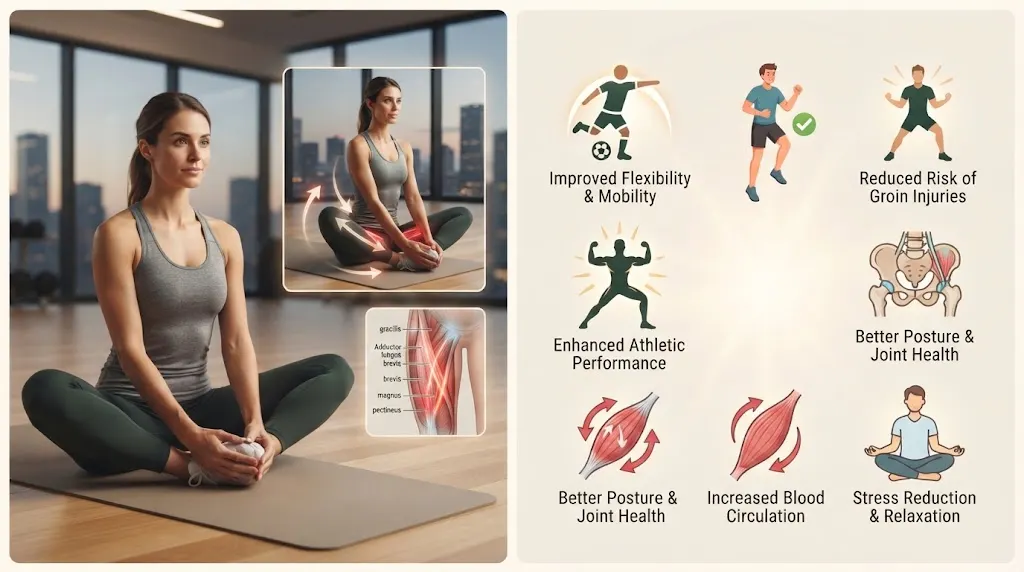

An adductor stretch targets the muscles along the inside of your thigh that help bring the leg toward the center of your body. These muscles include the adductor longus, brevis, magnus, gracilis, and pectineus. Together, they support hip stability, control side-to-side movement, and contribute to activities such as walking, running, squatting, and changing direction.
When the inner thigh muscles feel tight, movements involving wide steps, lateral lunges, or deep squats may feel restricted. Gentle stretching can improve your comfort in these positions and may help restore a smoother range of motion. The goal is not to force the legs as wide as possible, but to create a controlled stretch without sharp pain.
Adductor stretching is useful for athletes, office workers, and anyone who spends long periods sitting. It can also be included in warm-ups, cool-downs, or mobility routines depending on how it is performed. Dynamic variations work well before activity, while slower static stretches are usually better suited to after exercise or separate mobility sessions.
How to Do a Standing Adductor Stretch
Start by standing with your feet wider than shoulder-width apart and pointing your toes mostly forward. Shift your body weight slowly toward one side while bending that knee and keeping the opposite leg relatively straight. You should begin to feel a gentle stretch along the inner thigh of the straight leg without forcing your hips downward.
Keep your chest upright and avoid collapsing your upper body toward the floor. Your bent knee should track comfortably over your foot rather than turning inward sharply. Hold the position for around 20 to 30 seconds if you are performing a static stretch, then return to the center and repeat on the other side.
To make the stretch easier, use a narrower stance and shift less weight toward the bent leg. For a deeper stretch, widen your stance gradually while maintaining control and keeping the movement comfortable. Avoid bouncing because fast, uncontrolled movement can increase irritation, particularly when the adductor muscles are already sore or recovering from heavy exercise.
How to Do a Seated Butterfly Adductor Stretch
Sit on the floor with your back comfortably upright and bring the soles of your feet together. Allow your knees to move outward while holding your feet or ankles gently. Move your heels toward your body only as far as feels comfortable, and avoid forcing your knees toward the floor with your hands.
Keep your spine long rather than rounding heavily forward. If you want a slightly stronger stretch, hinge forward gently from your hips while maintaining a relaxed neck and shoulders. You should feel tension along the inner thighs and groin area, but the sensation should remain mild enough that you can breathe normally throughout the position.
If sitting upright is difficult, place a folded towel or cushion underneath your hips. Raising your pelvis slightly can reduce strain and make the position easier to maintain. People with sensitive knees or hips can also move their feet farther away from the body, which reduces the intensity while still providing a useful inner-thigh stretch.
Try a Half-Kneeling Adductor Stretch for More Control
Begin on your hands and knees, then extend one leg directly out to the side with the foot resting on the floor. Keep the extended leg straight but not rigid, and position your hands beneath your shoulders for support. Slowly move your hips backward until you feel a gentle stretch through the inner thigh of the extended leg.
Keep your back in a comfortable neutral position while moving. Avoid twisting your pelvis toward the straight leg because this changes the direction of the stretch. Move only as far backward as you can while keeping your breathing smooth and the sensation controlled, then return forward slowly before repeating the movement several times.
This variation can be useful because you control the intensity through hip movement instead of relying entirely on a wide standing position. It can work well for people building hip mobility gradually or recovering from general stiffness. Place padding under the supporting knee if kneeling on a hard floor feels uncomfortable.
Key Benefits of Regular Adductor Stretching
One of the main benefits of adductor stretching is improved hip mobility. Flexible inner-thigh muscles can make it easier to move your legs apart during squats, side lunges, sports, and everyday tasks. Better mobility does not automatically improve performance, but it can help you reach positions more comfortably when muscle tightness has been limiting your movement.
Stretching can also reduce the temporary sensation of tightness after long periods of sitting or demanding lower-body exercise. People often notice stiffness through the groin and inner thighs after running, cycling, strength training, or spending hours at a desk. Gentle mobility can help the muscles feel less restricted without requiring an aggressive stretching session.
Adductor flexibility also supports movements that require side-to-side control. Sports such as football, basketball, tennis, hockey, and martial arts frequently involve lateral steps and rapid directional changes. Stretching alone cannot prevent every injury, but maintaining comfortable mobility alongside strength training can help prepare the hips for the range of positions these activities require.
Adductor Stretching for Squats and Lower-Body Mobility
Tight adductors can make deep squatting feel uncomfortable because the hips need enough mobility to move into a wider, lower position. Some people compensate by allowing the knees to collapse inward, lifting the heels, or rounding the lower back. Improving hip mobility may help reduce these compensations when adductor tightness is one contributing factor.
Before squatting, use dynamic adductor movements rather than holding long static stretches. Controlled side lunges or gentle rocking movements can prepare the muscles while keeping them active. After training, slower static stretches may be more appropriate when your goal is improving flexibility rather than preparing immediately for heavy or explosive exercise.
Remember that squat limitations do not always come from the adductors. Ankle mobility, hip structure, strength, technique, and movement experience all influence how comfortably you squat. If stretching the inner thighs does not change your squat, avoid forcing greater flexibility and consider whether another area of mobility or strength needs attention.
Can Adductor Stretches Help Hip and Back Tightness?
The adductors attach around the pelvis and influence how the hips move, so stiffness in these muscles can sometimes contribute to a general feeling of restricted lower-body movement. Gentle stretching may improve comfort when tight inner thighs are one part of the problem. However, persistent hip or lower-back pain can have many causes beyond simple muscle tightness.
If you regularly experience back and hip pain, avoid assuming that stretching one muscle group will solve the issue. Joint problems, nerve irritation, muscle strain, tendon conditions, and other factors can produce similar symptoms. A broader assessment is more useful when discomfort continues or interferes with walking, sitting, or exercise.
Use adductor stretching as one part of a balanced mobility routine rather than as a complete treatment. Combine it with appropriate strength work, comfortable movement, and sensible activity management. If a stretch consistently increases pain in the groin, hip, or lower back, stop forcing the movement and consider getting professional guidance.
Static vs Dynamic Adductor Stretching
Static stretching involves moving into a position and holding it for a period of time. The standing side stretch and butterfly stretch are common examples when held without movement. Static adductor stretches can be useful after exercise or during a separate flexibility session when improving range of motion and reducing the sensation of stiffness are the main goals.
Dynamic stretching involves moving in and out of the position repeatedly instead of holding it. Side lunges, lateral weight shifts, and controlled adductor rock-backs are useful examples. Dynamic movements can be particularly helpful before workouts because they expose the muscles to increasing ranges while still keeping the body active and prepared for movement.
Choose the type of stretching based on what you are about to do. Before sports or strength training, controlled dynamic mobility is usually more practical than long, intense holds. After activity, static stretching can be included if it feels comfortable, although it should complement rather than replace strength training and appropriate recovery.
Common Adductor Stretch Mistakes to Avoid
One common mistake is forcing the stretch because you believe deeper automatically means better. Stretching should create mild to moderate tension rather than sharp pain or burning. Pushing aggressively can irritate the muscles or nearby tissues and may make mobility feel worse afterward, particularly if you are already recovering from an adductor strain.
Another mistake is bouncing quickly at the end of your available range. Rapid bouncing reduces control and can expose the muscles to sudden force when they are already lengthened. Move smoothly into and out of the position instead, especially when you are warming up, returning to exercise, or working with an area that frequently becomes sore.
Do not ignore your alignment simply to reach farther. Twisting the pelvis, collapsing the knee inward, or rounding aggressively through the back can change where the stretch is felt. Use a smaller range if necessary and prioritize steady breathing and controlled positioning because good form is more useful than achieving an impressive-looking stretch.
How Often Should You Stretch Your Adductors?
For general mobility, you can include gentle adductor stretches several times per week. Short sessions performed consistently are usually more practical than occasional aggressive stretching. A few controlled sets after workouts or during dedicated mobility sessions may be enough for people who simply want to maintain comfortable hip movement and reduce the feeling of tightness.
People working toward greater flexibility may benefit from more frequent practice, but recovery still matters. Muscles can become sore from stretching when the intensity or volume increases too quickly. Build gradually and avoid treating every session as a flexibility test where you repeatedly push to your maximum available range.
Your routine should also reflect how much adductor work you already perform. Heavy squats, lunges, running, skating, and sports may leave the inner thighs fatigued, so aggressive stretching immediately afterward may not always feel appropriate. Adjust the intensity based on soreness and choose lighter mobility when the muscles feel especially tired or sensitive.
When You Should Avoid or Modify Adductor Stretches
Avoid strong stretching immediately after an acute groin injury. If you felt a sudden pull, sharp pain, or tearing sensation while running or changing direction, aggressive stretching may irritate the injured tissue. Early management depends on the severity of the strain, so seek assessment when pain is significant, bruising develops, or walking becomes difficult.
People with hip joint problems may also need to modify wide-leg stretches. Deep butterfly positions or side lunges can be uncomfortable when the hip joint itself is irritated. Choose smaller ranges that remain comfortable and avoid repeatedly forcing through pinching sensations in the groin, especially when the discomfort continues after the stretching session ends.
Seek professional advice when inner-thigh pain persists, repeatedly returns, or appears alongside significant swelling, weakness, numbness, or inability to bear weight normally. Stretching is useful for flexibility, but it is not the correct treatment for every type of groin or hip pain. Understanding the cause helps determine whether mobility, strengthening, rest, or another approach is more appropriate.
Conclusion
Adductor stretches can improve inner-thigh flexibility, hip mobility, and comfort during movements that require the legs to move apart. Standing side stretches, butterfly stretches, and kneeling adductor rock-backs provide several ways to target the same general muscle group. The best variation is the one you can perform with steady breathing and controlled positioning.
Use dynamic movements before exercise and slower static stretches after training or during separate mobility sessions. Avoid bouncing or pushing aggressively into pain because a deeper stretch is not automatically a more effective one. Progress gradually and combine flexibility work with strengthening so your hips are both mobile and capable of controlling the range you develop.
If adductor tightness is accompanied by persistent groin, hip, or lower-back pain, do not assume stretching is the complete solution. Several conditions can create similar symptoms, and some require a different approach. When pain is significant or repeatedly returns, professional assessment can help you determine what is causing the problem and how to move safely.
FAQs
What muscles does an adductor stretch target?
Adductor stretches primarily target the inner-thigh muscles, including the adductor longus, brevis, magnus, gracilis, and pectineus. These muscles help control hip movement and bring the leg toward the body.
How long should I hold an adductor stretch?
For a static stretch, holding the position for around 20 to 30 seconds can be a reasonable starting point. Keep the sensation comfortable and avoid forcing deeper into pain.
Can tight adductors cause hip discomfort?
Tight adductors can contribute to restricted hip movement and may influence how the pelvis moves. However, persistent hip pain can have several causes and should not automatically be blamed on muscle tightness.
Should I stretch my adductors before working out?
Before exercise, dynamic adductor stretches such as controlled side lunges or rock-backs are generally more practical. Longer static holds can be saved for after training or separate flexibility sessions.
Is the butterfly stretch good for the adductors?
Yes. The butterfly stretch targets the inner-thigh and groin muscles and can be adjusted easily by changing how close your feet are to your body or how far you lean forward.