


What Is the Theory of Relativity? A Simple Guide to Einstein’s Big Idea
The theory of relativity is one of the most important ideas in modern physics. Developed by Albert Einstein in the early 20th century, it changed how scientists understand space, time, motion, gravity, energy, and the structure of the universe. Instead of treating space and time as completely separate, relativity shows that they are deeply connected.
Einstein’s theory actually consists of two related theories: special relativity and general relativity. Special relativity describes how space and time behave for objects moving at constant speeds, particularly speeds approaching that of light. General relativity extends these ideas to acceleration and explains gravity as a consequence of curved spacetime.
Some effects predicted by relativity sound strange because they are not noticeable during everyday life. Moving clocks can run more slowly, distances can appear shorter, and gravity can change the passage of time. These effects become significant only at extremely high speeds or in strong gravitational fields.
Understanding what the theory of relativity is does not require advanced mathematics. The basic ideas can be explained through familiar examples involving clocks, trains, satellites, planets, and light. Relativity is not just an abstract theory either—it helps explain GPS technology, black holes, gravitational waves, planetary motion, and the evolution of the universe.
What Is the Theory of Relativity in Simple Terms?
The theory of relativity explains that measurements of space and time depend partly on motion and gravity. Two observers moving differently can measure different amounts of time or distance while both measurements remain physically correct from their own frames of reference.
This does not mean that everything is simply a matter of opinion. Relativity is built around precise physical rules. One of the most important is that the speed of light in a vacuum is measured to be the same by all inertial observers, regardless of how the source or observer is moving.
That seemingly simple principle leads to surprising consequences. If the speed of light must remain constant, then space and time themselves have to adjust depending on relative motion. This is why moving clocks can tick more slowly and moving objects can appear shortened along their direction of travel.
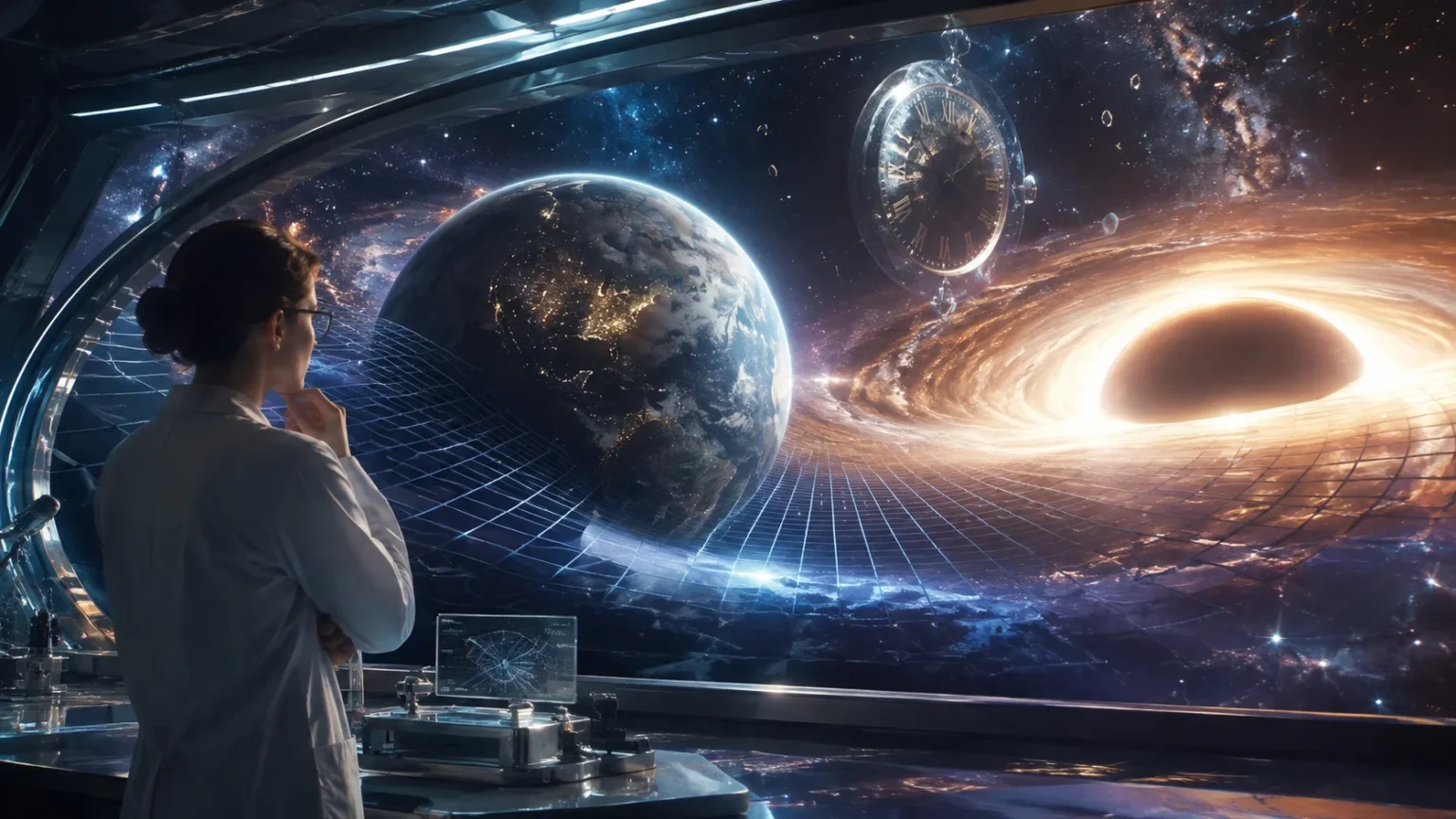
General relativity adds gravity to the picture. Instead of describing gravity purely as a force pulling objects together, Einstein showed that matter and energy curve spacetime, and objects move along paths determined by that curvature.
Why Did Einstein Develop Relativity?
Before Einstein, Isaac Newton’s laws provided an extremely successful description of motion and gravity. Newton treated space and time as absolute backgrounds that existed independently of the objects moving within them. For many everyday situations, this model remains an excellent approximation.
By the late 19th century, however, scientists recognized tensions between classical mechanics and the equations describing electricity, magnetism, and light. In particular, light did not behave as classical ideas about relative motion seemed to predict.
Einstein approached the problem by reconsidering fundamental assumptions about space and time. In 1905, he published the theory of special relativity, which showed that the laws of physics should take the same form for observers moving at constant velocity relative to one another.
Ten years later, Einstein completed general relativity. This new theory incorporated acceleration and gravity, providing a deeper explanation of gravitational phenomena that Newton’s theory described successfully but did not explain in terms of spacetime geometry.
What Is Special Relativity?
Special relativity describes physics in reference frames that move at constant velocities relative to one another. It is called “special” because it initially focuses on situations without gravity and without the complications introduced by accelerating reference frames.
The theory rests on two central principles. First, the laws of physics are the same for all observers moving at constant velocity. Second, the speed of light in a vacuum is the same for all such observers, regardless of their own motion.
These principles force us to abandon the everyday idea that everyone shares one universal clock. Two observers moving relative to each other may disagree about how much time passes between events or how far apart objects are.
Special relativity leads directly to phenomena including time dilation, length contraction, relativity of simultaneity, and mass–energy equivalence. These effects are tiny at ordinary speeds but become increasingly important as an object approaches the speed of light.
What Is General Relativity?
General relativity is Einstein’s theory of gravity. Published in 1915, it replaced the idea that gravity is simply an invisible force acting across space with a geometric description involving the curvature of spacetime.
According to the theory, matter and energy change the geometry of spacetime around them. Massive objects such as stars and planets create significant curvature, and other objects follow the natural paths allowed by that curved geometry.
An often-used analogy is placing a heavy ball on a stretched sheet. The ball creates a depression, and smaller objects placed nearby tend to move along curved paths around it. The analogy is imperfect, but it helps visualize how mass can influence surrounding geometry.
General relativity explains planetary orbits, gravitational time dilation, black holes, gravitational lensing, and gravitational waves. It also provides the framework scientists use to describe the large-scale structure and evolution of the universe.
What Is Spacetime?
Spacetime is the idea that the three dimensions of space and the dimension of time form one connected four-dimensional framework. Every event can be described by where it happened and when it happened.
Before relativity, physicists commonly treated space and time as independent. Einstein’s work showed that observers moving relative to each other can disagree about spatial distances and time intervals while still agreeing on deeper spacetime relationships.
The connection between space and time becomes especially important at high speeds. If one observer measures a moving object as having a shorter length, that same situation is connected to differences in how the observers measure elapsed time and simultaneity.
General relativity goes further by allowing spacetime itself to curve. Matter and energy influence this geometry, creating what we experience as gravitational effects around planets, stars, galaxies, and black holes.
Why Is the Speed of Light So Important?
Light travels through a vacuum at approximately 299,792 kilometers per second, often rounded to about 300,000 kilometers per second. In relativity, this speed is usually represented by the symbol c.
The remarkable part is that every inertial observer measures the same value for the speed of light. If you travel toward a light beam, you do not measure it moving past you faster than someone standing still would.
This behavior is completely different from ordinary objects. If a car approaches you while you drive toward it, your relative speed depends on both vehicles. Light does not follow this simple addition rule.
To preserve the constant speed of light, measurements of time and distance must depend on the observer’s motion. This requirement is what produces many of the famous predictions associated with special relativity.
What Is Time Dilation?
Time dilation means that different observers can measure different amounts of elapsed time depending on their relative motion or gravitational environment. Time is therefore not universally identical for every observer.
In special relativity, a clock moving rapidly relative to an observer appears to tick more slowly than a clock at rest relative to that observer. The effect becomes increasingly significant as the moving clock approaches the speed of light.
Imagine an astronaut traveling through space at an extremely high speed and later returning to Earth. Less time could pass for the astronaut than for people who remained on Earth, meaning the astronaut would have aged less during the journey.
Time dilation is not merely a thought experiment. Highly accurate clocks and measurements involving fast-moving particles have confirmed relativistic timing effects, and modern technologies must account for them to operate accurately.
How Does Gravity Affect Time?
General relativity predicts another form of time dilation caused by gravity. A clock located deeper within a gravitational field runs more slowly compared with a clock farther away from the source of gravity.
For example, a clock closer to Earth’s surface experiences slightly stronger gravity than one located far above the planet. The difference is extremely small in everyday life, but precision instruments can measure it.
The effect becomes much stronger around extremely dense objects. Near a black hole, gravitational time dilation can become enormous compared with an observer located much farther away from the black hole.
This connection between gravity and time is one of the most remarkable consequences of relativity. Gravity does not merely influence where objects move; it also influences how quickly time passes.
What Is Length Contraction?
Length contraction is another prediction of special relativity. An object moving at very high speed relative to an observer is measured as being shorter along the direction of its motion.
The object does not feel itself physically being crushed. Someone traveling with the object measures its ordinary length because the object is stationary relative to that observer.
The effect depends on the relative motion between observers. As the object’s speed becomes closer to the speed of light, the difference between the measured lengths becomes increasingly significant.
Length contraction is essentially unnoticeable during ordinary travel because cars, airplanes, and spacecraft move far too slowly compared with light. It becomes relevant mainly in particle physics and other situations involving relativistic speeds.
What Is the Relativity of Simultaneity?
One of the strangest consequences of special relativity is that two events considered simultaneous by one observer may not be simultaneous for another observer moving relative to the first.
Imagine flashes of light occurring at opposite ends of a moving train. An observer standing beside the tracks might receive both flashes at the same time and conclude that the events happened simultaneously.
A passenger moving with the train may be traveling toward one flash and away from the other. Because the speed of light remains the same, the passenger’s analysis of when the events occurred can differ from the observer beside the tracks.
This means there is no universal definition of “right now” that applies identically to every observer throughout the universe. Simultaneity depends on the observer’s state of motion.
What Does E = mc² Mean?
Perhaps the most famous equation associated with relativity is E = mc². It expresses the relationship between energy, represented by E, mass, represented by m, and the speed of light, represented by c.
The equation tells us that mass is a form of energy. Because the speed of light squared is an enormous number, even a small amount of mass corresponds to a very large amount of energy.
This relationship helps explain the energy released during nuclear reactions. In stars, nuclear fusion converts part of the mass associated with atomic nuclei into other forms of energy, eventually producing the light and heat that stars radiate.
The equation does not mean ordinary objects suddenly release all their mass as usable energy. Instead, it reveals a fundamental relationship between quantities that classical physics once treated as much more separate.
Can Anything Travel Faster Than Light?
According to special relativity, an object with mass cannot be accelerated through the speed of light in a vacuum. As its speed approaches light speed, increasingly large amounts of energy are required to continue accelerating it.
Reaching the speed of light would require an unbounded amount of energy for an ordinary massive particle, making the transition impossible within the framework of relativity.
Particles without rest mass, such as photons, naturally travel at the speed of light in a vacuum. They do not need to be accelerated from a lower speed in the same way a massive object would.
Relativity also prevents ordinary information or matter from traveling locally faster than light. This speed limit plays an important role in preserving the causal structure of spacetime, meaning causes cannot normally occur after their effects.
How Does Relativity Explain Gravity?
Newton described gravity as an attractive force between masses. Einstein provided a deeper interpretation by showing that gravity can be understood as the effect of curved spacetime.
Imagine Earth orbiting the Sun. In Newtonian physics, the Sun’s gravity pulls Earth inward while Earth’s forward motion keeps it in orbit. General relativity instead describes Earth as following the straightest possible path through spacetime curved by the Sun.
Objects falling toward Earth behave similarly. They follow natural trajectories through curved spacetime, while a person standing on the ground actually feels an upward supporting force from the surface preventing free fall.
Newton’s equations remain extremely useful for everyday engineering and most planetary calculations because they closely approximate relativity under ordinary conditions. General relativity becomes particularly important when gravity is extremely strong or very precise measurements are required.
How Did Relativity Improve Our Understanding of Mercury?
Mercury’s orbit provided an important early test of general relativity. Astronomers had noticed that the closest point of Mercury’s orbit around the Sun slowly shifted in a way that Newtonian calculations could not completely explain.
Most of the orbital shift could be accounted for by the gravitational influence of other planets. However, a small unexplained amount remained and became a longstanding puzzle in astronomy.
When Einstein applied general relativity to Mercury’s orbit, the additional curvature of spacetime near the Sun produced precisely the kind of correction that was needed to explain the remaining shift.
This success gave physicists early confidence that general relativity was doing more than providing a new mathematical description. It successfully explained an astronomical observation that had resisted a complete classical explanation.
What Is Gravitational Lensing?
Gravitational lensing occurs when gravity bends the path of light. A massive object such as a galaxy or galaxy cluster can curve spacetime strongly enough to deflect light coming from an object located farther behind it.
From Earth, the background object may appear distorted, magnified, duplicated, or stretched into arcs. In some arrangements, light can even form a nearly complete ring known as an Einstein ring.
Astronomers use gravitational lensing as a powerful scientific tool. It can reveal distant galaxies that would otherwise be difficult to observe and help scientists estimate the distribution of mass in galaxies and galaxy clusters.
Because lensing responds to gravity rather than only visible matter, it also provides evidence about invisible mass such as dark matter. This makes Einstein’s theory valuable for studying some of the largest structures in the universe.
What Are Black Holes?
A black hole is a region where spacetime is curved so strongly that beyond a boundary called the event horizon, nothing traveling at or below the speed of light can escape outward.
Black holes can form when sufficiently massive stars collapse after exhausting their nuclear fuel. Other black holes, including supermassive ones containing millions or billions of times the Sun’s mass, exist near the centers of many galaxies.
General relativity predicts the basic properties of black holes by describing what happens when matter becomes concentrated enough to create extreme spacetime curvature.
Black holes are not cosmic vacuum cleaners that automatically swallow everything nearby. Objects can orbit them just as planets orbit stars, provided they remain outside the event horizon and follow stable trajectories.
What Are Gravitational Waves?
Gravitational waves are ripples in spacetime produced when massive objects accelerate in certain ways. Einstein predicted their existence as a consequence of general relativity more than a century ago.
Powerful events such as collisions between black holes or neutron stars can produce gravitational waves strong enough to travel across enormous cosmic distances.
When these waves pass through Earth, they stretch and compress spacetime by extraordinarily tiny amounts. Highly sensitive observatories can measure these changes using laser-based instruments.
The detection of gravitational waves opened an entirely new way of studying the universe. Instead of relying only on light, astronomers can now observe the gravitational signatures of some of the most violent events in the cosmos.
How Is Relativity Used in GPS?
Relativity may seem far removed from ordinary technology, but GPS navigation provides one of its clearest practical applications. GPS satellites carry extremely accurate atomic clocks used to calculate position.
Because the satellites move rapidly relative to observers on Earth, special relativity predicts that their clocks should run slightly slower.
At the same time, the satellites experience weaker gravity because they orbit high above Earth. General relativity predicts that their clocks should run slightly faster because of this reduced gravitational field.
Engineers must account for both effects. Without relativistic corrections, timing errors would accumulate and GPS position calculations would become increasingly inaccurate, making relativity essential to navigation systems used every day.
Does Relativity Affect Everyday Life?
Most relativistic effects are too small to notice directly during ordinary activities. Walking, driving, or flying in an airplane produces time dilation, but the difference is far below what ordinary clocks can detect.
Gravity also changes time everywhere, including between different floors of a building. Again, the effect is extremely small, although modern atomic clocks can measure differences caused by surprisingly modest changes in height.
Relativity becomes practically important whenever extraordinary precision is required. Satellite navigation, particle accelerators, astronomy, and high-precision timing all need relativistic effects to be considered.
This is an important reminder that relativity is not only about distant galaxies and black holes. The same laws operate around us constantly, even when their effects are too small for our senses to notice.
Is Relativity Just a Theory?
In everyday conversation, the word “theory” can mean a guess. In science, however, a scientific theory is a comprehensive explanation supported by evidence, testing, observations, and successful predictions.
Relativity has been tested through many different kinds of experiments and astronomical observations. Measurements of time dilation, light bending, planetary motion, gravitational waves, and precision clocks all agree with its predictions within tested limits.
Scientists continue testing relativity because science does not treat even highly successful theories as immune from examination. Extremely strong gravity and very small quantum scales remain important areas where researchers look for possible limitations.
Calling relativity a theory therefore does not imply that scientists are unsure whether its basic effects exist. It means relativity is a broad scientific framework explaining a large range of physical observations.
Special Relativity vs General Relativity
Special relativity focuses primarily on observers moving at constant velocity and explains how motion affects measurements of space and time. It introduced time dilation, length contraction, relativity of simultaneity, and mass–energy equivalence.
General relativity extends the framework to include acceleration and gravity. It describes gravity through the geometry of curved spacetime rather than only as a force between masses.
Special relativity is particularly important in particle physics and situations involving extremely high speeds. General relativity becomes essential for black holes, gravitational waves, cosmology, and precise calculations involving strong gravity.
The two theories are therefore not competing explanations. General relativity incorporates the insights of special relativity while expanding them into a broader description of spacetime and gravitation.
Does Relativity Replace Newton’s Laws?
Relativity does not make Newtonian physics useless. Newton’s laws remain remarkably accurate for objects moving much slower than light and in gravitational fields that are not extremely strong.
Engineers can design bridges, vehicles, machinery, and many spacecraft trajectories using Newtonian mechanics because relativistic corrections would often be far smaller than other uncertainties.
Relativity becomes necessary when speeds approach the speed of light, gravity becomes very strong, or measurements need extraordinary precision. Under those conditions, Newtonian calculations begin deviating measurably from reality.
This relationship is common in science. New theories often contain older theories as useful approximations within particular limits rather than making everything previously discovered completely wrong.
What Does Relativity Say About the Universe?
General relativity provides the mathematical foundation of modern cosmology, the scientific study of the universe as a whole. Einstein’s equations connect the distribution of matter and energy with the geometry and evolution of spacetime.
When scientists apply these equations to the universe, they find that spacetime does not need to remain static. It can expand or contract depending on its contents and overall geometry.
Observations show that the universe is expanding, and general relativity provides the framework used to model that expansion. Modern cosmological models also incorporate dark matter, dark energy, radiation, and ordinary matter.
Relativity therefore connects Einstein’s original theory of gravity with questions about the origin, history, structure, and ultimate future of the universe.
Relativity and Quantum Mechanics
Relativity and quantum mechanics are two foundational theories of modern physics. Relativity excels at describing gravity, stars, planets, galaxies, and the large-scale universe, while quantum mechanics describes particles and interactions at extremely small scales.
Both theories are extraordinarily successful within their own domains. The major difficulty appears in situations where strong gravity and quantum effects become important simultaneously.
The interior of black holes and the very early universe are examples where physicists expect both quantum mechanics and gravity to matter. Existing theories cannot yet provide a completely unified description under such extreme conditions.
Finding a successful theory of quantum gravity remains one of physics’ biggest open problems. Approaches including string theory and loop quantum gravity attempt to address the challenge, but no experimentally confirmed complete theory has yet replaced general relativity in this domain.
Common Misconceptions About Relativity
One misconception is that relativity means “everything is relative.” Einstein’s theory does not say that every viewpoint is equally correct about everything. It establishes exact mathematical relationships connecting measurements made by different observers.
Another misconception is that time dilation is merely an optical illusion. It is a real physical effect that can be measured by comparing clocks following different trajectories or experiencing different gravitational conditions.
People also sometimes assume relativity says mass increases in a simple physical sense whenever an object accelerates. Modern treatments generally keep an object’s invariant mass constant and describe increasing energy and momentum instead.
Finally, relativity does not say humans can easily travel through time or exceed the speed of light. Although the theory allows different observers to experience different amounts of elapsed time, practical relativistic travel requires extreme speeds and enormous amounts of energy.
Why Is the Theory of Relativity Important?
Relativity fundamentally changed our understanding of space and time by showing that they are dynamic quantities rather than fixed backgrounds shared identically by everyone.
It transformed our understanding of gravity by describing it as spacetime curvature. This insight explains phenomena ranging from the orbit of Mercury to black holes and gravitational lensing.
The theory also has practical consequences. GPS systems require relativistic timing corrections, while particle accelerators must account for relativistic energy and momentum when particles approach the speed of light.
Most importantly, relativity demonstrates how reconsidering basic assumptions can transform science. Einstein began with simple questions about motion and light and developed a framework that now helps us understand both everyday technology and the largest structures in the universe.
Final Thoughts: What Is the Theory of Relativity?
The theory of relativity is Einstein’s framework for understanding space, time, motion, gravity, matter, and energy. It consists of special relativity, developed in 1905, and general relativity, completed in 1915.
Special relativity shows that measurements of time and distance depend on relative motion while the speed of light remains constant. This leads to time dilation, length contraction, relativity of simultaneity, and the famous relationship expressed by E = mc².
General relativity explains gravity as the curvature of spacetime produced by matter and energy. It successfully describes planetary motion, gravitational time dilation, black holes, gravitational lensing, gravitational waves, and important aspects of cosmology.
More than a century after Einstein developed these ideas, relativity remains one of the foundations of modern physics. Its predictions continue to match experiments and observations while helping scientists explore some of the deepest questions about space, time, gravity, and the universe.
Frequently Asked Questions
What is the theory of relativity in simple words?
The theory of relativity explains how measurements of space and time depend on motion and gravity. It also describes gravity as the curvature of spacetime caused by matter and energy.
What are the two theories of relativity?
The two parts are special relativity and general relativity. Special relativity focuses on high-speed motion, while general relativity explains gravity and curved spacetime.
What does E = mc² mean?
E = mc² means that mass and energy are fundamentally related. Even a small amount of mass corresponds to a very large amount of energy because the speed of light squared is enormous.
Does time really slow down at high speeds?
Yes. According to special relativity, a moving clock runs more slowly relative to an observer when the clock is traveling at very high speed. This effect has been experimentally measured.
Why is Einstein’s theory of relativity important today?
Relativity helps explain black holes, gravitational waves, planetary motion, and the expanding universe. It is also required for accurate technologies such as GPS satellite navigation.