

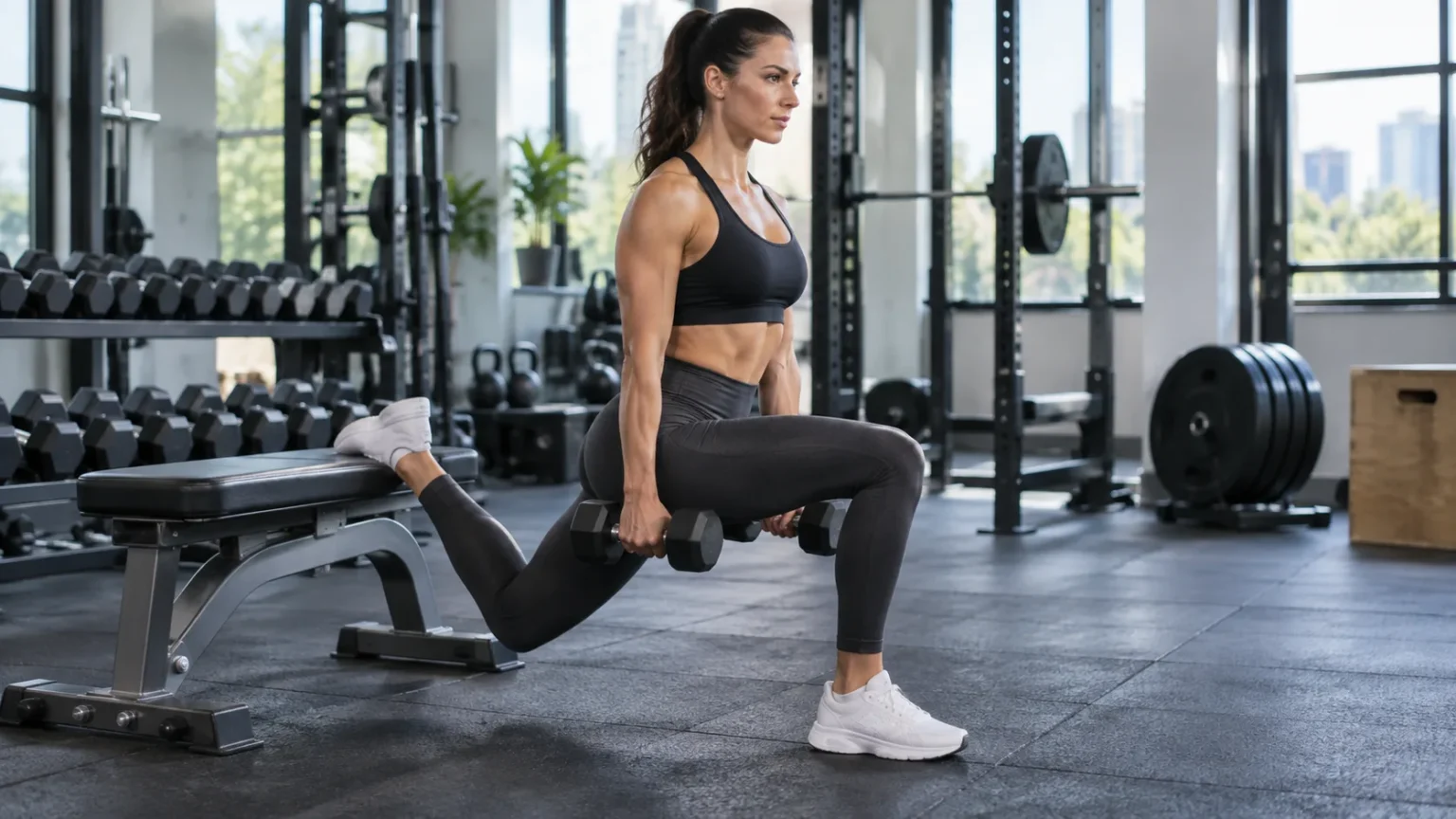

Split squats are one of the most effective lower-body exercises for building strength, balance, and control one leg at a time. Unlike traditional squats, they place your feet in a staggered stance, which increases the demand on each leg individually. This makes them especially useful for strengthening the quads, glutes, hamstrings, and stabilizing muscles around the hips.
The exercise can be performed using only body weight or progressed with dumbbells, barbells, resistance bands, or other equipment. Proper technique matters because stance length, knee position, balance, and depth all influence which muscles work hardest. Learning the correct form can help you gain strength while keeping the movement comfortable and controlled.
What Are Split Squats?
A split squat is a lower-body strength exercise performed with one foot positioned in front of the other. Unlike a lunge, the feet generally stay planted throughout the set instead of repeatedly stepping forward or backward. You lower your body vertically by bending both knees and then push through the front leg to return upward.
The staggered stance places more demand on one leg while the rear leg provides additional balance and support. This makes split squats useful for identifying differences between your left and right sides. They also require greater hip and core stability than many two-leg exercises because your base of support is narrower.
Split squats can be adapted easily for different fitness levels. Beginners can hold onto a wall or chair for balance, while more advanced trainees can add dumbbells or a barbell. Changing stance length, load, or foot elevation can also shift the challenge toward different lower-body muscles.
What Muscles Do Split Squats Work?
Split squats mainly work the quadriceps and gluteus maximus of the front leg. The quadriceps straighten the knee as you rise, while the glutes help extend the hip. The exact balance between these muscles changes depending on how far apart your feet are and how much your torso leans forward.
The hamstrings and adductors also contribute during the movement. These muscles help control the hip and support the leg as you lower and push back up. The rear leg works less than the front but still contributes to balance, hip positioning, and stability during each repetition.
Your core and hip stabilizers are also active because the staggered stance challenges your balance. The gluteus medius helps control the pelvis, while the abdominal muscles resist unwanted twisting. This is why split squats often feel more demanding than they look even when performed without added weight.
How to Do a Split Squat Correctly
Stand with one foot several feet in front of the other and keep both feet pointing generally forward. Your stance should be wide enough that you can lower your hips comfortably without losing balance. Keep your chest relaxed, brace your core lightly, and distribute most of your working effort through the front leg.
Bend both knees and lower your body toward the floor in a controlled motion. The rear knee should move downward while the front knee bends naturally over the foot. Avoid forcing the front knee to stay behind the toes because some forward knee movement is normal when your ankle and hip move comfortably.
Push through the front foot to return to the starting position. Keep the entire foot planted rather than allowing the heel to lift. Complete your repetitions on one side before switching legs, and focus on smooth movement rather than rushing through the set or using momentum.
Key Benefits of Split Squats
One major benefit of split squats is unilateral strength development. Because each leg works more independently, the exercise can reveal strength differences that may be less obvious during regular squats. Training one side at a time can help improve balance between the legs and build more controlled lower-body strength.
Split squats also improve balance and coordination. The staggered stance challenges the hips, ankles, and core to stabilize the body while the legs produce force. This can carry over to everyday tasks such as walking upstairs, stepping over obstacles, or moving through positions where one leg needs to support more body weight.
Another advantage is versatility. Split squats can be performed at home, in the gym, or while traveling, and they require very little space. They also combine well with other lower-body and band exercises when you want a complete strength routine without depending entirely on heavy gym machines.
Split Squats vs Lunges
Split squats and lunges use similar muscle groups, but the movement pattern is different. In a split squat, your feet remain in place while you move up and down. A lunge usually includes a stepping action, which adds more coordination and dynamic balance to the exercise.
Split squats can therefore be easier for beginners because there is less movement to control. Once the stance is established, you can focus on lowering and rising smoothly. Lunges require you to control the step, landing, and return, which can make them more demanding for people still developing balance.
Both exercises are valuable and can be included in the same training program. Split squats work well for controlled strength development, while lunges can add more movement variety. Choosing between them depends on your goals, available space, balance, and how comfortable each exercise feels.
Split Squats vs Bulgarian Split Squats
The Bulgarian split squat is a more advanced version in which the rear foot is elevated on a bench or platform. Elevating the back leg increases the balance challenge and usually shifts more work toward the front leg. This makes the exercise significantly harder even when performed with the same amount of weight.
A regular split squat is often better for beginners because both feet remain on the floor. This creates a more stable base and makes it easier to learn the correct movement pattern. Once you can perform controlled bodyweight split squats comfortably, the Bulgarian variation may become a useful progression.
There is no need to rush into rear-foot elevation. A standard split squat can remain challenging by adding dumbbells, increasing repetitions, or slowing the lowering phase. Progress should be based on strength and control rather than choosing the most difficult variation simply because it appears more advanced.
Common Split Squat Form Mistakes
One common mistake is using a stance that is too short. When the feet are very close together, the movement can feel cramped and place excessive pressure on the front knee. Lengthen the stance slightly so both knees can bend comfortably while the body lowers mostly downward instead of sharply forward.
Another mistake is allowing the front knee to collapse inward. The knee should generally track in the same direction as the toes rather than drifting toward the opposite leg. Reducing the load and focusing on hip control can make it easier to maintain better alignment throughout the movement.
People also sometimes push too strongly through the rear foot. The back leg should provide support, but the front leg should handle most of the work. If you feel the exercise mainly in the rear leg, adjust your stance and consciously drive through the front foot during the upward phase.
How Many Split Squats Should You Do?
Beginners can start with two or three sets of 8 to 12 repetitions on each leg. Body weight may provide enough challenge initially, especially if balance is still developing. The final repetitions should feel difficult while still allowing you to maintain stable posture and controlled knee movement.
If your goal is muscle growth, moderate repetition ranges with added resistance can work well. For general strength and control, you can use slightly heavier resistance and fewer repetitions. Higher repetitions may also be useful with bodyweight training when heavier equipment is not available.
Train split squats one to three times per week depending on your overall lower-body program. Squats, deadlifts, lunges, running, and sports also create leg fatigue, so recovery matters. More sets are not automatically better if soreness or tiredness prevents you from moving well in later workouts.
How to Progress Split Squats Safely
The easiest way to progress is by adding resistance once bodyweight repetitions become comfortable. Hold dumbbells at your sides, use a kettlebell at chest level, or add a barbell when you have good balance. Increase the load gradually rather than making large jumps that cause your technique to change.
You can also increase difficulty without adding weight. Slow the lowering phase, pause near the bottom, or increase the number of repetitions. These methods increase time under tension and can make a relatively light exercise feel much more challenging while allowing you to maintain control.
More advanced variations include front-foot-elevated split squats and Bulgarian split squats. Elevating the front foot can increase the available range of motion, while rear-foot elevation increases the balance demand. Introduce one change at a time so you can understand how your body responds to each progression.
Best Practices for Split Squat Training
Warm up with a few minutes of light movement before beginning demanding sets. Gentle bodyweight squats, walking, or easy split squats can prepare the hips, knees, and ankles for greater loading. You do not need an elaborate warm-up, but the first working set should not be your first lower-body movement of the day.
Use a range of motion that feels controlled and comfortable. Going deeper can increase muscular demand, but only when your hips, knees, and ankles can tolerate the position without pain. Depth should progress naturally as mobility and strength improve rather than being forced simply to match someone else’s technique.
Keep your training balanced by combining split squats with hip-hinge, calf, and core exercises. Romanian deadlifts, bridges, calf raises, and stability work can complement the movement well. A complete lower-body program develops several movement patterns instead of relying on one exercise to handle every strength and mobility goal.
When Should You Modify or Avoid Split Squats?
People with active knee, hip, ankle, or back pain may need to adjust the exercise. Holding onto a stable support, shortening the range of motion, or using a lighter load can make split squats more manageable. The movement should create muscular effort rather than sharp or worsening joint pain.
If you are returning after an injury or surgery, follow guidance from your healthcare professional or physical therapist. Certain conditions may require temporary restrictions on bending depth or weight-bearing exercises. A modified split squat can sometimes be useful during rehabilitation, but the correct timing depends on the specific injury.
Stop exercising and seek assessment if you experience sudden severe pain, major swelling, instability, or inability to bear weight normally. Persistent discomfort that continues despite changing technique also deserves attention. Training through pain is not necessary for progress and can make it harder to identify the actual cause.
Conclusion
Split squats are a versatile lower-body exercise that strengthens the quadriceps, glutes, hamstrings, hips, and stabilizing muscles. Their staggered stance makes each leg work more independently, which can improve balance, coordination, and unilateral strength. They can be performed using only body weight or progressed with resistance.
Good form starts with a comfortable stance, stable front foot, controlled knee movement, and most of the effort coming from the front leg. Avoid rushing repetitions or adding heavy weight before you can maintain balance. Small improvements in control and range of motion are valuable signs of progress.
Use split squats alongside other lower-body exercises rather than treating them as the only movement you need. Gradually increase resistance, repetitions, or exercise difficulty while allowing enough recovery between sessions. With consistent practice and proper technique, split squats can become a powerful addition to almost any strength program.
FAQs
What muscles do split squats work?
Split squats mainly work the quadriceps and glutes of the front leg. The hamstrings, adductors, calves, hip stabilizers, and core also contribute to balance and control.
Are split squats good for beginners?
Yes. Beginners can perform bodyweight split squats while holding a wall or chair for support. Start with a comfortable range of motion and gradually increase depth and resistance.
What is the difference between a split squat and a lunge?
In a split squat, both feet remain planted throughout the set. Lunges usually involve stepping into and out of the position, which adds more dynamic balance and coordination.
How many split squats should I do?
A good starting point is two or three sets of 8 to 12 repetitions per leg. Adjust the repetitions and resistance according to your strength, goals, and recovery.
Are split squats bad for your knees?
Split squats are not inherently bad for healthy knees when performed with appropriate technique and loading. Reduce the range or resistance if the exercise causes pain and seek guidance if symptoms persist.