

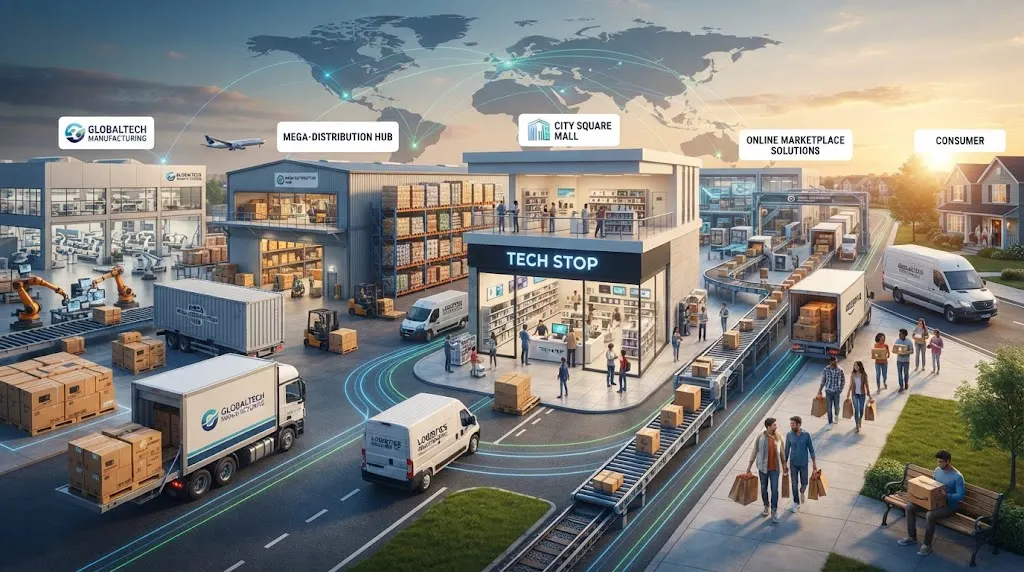

Channels of Distribution: Types & Real Examples
Channels of distribution are the routes products and services follow as they move from a producer to the final customer. Sometimes that path is extremely short, such as when a business sells directly through its own website. In other cases, products move through distributors, wholesalers, retailers, marketplaces, agents, or other intermediaries before reaching buyers. The right distribution channel affects far more than delivery because it can influence pricing, customer experience, brand control, market reach, and profit margins. Businesses therefore need to choose channels that match how their customers prefer to buy. Understanding distribution channels is useful for marketers, entrepreneurs, retailers, manufacturers, and anyone studying how products reach the market.
Modern distribution has become more complex as online shopping, direct-to-consumer brands, global marketplaces, social commerce, and omnichannel retail have expanded. A company may sell through its own stores, website, mobile app, third-party retailers, distributors, and online marketplaces at the same time. This flexibility can help businesses reach more customers, but it also creates challenges involving inventory, pricing, logistics, channel conflict, and customer data. Traditional wholesalers and retailers still play major roles, even as digital channels continue to grow. The strongest distribution strategy is therefore rarely about choosing the newest option available. It is about finding the most efficient and customer-friendly route between a product and the people who want to buy it.
What Are Channels of Distribution?
A channel of distribution is the network of businesses, platforms, and intermediaries involved in moving a product or service from its producer to the final customer. The channel can include manufacturers, wholesalers, distributors, agents, retailers, e-commerce platforms, and logistics providers. Each participant performs one or more functions that help make the product available to the target market. A manufacturer might produce an item but rely on a wholesaler to distribute it across hundreds of retail locations. Another company may avoid intermediaries and sell directly through its website. Distribution channels therefore describe both who participates in the selling process and how the customer ultimately receives the offering.
Distribution is often discussed as one of the major components of marketing because a good product cannot generate sales if customers cannot conveniently access it. A company may have competitive pricing and strong advertising, yet still struggle if its products are unavailable where the target audience prefers to shop. Distribution decisions determine market coverage, product availability, delivery speed, and sometimes the overall buying experience. A premium brand may choose selective distribution to protect its positioning, while a mass-market snack company may seek availability in as many stores as possible. The appropriate strategy depends on customer expectations, product characteristics, competitive conditions, and the resources available to the business.
Intermediaries are businesses or individuals that help move goods between producers and final consumers. Wholesalers typically buy large quantities from manufacturers and resell smaller quantities to retailers or business customers. Distributors often maintain close relationships with manufacturers and may handle sales, warehousing, logistics, or regional market development. Retailers sell directly to final consumers through physical stores, websites, apps, or other shopping environments. Agents and brokers may connect buyers and sellers without owning the product themselves. Each intermediary adds functions that the manufacturer would otherwise need to perform internally, although every additional layer can also reduce the producer’s direct control over pricing and customer relationships.
The length of a distribution channel depends on the number of intermediaries between the producer and customer. A direct channel has no independent intermediary because the producer sells straight to the buyer. A one-level channel may involve one retailer, while longer indirect channels can include wholesalers, distributors, retailers, and other participants. Longer channels can expand geographic reach and reduce the manufacturer’s operational burden, especially in fragmented markets. However, they can also create additional costs, communication challenges, and less visibility into final customer behavior. Businesses therefore evaluate channel length based on whether each additional participant provides enough value to justify the complexity and margin involved.
Distribution should not be confused with physical logistics, although the two concepts are closely connected. Logistics focuses on activities such as transportation, warehousing, inventory handling, order fulfillment, and delivery. Distribution channels describe the broader commercial route and relationships through which products reach buyers. For example, a brand might use an online marketplace as a distribution channel while relying on a third-party logistics company to store and ship inventory. The marketplace helps generate and process sales, while the logistics provider handles physical movement. Successful companies coordinate both areas because an effective sales channel can still disappoint customers if inventory is unavailable or delivery is unreliable.
Why Distribution Channels Matter to Businesses and Customers
A strong distribution strategy increases market reach by making products available where target customers already shop. A small manufacturer might struggle to build stores across an entire country, but partnerships with established retailers can provide access to thousands of existing customers. Digital marketplaces can similarly help brands reach audiences they might not attract through their own websites alone. This ability to use another company’s audience, infrastructure, and reputation can accelerate expansion considerably. Distribution partners can also provide regional knowledge that helps businesses enter unfamiliar markets. For companies with limited sales resources, the right intermediaries can transform a local product into one that reaches national or international customers.
Distribution channels also influence the customer’s buying experience. People increasingly expect products to be available through convenient channels, whether that means a nearby store, same-day delivery service, mobile app, marketplace, or direct website. A customer who discovers a product through social media may want to purchase it without navigating a complicated process. Another shopper may prefer visiting a physical store to inspect the item before buying. Businesses that understand these preferences can design channels around real purchasing behavior instead of forcing every customer through one route. Convenience has become an important competitive advantage, particularly when several brands offer products with similar features and prices.
Profit margins are heavily influenced by channel structure because intermediaries usually need compensation for the value they provide. A manufacturer selling directly can potentially keep a larger portion of the final selling price, but it must also pay for marketing, customer service, fulfillment, technology, and returns. Selling through retailers reduces some of those responsibilities but requires the manufacturer to sell at a wholesale price that allows the retailer to earn a margin. Distributors and agents may add further costs. The best channel is therefore not automatically the one with the fewest intermediaries. Businesses need to compare total costs, sales volume, customer acquisition expenses, operational requirements, and strategic value.
Brand control is another important consideration when selecting distribution channels. Direct-to-consumer businesses can control website design, product presentation, pricing, packaging, and communication throughout most of the buying journey. Products sold through independent retailers may appear beside competing brands and follow the retailer’s merchandising decisions. Discounting can also influence how customers perceive a brand if channel partners frequently lower prices. Luxury and premium companies often manage distribution carefully for this reason. They may select only certain retailers that match the desired customer experience. Mass-market brands, by contrast, may prioritize availability and convenience over highly controlled presentation because broad market coverage supports their business model.
Distribution channels also provide valuable information about demand. Direct channels can give companies detailed access to customer behavior, purchase history, product preferences, and feedback. Indirect channels may provide less individual-level information because the retailer or distributor controls the customer relationship. However, channel partners can still offer sales trends, regional insights, inventory information, and feedback from stores. Businesses increasingly combine data from multiple channels to understand customer journeys more accurately. This information can influence pricing, product development, marketing campaigns, inventory planning, and future expansion. A strong distribution network therefore does more than deliver products because it can become an important source of market intelligence.
Direct Distribution Channels
Direct distribution occurs when a producer sells products or services directly to the final customer without using an independent wholesaler or retailer. A company-owned website is one of the most common modern examples because the brand can accept orders, process payments, and arrange delivery itself. Company stores, sales teams, mobile apps, catalogs, and direct subscriptions can also form part of a direct distribution model. The defining characteristic is that the producer maintains the commercial relationship with the buyer. Direct distribution has grown significantly as e-commerce tools and fulfillment services have made it easier for businesses to sell without building a traditional retailer network.
One major advantage of direct distribution is greater control over the customer experience. The company decides how products are presented, which prices appear, what promotions are offered, and how customer service operates. Businesses can communicate their brand story without depending on a retailer to explain the product properly. They can also collect first-party customer data that helps personalize marketing and improve future products. Direct relationships may strengthen customer loyalty because the brand can continue communicating after the purchase. However, collecting customer data also creates responsibilities involving privacy, security, consent, and appropriate use. Greater control therefore comes with greater responsibility.
Direct-to-consumer, often shortened to DTC or D2C, is a well-known direct distribution strategy in which brands sell straight to consumers rather than relying entirely on traditional retail partners. Clothing companies, beauty brands, food businesses, furniture sellers, and electronics companies can all use DTC channels. Many brands begin online because launching an e-commerce store is usually less expensive than opening a large physical retail network. Successful DTC companies may later add physical stores or partnerships with retailers as they grow. This demonstrates that direct distribution does not have to remain exclusive forever. Businesses can combine channels when additional reach becomes more valuable than maintaining a purely direct model.
Direct distribution can produce attractive gross margins because the manufacturer is not selling the product to a retailer at a discounted wholesale price. However, the higher selling price retained by the company does not automatically translate into higher profit. The business must attract customers through advertising, content, social media, referrals, or other marketing channels. It may also need warehouses, packaging operations, delivery partnerships, returns processing, payment technology, and customer support. Customer acquisition costs can become particularly high in competitive online markets. Companies therefore need to calculate the full economics of direct distribution rather than assuming that removing retailers automatically makes the business more profitable.
Apple provides an easy example of direct distribution because customers can purchase products through Apple-operated stores and the company’s own online sales channels. Nike also places significant emphasis on direct digital and physical customer relationships while continuing to use selected retail partners. Many software companies use an even more direct model because customers can subscribe to a digital service without physical inventory changing hands. A small local bakery taking orders through its own website is another simple direct channel example. These businesses differ greatly in scale, yet the principle remains the same. The producer or service provider sells to the end customer without another independent retailer becoming the seller in the transaction.
Indirect Distribution Channels
Indirect distribution occurs when one or more independent intermediaries help move products from the producer to the final customer. These intermediaries may include distributors, wholesalers, agents, brokers, dealers, or retailers. Manufacturers often choose indirect distribution when building their own sales and logistics network would be expensive or inefficient. A food producer, for example, may sell through distributors that already serve supermarkets, convenience stores, restaurants, and independent shops. Instead of creating thousands of direct relationships, the producer can use an established network. This approach is especially useful when customers are geographically dispersed or when an industry already relies heavily on specialized distribution partners.
Retailers are among the most familiar participants in indirect distribution. They purchase or otherwise offer products from manufacturers and make them available to final consumers through stores, websites, apps, or multiple channels. Supermarkets are a classic example because they gather thousands of products from many brands in one convenient location. Consumers benefit because they can compare options and purchase several categories of goods during one shopping trip. Manufacturers gain access to the retailer’s traffic, locations, technology, and customer relationships. In exchange, retailers expect enough margin to cover their operating costs and profit requirements. This creates a shared commercial relationship where both parties need the product to sell successfully.
Wholesalers usually operate between manufacturers and retailers or other business buyers rather than selling primarily to individual consumers. They purchase goods in relatively large volumes, store inventory, and then break those quantities into smaller orders for customers. This function is valuable for small retailers that cannot purchase truckloads of products directly from every manufacturer. Wholesalers can also offer a broad assortment from multiple suppliers, simplifying procurement for their customers. Manufacturers benefit because they can sell larger quantities without managing hundreds of small accounts individually. The trade-off is reduced direct visibility into final buyers and a portion of the margin going to the intermediary.
Distributors can perform an even broader set of functions depending on the industry. They may handle warehousing, transportation, sales support, technical training, installation, marketing, financing, or after-sales service within an assigned market. Manufacturers of industrial equipment, electronics, medical devices, and specialized products often rely on distributors that understand regional customers and technical requirements. A strong distributor can accelerate market entry because it already has sales relationships and local infrastructure. However, choosing the wrong distributor can limit growth if the partner does not prioritize the manufacturer’s products. Companies therefore evaluate distribution partners based on market coverage, reputation, capabilities, financial stability, and strategic alignment.
Coca-Cola provides a useful example of an indirect distribution system because its products reach consumers through a broad network involving bottling operations, distributors, retailers, restaurants, and other outlets. Consumer-goods manufacturers commonly use similar structures because customers expect their products to be available in supermarkets, convenience stores, pharmacies, and local shops. Pharmaceutical manufacturers may also rely on wholesalers and pharmacies to reach patients, although that industry includes additional regulatory requirements. Automotive companies traditionally sell vehicles through dealer networks in many markets. These examples show why indirect channels remain important despite the growth of e-commerce. Intermediaries can provide scale, local reach, and specialized capabilities that would be costly for every producer to build independently.
Distribution Channel Levels: Zero, One, Two, and Three-Level Channels
A zero-level distribution channel is another name for direct distribution because there are no independent intermediaries between the producer and the customer. The manufacturer, creator, or service provider handles the sale directly. Examples include a farmer selling produce at a farm stand, a software company selling subscriptions on its website, or a furniture maker taking orders through a company showroom. Zero-level channels provide strong control over pricing and customer relationships. They can also produce valuable first-party customer data. However, the producer must take responsibility for sales, marketing, payment processing, customer support, and often delivery or fulfillment, which can make direct distribution demanding as the business grows.
A one-level distribution channel contains one intermediary between the producer and the final customer. The most common version is manufacturer to retailer to consumer. A clothing manufacturer might sell products to a department store, which then sells those items to shoppers. The retailer provides store locations, customer traffic, merchandising, payment systems, and often online ordering capabilities. This model can give the manufacturer broader reach without requiring its own network of stores. However, the retailer becomes an important influence over product visibility and customer experience. Manufacturers may compete for shelf placement, promotional support, and favorable positioning against other brands sold through the same retailer.
A two-level channel commonly follows the path manufacturer to wholesaler to retailer to consumer. This structure is useful in markets containing many small retailers spread across a large geographic area. The manufacturer can ship large quantities to wholesalers, which divide the inventory into smaller amounts for individual stores. Food, household products, hardware, and other high-volume categories often use versions of this model. Wholesalers reduce the number of separate transactions manufacturers must manage while giving retailers access to products from many suppliers. The additional layer does add costs and reduces direct manufacturer control. However, the efficiency gained through aggregation can make the overall channel economically attractive.
A three-level channel may include an agent or broker in addition to wholesalers and retailers. One possible structure is manufacturer to agent to wholesaler to retailer to consumer. Agents can help manufacturers identify buyers, negotiate arrangements, or enter markets where they have limited local knowledge. Unlike wholesalers, agents do not always take ownership of the products they help sell. Instead, they may earn commissions for facilitating transactions. Longer distribution channels can be useful for international trade, fragmented markets, and industries where specialized commercial relationships matter. However, every additional level can make communication, pricing, and coordination more complicated, so companies need to ensure that each intermediary contributes meaningful value.
Channel levels should not be viewed as a ranking where shorter always means better. A zero-level channel provides control but may not offer enough reach for a mass-market product. A two-level channel may reduce direct customer contact but make a product available in thousands of locations that the manufacturer could never operate independently. The right structure depends on product value, customer buying behavior, geographic coverage, order size, logistics requirements, and company resources. Businesses can also use several channel levels simultaneously. A manufacturer might sell directly online while using retailers domestically and distributors in international markets. Modern distribution strategy is increasingly flexible rather than based on one permanent channel structure.
Hybrid and Omnichannel Distribution Strategies
Hybrid distribution occurs when a company uses both direct and indirect channels to reach customers. A brand might sell through its own website while also supplying department stores, marketplaces, specialty retailers, or distributors. This approach allows the business to combine the control and customer data of direct sales with the reach and convenience offered by established partners. Hybrid distribution is extremely common because different customers prefer different buying environments. Some shoppers want to buy directly from a brand, while others prefer a familiar retailer where they can compare several alternatives. Using multiple channels can therefore increase total market coverage without forcing every customer into the same purchasing journey.
Omnichannel distribution takes the concept further by connecting multiple sales and fulfillment channels into a more unified customer experience. A shopper might research a product through a mobile app, purchase it online, collect it from a store, and later return it at another location. The customer sees one brand experience even though several inventory, payment, and fulfillment systems are working behind the scenes. Omnichannel strategies require accurate inventory visibility because customers expect websites to reflect whether products are actually available. Businesses also need integrated customer records and order-management systems. When executed well, omnichannel distribution makes channel boundaries less noticeable to customers and allows them to choose whichever buying method is most convenient.
Retailers increasingly use stores as both selling locations and fulfillment hubs. An online order can sometimes be shipped from a nearby store rather than a distant distribution center, potentially reducing delivery time. Buy online, pick up in store is another common omnichannel option that combines digital convenience with physical retail infrastructure. Customers can avoid delivery waits while retailers gain an opportunity for additional in-store purchases. Some companies also support curbside pickup, local delivery, and online returns through stores. These options show how distribution is becoming closely connected with fulfillment strategy. The physical and digital channels are no longer always managed as completely separate businesses.
Marketplaces add another layer to hybrid distribution because they give brands access to enormous existing audiences. Sellers can list products on platforms where millions of customers already search, compare prices, read reviews, and complete purchases. This reach can help new brands generate sales faster than relying entirely on their own websites. However, marketplace selling may involve fees, intense price competition, limited customer data, and reduced control over presentation. Businesses can also become dependent on marketplace algorithms and policies. A balanced strategy may use marketplaces for reach while encouraging long-term customer relationships through direct channels where permitted. The exact approach depends on margins, brand positioning, and customer acquisition economics.
Channel conflict is one of the biggest challenges in hybrid distribution. Retail partners may become frustrated if a manufacturer sells the same products for lower prices on its own website. Direct sales teams can similarly compete with distributors for the same business customers. Companies reduce these problems through pricing policies, exclusive products, geographic territories, differentiated services, or clearly defined customer segments. Communication with partners is essential because distribution relationships can deteriorate when participants believe the producer is competing unfairly against them. The objective of hybrid distribution is not simply to add as many channels as possible. Each channel should serve a clear role within the broader customer and market strategy.
Real Examples of Distribution Channels
Apple demonstrates how a large brand can combine direct and indirect distribution. Consumers can buy products through Apple-operated stores and online channels, giving the company significant control over presentation, service, and customer experience. At the same time, Apple products are available through authorized retailers, telecommunications companies, and other partners in many markets. These indirect channels extend geographic reach and allow customers to purchase products through businesses they already use. The company therefore does not rely entirely on one distribution method. Its model illustrates how a strong brand can protect a distinctive direct experience while still benefiting from third-party partners that provide additional convenience and market coverage.
Nike provides another useful hybrid distribution example. The company has invested heavily in its own stores, website, and digital experiences, which allow closer relationships with consumers and greater control over brand presentation. At the same time, selected retailers continue to play an important role in making Nike products available to customers who prefer multibrand shopping environments. This balance demonstrates an important principle of modern distribution: direct-to-consumer growth does not always require abandoning wholesale partners entirely. Instead, companies may become more selective about which retailers they work with and what products each channel receives. Distribution becomes a strategic tool for shaping both reach and brand positioning.
Coca-Cola illustrates why indirect distribution is particularly powerful for fast-moving consumer goods. Customers expect beverages to be available almost everywhere, including supermarkets, restaurants, convenience stores, vending locations, entertainment venues, and small neighborhood shops. Reaching such a broad market through company-owned stores alone would be unrealistic. A network involving bottling operations, distribution partners, retailers, and food-service businesses helps place products close to customers. The strategy prioritizes availability because beverage purchases are often driven by immediate convenience. This example shows how the desired level of market coverage influences channel design. Products purchased frequently and impulsively often benefit from intensive distribution across many outlets.
Amazon demonstrates the importance of digital marketplaces as distribution channels for both large brands and independent sellers. Businesses can place products in front of customers who are already visiting the marketplace with strong purchase intent. Some sellers handle storage and delivery themselves, while others use fulfillment services that manage inventory, packing, shipping, and selected customer-service functions. The platform therefore combines distribution, digital merchandising, payment technology, and logistics capabilities. Sellers gain reach and convenience but also face competition, platform fees, and less control than they would have on their own websites. Marketplace distribution can be highly effective when businesses understand the economics rather than treating sales volume as the only measure of success.
A local business can use the same distribution principles on a much smaller scale. Consider a coffee roaster that sells bags directly through its café and website, supplies independent grocery stores, and works with a distributor to reach restaurants. Direct sales may offer better margins and closer customer relationships, while wholesale partners create broader visibility. The roaster could also use subscriptions to generate recurring direct-to-consumer revenue. None of these channels needs to replace the others if each serves a distinct customer segment. This example shows that distribution strategy is relevant to businesses of every size. The underlying question remains the same: which route allows the product to reach the right buyer efficiently and profitably?
How to Choose the Right Distribution Channel
The first step in selecting a distribution channel is understanding how target customers prefer to shop. A business selling complex industrial equipment may need experienced sales representatives and specialized distributors because buyers require demonstrations, technical advice, and ongoing support. A low-cost household product may perform better through supermarkets and marketplaces where convenience matters most. Digital products can often use direct online distribution because no physical shipment is required. Customer research should examine where buyers search, compare, purchase, and expect support. Companies that choose channels based only on internal convenience risk creating unnecessary friction for customers and losing sales to competitors with easier purchasing options.
Product characteristics also influence channel choice. Perishable products require fast distribution and careful storage, while luxury products may benefit from selective retail environments that support premium positioning. Large industrial machinery often needs specialized transportation and installation, making expert distributors valuable. Small standardized products can move more easily through mass retail and e-commerce networks. Products requiring explanation may need trained salespeople, demonstrations, or strong educational content before customers feel comfortable buying. Companies should therefore evaluate size, value, complexity, shelf life, technical requirements, and purchase frequency. Distribution should be designed around the realities of the product rather than copied from another company with completely different operational needs.
Market coverage is another major consideration. Intensive distribution aims to place products in as many suitable outlets as possible and is commonly associated with frequently purchased consumer goods. Selective distribution uses a smaller number of approved sellers, giving the producer greater control while maintaining reasonable reach. Exclusive distribution limits sales to very few authorized outlets or partners and can support luxury positioning or specialized service requirements. No coverage strategy is universally superior. A premium watch company and a bottled-water brand have completely different customer expectations. The right level depends on how easily the product should be available and what type of brand experience the company wants to create.
Financial analysis is essential before adding or removing a distribution channel. Businesses should estimate sales volume, gross margin, fulfillment costs, platform fees, discounts, returns, marketing expenses, commissions, and partner support requirements. Direct channels may retain more revenue per transaction but require greater spending on customer acquisition and infrastructure. Indirect channels may generate lower margins per unit but produce much larger volumes through established retail networks. Companies should also consider working capital because some partners pay weeks after receiving products while direct online customers usually pay at purchase. Evaluating contribution margin by channel provides a clearer picture than comparing revenue alone. A high-revenue channel can still be unattractive if its costs are excessive.
Companies should test and refine distribution rather than treating the initial decision as permanent. Customer behavior changes, new marketplaces emerge, retailer relationships evolve, and fulfillment technology improves. A startup may begin with direct online sales because it lacks the volume needed to attract large retailers. As awareness grows, wholesale partnerships may become practical and help the brand reach customers who rarely buy from unfamiliar websites. International expansion could later require distributors with local market knowledge. Performance should be measured through sales, profitability, customer acquisition cost, repeat purchase behavior, inventory turnover, and customer satisfaction. Distribution works best as an evolving strategy that responds to actual market evidence.
Common Distribution Challenges and the Future of Distribution
Inventory management becomes more difficult as companies add distribution channels. The same product may be sold through a website, stores, marketplaces, wholesalers, and other partners simultaneously. If inventory systems are not synchronized, a customer may order an item online that has already been sold somewhere else. Excess inventory creates a different problem because unsold products tie up cash and increase storage expenses. Businesses increasingly use centralized inventory systems and forecasting tools to coordinate stock across multiple channels. Accurate demand planning remains difficult, especially when promotions or unexpected trends create sudden changes. Strong distribution therefore depends on reliable information flowing alongside the physical products.
Channel conflict can also become more serious as manufacturers strengthen their direct-to-consumer businesses. Retailers may question why they should promote a brand that competes with them through lower direct prices or exclusive products. Distributors may become concerned when manufacturers approach customers they originally developed. These tensions can weaken relationships and reduce partner enthusiasm. Clear channel policies can help by defining pricing, territories, customer ownership, promotional rules, and product availability. Companies may also create channel-specific products or services so partners are not competing on exactly identical offers. Successful multichannel businesses understand that partners need economic reasons to remain committed to the relationship.
Technology is making distribution more data-driven. Artificial intelligence can help companies forecast demand, optimize inventory placement, predict delivery requirements, and identify sales patterns across locations. Warehouse automation can reduce the time required to pick and pack orders, while route optimization can improve delivery efficiency. Retail systems increasingly connect online and offline inventory so customers can see product availability before visiting a store. Digital platforms also make it easier for smaller manufacturers to reach international customers without building traditional foreign retail networks immediately. Technology does not eliminate distribution complexity, but it provides businesses with better tools for coordinating increasingly connected channels.
Social commerce is also changing where product discovery becomes a transaction. Consumers can discover products through creators, short videos, livestreams, social platforms, and online communities before moving directly into a purchasing experience. This shortens the distance between marketing and distribution because the environment where someone learns about a product can also become the place where the sale happens. Brands need to consider how social platforms fit alongside their own websites, marketplaces, and retail partners. Strong content may create demand, but inventory and fulfillment still determine whether the customer receives a good experience. Social commerce therefore reinforces the need to connect marketing, sales, distribution, and logistics rather than managing them independently.
The future of distribution is likely to become increasingly flexible, connected, and customer-driven. Businesses will continue combining physical stores, direct e-commerce, marketplaces, retail partners, distributors, social platforms, and local fulfillment options. Customers may care less about which internal channel processes an order and more about whether the product is available at the right price and arrives when expected. Companies that integrate inventory, customer data, fulfillment, and partner relationships will be better positioned to deliver that experience. Traditional intermediaries are unlikely to disappear because many continue providing valuable scale and expertise. Instead, successful distribution will involve choosing the right combination of channels and making them work together efficiently.
Frequently Asked Questions About Channels of Distribution
What are channels of distribution?
Channels of distribution are the routes products and services follow from producers to final customers. They can involve manufacturers, distributors, wholesalers, retailers, agents, marketplaces, or direct sales channels.
What are the main types of distribution channels?
The main categories are direct and indirect distribution channels. Businesses may also use hybrid or omnichannel strategies that combine direct selling with retailers, wholesalers, marketplaces, and other partners.
What is a direct distribution channel?
Direct distribution occurs when a producer sells directly to the final customer without an independent intermediary. Company websites, company-owned stores, subscriptions, and direct sales teams are common examples.
What is an indirect distribution channel?
Indirect distribution uses one or more intermediaries between the producer and customer. These intermediaries can include wholesalers, distributors, retailers, dealers, agents, and online marketplaces.
What is a zero-level distribution channel?
A zero-level channel is a direct route from producer to customer with no independent intermediary. An online software subscription purchased directly from the provider is a simple example.
What is a two-level distribution channel?
A two-level channel commonly follows the route manufacturer to wholesaler to retailer to consumer. This structure is useful when manufacturers need to reach many smaller retailers efficiently.
What is intensive distribution?
Intensive distribution aims to make a product available through as many suitable outlets as possible. It is commonly used for frequently purchased consumer products where convenience and widespread availability influence sales.
What is selective distribution?
Selective distribution involves choosing a limited group of retailers or partners instead of selling through every available outlet. Brands often use this strategy when they want greater control over customer experience, service, or positioning.
What is omnichannel distribution?
Omnichannel distribution connects multiple sales and fulfillment channels so customers can move between them more easily. Examples include purchasing online and collecting in a store or returning an online order at a physical location.
How does a company choose the best distribution channel?
A company should consider customer buying behavior, product characteristics, desired market coverage, costs, margins, logistics, brand control, and partner capabilities. The best strategy is the channel mix that reaches the right customers efficiently while supporting profitable growth.