

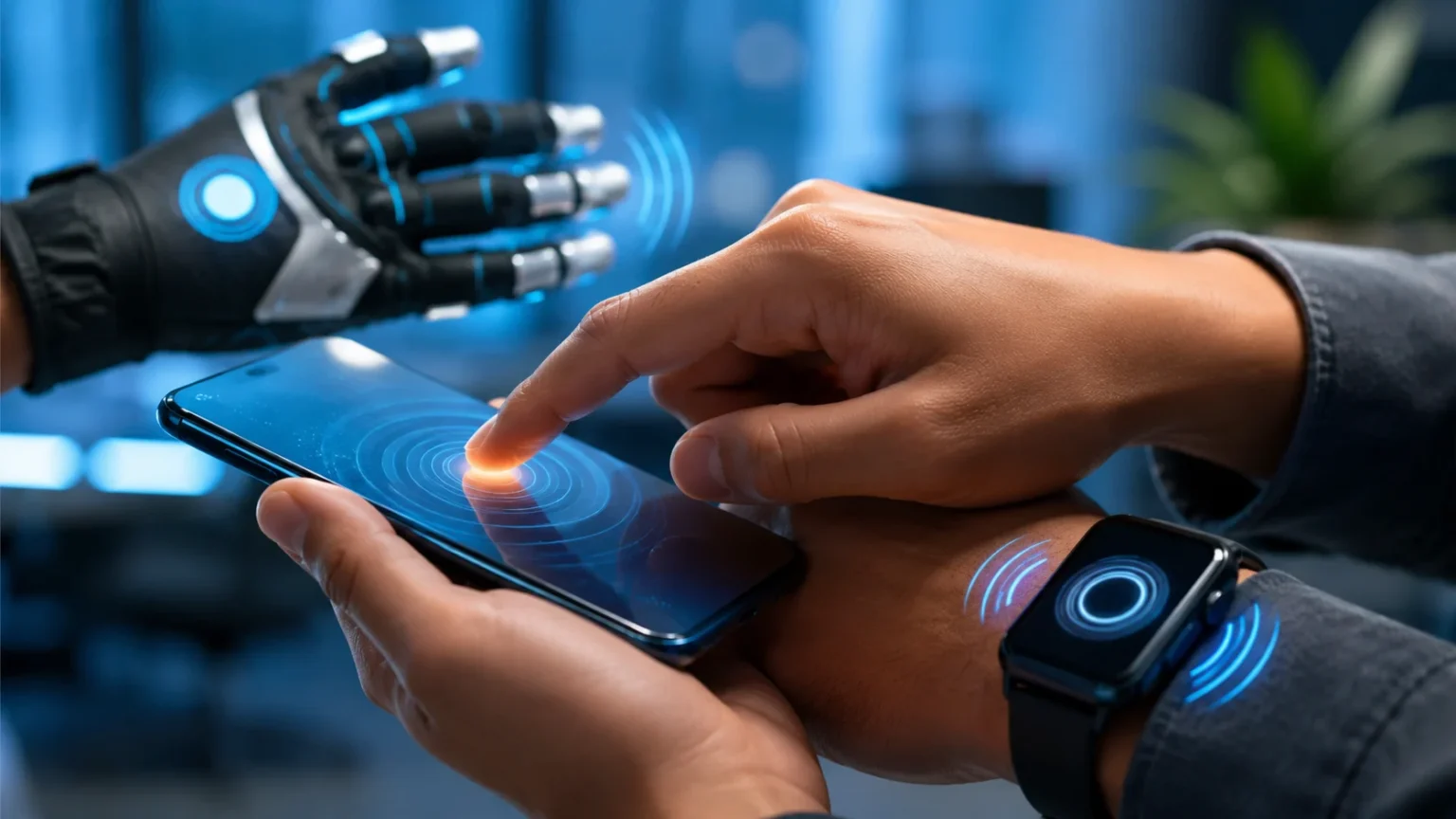

What Are Haptics? How the Technology Works
Haptics is the technology that uses touch, vibration, motion, and force to communicate information through physical sensations. You experience haptic technology whenever your smartphone vibrates after you tap a virtual button, a game controller responds to an explosion, or a smartwatch delivers a subtle pulse to your wrist. Modern haptic feedback has evolved far beyond simple buzzing motors and now includes highly precise effects that can imitate textures, impacts, resistance, movement, and other real-world sensations. These technologies are becoming increasingly important in smartphones, virtual reality, gaming, automobiles, healthcare, robotics, and industrial systems. This guide explains what haptics are, how haptic technology works, the different types of haptic feedback, common applications, benefits, limitations, and what the future of touch-based digital interaction may look like.
What Are Haptics?
Haptics refers to technologies designed to create or reproduce the sense of touch through mechanical forces, vibrations, motion, or other physical sensations. The word comes from the Greek concept of touch, and modern haptic systems are designed to make digital interactions feel more physical. Instead of receiving information only through sight or sound, users can feel a response directly through their skin or muscles. A smartphone vibration, for example, can confirm that a virtual button has been pressed without requiring the user to look at the screen. Haptic feedback therefore adds another sensory communication channel between people and electronic devices.
The simplest form of haptic feedback is vibration. Early mobile phones commonly used small vibration motors to alert users to incoming calls or messages without producing sound. Modern devices use more precise actuators that can generate short taps, pulses, clicks, and patterned vibrations with significantly greater control. This allows designers to create different tactile sensations for different actions. A smartphone might produce one type of pulse when typing on a virtual keyboard and another when a payment is completed. These subtle differences help users recognize actions more naturally while making digital controls feel more responsive and deliberate.
Haptic technology is not limited to vibrations. Advanced systems can create force, pressure, resistance, temperature changes, surface movement, and sensations resembling texture. A steering wheel may push against a driver’s hands when a lane departure system detects unintended movement, while a robotic surgical device can provide resistance representing contact with tissue. Virtual reality controllers may simulate the sensation of pulling a trigger, touching a surface, or striking an object. Researchers are also developing wearable haptic devices capable of creating sensations across the hands, arms, or body. The broader goal is to make interactions with digital or remote environments feel increasingly physical.
Haptics should not be confused with the general concept of a touchscreen. A touchscreen detects where a person touches a display, while haptic technology provides a physical response to that interaction. Many modern devices combine both technologies so that users receive immediate tactile confirmation when they tap, swipe, drag, or press something on the screen. This feedback can make a flat glass surface feel as though it contains distinct controls. Some systems can even alter vibration patterns to suggest different textures or boundaries. By connecting touch input with tactile output, haptics helps digital interfaces become more intuitive and engaging.
The importance of haptics continues to increase as computing moves beyond traditional screens and keyboards. Virtual reality, augmented reality, wearable computing, autonomous vehicles, robotics, and spatial interfaces all require new ways for people to understand what digital systems are doing. Visual information alone can become overwhelming when multiple alerts or controls compete for attention. Haptic feedback can communicate information quietly and immediately without requiring users to look away from what they are doing. This ability makes haptics valuable for entertainment as well as accessibility, safety, productivity, and communication. As devices become more immersive, touch is becoming an increasingly important part of digital experience design.
How Does Haptic Technology Work?
Haptic technology works by converting digital instructions into physical sensations that the human body can detect. When software determines that a haptic response should occur, it sends an electrical signal to a component called an actuator. The actuator converts electrical energy into mechanical movement, vibration, force, or another physical effect. That motion travels through the device and reaches the user’s skin, muscles, or joints. The brain interprets the sensation as a tap, buzz, click, impact, or other form of feedback. The entire process often happens within milliseconds, allowing the physical response to feel directly connected to the user’s action.
A simple example occurs when you press a virtual key on a smartphone keyboard. The operating system detects the touchscreen input and determines that a tactile response has been enabled for typing. It then sends a short command to the phone’s haptic actuator, which rapidly moves and produces a small physical pulse. You feel that pulse through your fingertip or hand, creating the impression that the virtual key has responded. The movement may last only a fraction of a second. When this timing is accurate, the sensation feels natural because visual, auditory, and tactile feedback occur almost simultaneously.
Different actuator technologies produce different qualities of haptic feedback. Traditional devices often use an eccentric rotating mass, or ERM motor, containing a small uneven weight attached to a rotating motor shaft. When the weight spins, it creates vibration through the device. More advanced products commonly use linear resonant actuators, or LRAs, which move a mass back and forth along a straight path. LRAs can start and stop more quickly than many conventional vibration motors, allowing sharper and more controlled effects. Other technologies include piezoelectric actuators, electrostatic systems, ultrasonic haptics, and specialized force-feedback mechanisms designed for more sophisticated applications.
Software plays an equally important role because the actuator alone cannot determine what sensation should be produced. Developers create haptic patterns by specifying factors such as intensity, frequency, duration, timing, and repetition. A strong collision in a video game may produce a powerful vibration, while a menu selection might generate only a brief tap. Well-designed patterns allow users to associate specific sensations with particular events. Operating systems and development platforms often provide standardized haptic APIs that help developers create consistent experiences. Careful software design is essential because excessive or poorly timed feedback can become distracting rather than useful.
The human nervous system completes the haptic experience by interpreting the physical stimulation created by the device. Receptors in the skin detect pressure, vibration, stretching, temperature, and other changes, while receptors in muscles and joints provide information about movement and position. These signals travel through nerves to the brain, where they are combined with visual and auditory information. A convincing haptic effect does not always need to perfectly reproduce reality because the brain naturally integrates signals from multiple senses. If a user sees a virtual object while simultaneously feeling an appropriate vibration or force, the combined experience can create a surprisingly believable sense of physical interaction.
Types of Haptic Feedback
Vibrotactile feedback is the most common type of haptic technology used in consumer electronics. It creates sensations by generating controlled vibrations against the skin. Smartphones, smartwatches, game controllers, fitness trackers, and handheld devices frequently use vibrotactile feedback because the required hardware can be compact and relatively energy-efficient. Different combinations of vibration intensity, frequency, and duration can communicate different messages. For example, a smartwatch may use one pattern for a notification and another for navigation instructions. Vibrotactile haptics is particularly useful when information needs to be communicated silently or when users cannot continuously look at a display.
Force feedback creates physical resistance or movement that users can feel through a device. Gaming steering wheels are a familiar example because the wheel can resist turning, shake over simulated rough surfaces, or pull in response to virtual vehicle behavior. Flight simulators, robotic controls, training systems, and medical devices also use force feedback to represent physical interaction more realistically. Unlike basic vibration, force feedback can influence the user’s movement rather than simply stimulating the skin. This makes it particularly valuable when the direction or magnitude of a force carries meaningful information. Advanced systems can dynamically adjust resistance according to conditions occurring within a virtual or remote environment.
Kinesthetic haptics focuses on sensations involving muscles, joints, movement, and body position. These systems may apply forces that make users feel as though they are lifting, pushing, pulling, or interacting with physical objects. Robotic exoskeletons, rehabilitation equipment, virtual reality gloves, and remote manipulation systems can use kinesthetic feedback. If a user reaches toward a virtual wall, for instance, a wearable mechanism could create resistance that prevents the hand from moving further. The sensation provides more information than vibration alone because it influences how the body moves. Kinesthetic haptics can create highly immersive experiences, but the hardware is generally more complex than conventional vibration-based systems.
Surface haptics attempts to change how a touchscreen or flat surface feels when a person moves a finger across it. Technologies such as electrostatic friction and ultrasonic vibration can alter the perceived resistance between the finger and the display. This can make different areas of a smooth screen feel more distinct even though the physical surface remains flat. Designers may use surface haptics to simulate buttons, boundaries, textures, or directional cues. The technology could eventually improve accessibility and make touchscreen controls easier to operate without constant visual attention. Researchers are also exploring methods for creating more realistic virtual textures that could be useful in retail, education, design, and entertainment.
Mid-air haptics creates tactile sensations without requiring the user to hold or touch a physical device. Some systems use carefully directed ultrasonic waves to create pressure points that can be felt on the hands. By controlling where those waves intersect, the system can generate patterns that feel like buttons, shapes, pulses, or moving sensations in empty space. Mid-air haptic interfaces could support touchless controls in vehicles, public displays, medical environments, and virtual reality applications. The technology remains less common than conventional vibration systems, partly because creating detailed sensations through air is technically challenging. Nevertheless, it demonstrates how haptic feedback can extend beyond traditional physical controllers.
Key Components of a Haptic System
The actuator is one of the most important components in any haptic system because it generates the physical sensation experienced by the user. Depending on the design, an actuator may produce vibration, force, movement, pressure, or changes in surface friction. Consumer devices often use compact LRAs or other miniature actuators because space and power consumption are important considerations. Larger systems such as driving simulators and industrial controllers can use motors capable of producing much stronger forces. The quality of an actuator affects how quickly the sensation begins and stops, how precisely it can be controlled, and how many different tactile effects the device can realistically create.
Sensors are also important because advanced haptic systems frequently need to understand what the user is doing before producing an appropriate response. Touchscreens detect finger position, while motion sensors can track acceleration, rotation, orientation, or hand movement. Pressure sensors can determine how strongly a user is pressing an object, and position sensors can measure movement within a controller or robotic device. This information is sent to software that decides how the system should respond. In interactive haptics, sensing and feedback form a continuous loop. The user acts, the device measures the action, the software interprets it, and the actuator generates a physical response.
A processing system coordinates sensor input, software instructions, and actuator output. In a smartphone, the main processor and specialized controllers can handle this communication extremely quickly. In more complex systems, dedicated haptic processors may help generate detailed effects with minimal delay. Processing speed matters because noticeable lag between an action and a physical response can weaken the illusion of direct interaction. This is especially important in virtual reality, surgical robotics, and high-performance gaming. The system must calculate what users are doing and adjust the feedback almost immediately. Low latency helps tactile sensations remain synchronized with images, sound, and physical movement.
Haptic software determines how physical hardware should behave in different situations. Developers can create libraries of effects representing taps, clicks, impacts, alerts, textures, resistance, or environmental events. Game developers may synchronize vibration with footsteps, weapons, vehicle movement, and collisions, while mobile interface designers may use subtle pulses to confirm selections. Advanced applications can calculate haptic responses dynamically based on virtual physics or real-world sensor information. The quality of these algorithms strongly influences whether feedback feels meaningful or artificial. Good haptic design uses physical sensations selectively and consistently so that users gradually learn what different patterns communicate.
The mechanical design of the device also affects haptic performance because vibrations and forces must travel through physical materials before reaching the user. The placement of actuators, rigidity of the housing, weight of components, and materials used in construction can significantly change how feedback feels. A powerful actuator can still produce poor results if its vibrations are absorbed or distributed incorrectly. Engineers therefore consider hardware structure and tactile design together. In wearable devices, comfort and skin contact become additional considerations because feedback may be delivered continuously for long periods. Effective haptic systems require coordination between mechanical engineering, electronics, software development, industrial design, and human sensory perception.
Haptics in Smartphones and Wearable Devices
Smartphones are among the most widespread examples of haptic technology because users interact with them hundreds of times throughout the day. Modern phones use haptic feedback for virtual keyboards, navigation gestures, notifications, security confirmations, camera controls, gaming, and accessibility features. A subtle vibration can confirm an action even when there is no physical button to move beneath the finger. More advanced actuators can create short, precise sensations that feel closer to mechanical clicks than traditional buzzing. These responses improve the perception of responsiveness and can make software controls easier to understand. Haptics has therefore become an important part of modern mobile user-interface design.
Virtual keyboards demonstrate how haptics can make touchscreen interaction feel more physical. Unlike mechanical keyboards, glass displays provide no natural movement when a key is pressed. Small tactile pulses can compensate for this lack of physical travel by giving users immediate confirmation after each touch. The feedback may help some people type more confidently because they do not need to depend entirely on visual confirmation. However, the effect must be carefully tuned because strong vibrations on every keystroke could quickly become annoying. Good mobile haptics tends to be brief and subtle. The goal is to support interaction rather than constantly remind users that the haptic mechanism is operating.
Smartwatches and fitness trackers use haptics particularly effectively because they remain in direct contact with the wearer’s skin. A watch can deliver discreet notifications through carefully designed taps that may be noticeable to the wearer without disturbing other people. Navigation applications can use different patterns to indicate upcoming left and right turns, reducing the need to look repeatedly at a screen while walking. Fitness applications may signal workout intervals, heart-rate zones, or completed goals. Because wrist devices have small screens, tactile communication can reduce visual dependence. Haptics therefore helps wearable devices deliver useful information while remaining compact, quiet, and relatively unobtrusive.
Haptic feedback can also improve accessibility for people who have difficulty relying on visual or auditory interfaces. Different vibration patterns can communicate alerts, navigation cues, successful actions, or changes in device status. Screen-reading and accessibility tools may combine spoken information with tactile confirmation, giving users multiple ways to understand an interface. Wearable haptic systems are being investigated for navigation guidance and environmental awareness as well. Designing accessible haptics requires careful testing because users may perceive vibration intensity and patterns differently. Nevertheless, tactile feedback offers an additional communication channel that can make technology more inclusive when combined thoughtfully with other accessibility features.
Battery consumption and physical space remain important engineering challenges for mobile haptic systems. Actuators require electrical power and must fit inside devices already packed with processors, cameras, batteries, antennas, speakers, and sensors. Manufacturers therefore seek mechanisms capable of producing strong, precise effects without consuming excessive energy or occupying too much internal space. Software can also reduce power use by limiting unnecessary vibration and controlling effect duration. The challenge becomes even greater for thin wearable devices with very small batteries. Advances in actuator efficiency, materials, and control systems are helping designers deliver more detailed haptic experiences without significantly sacrificing battery life or device portability.
Haptics in Gaming, Virtual Reality and Augmented Reality
Gaming has played a major role in making haptic feedback familiar to consumers. Game controllers have used vibration for decades to represent explosions, collisions, weapon recoil, vehicle movement, and environmental effects. Modern controllers can create far more detailed feedback, allowing different parts of a device to produce distinct sensations. Some systems can also change trigger resistance according to actions occurring inside the game. Pulling a virtual bowstring, accelerating a vehicle, or firing different weapons may therefore feel physically different. These effects strengthen the connection between player input and events on screen, making gameplay feel more responsive and immersive.
Virtual reality creates an even greater need for haptics because users expect to interact physically with objects they can see around them. Visual immersion can be convincing until a player reaches toward a virtual object and feels nothing. Handheld controllers partly solve this problem by providing vibration when virtual contact occurs. More advanced VR haptic devices include gloves, vests, sleeves, shoes, and full-body systems that can deliver tactile sensations across larger areas. These devices may simulate impact, pressure, movement, or resistance. Combining visual, auditory, and tactile feedback can make virtual experiences feel more believable and improve the user’s sense of presence inside a simulated environment.
Haptic gloves are an important area of virtual reality development because the hands play such a central role in interacting with the physical world. Some gloves use vibration motors positioned near the fingertips, while more complex designs apply resistance when users grasp virtual objects. If someone picks up a virtual ball, for example, the glove may restrict finger movement at the point where the digital surface should exist. This creates the impression that the hand has encountered a real object. Achieving realistic sensations remains challenging because human touch is extremely sensitive. Weight, texture, temperature, flexibility, and shape all contribute to how real objects feel.
Augmented reality can use haptics to connect digital information with physical surroundings. AR systems overlay virtual content onto the real world through phones, glasses, headsets, or other displays. Adding tactile responses could allow users to feel interactions with virtual controls or receive navigation instructions while still paying attention to their environment. Industrial workers might receive a vibration when approaching the correct component during an assembly process, while technicians could be guided through complicated repairs. Haptic feedback can reduce the amount of visual information that must be shown at once. This makes tactile cues especially valuable when users need to keep their eyes focused on physical tasks.
The challenge for immersive haptics is creating convincing sensations without requiring bulky, expensive, or uncomfortable equipment. Simulating a lightweight tap is relatively easy compared with reproducing the weight of a large object or the complex texture of a fabric surface. Physical forces must also be generated safely so that users are not injured by unexpected resistance or movement. Wireless latency, battery life, tracking accuracy, and device compatibility add further complications. Despite these limitations, haptics remains one of the most promising areas for improving VR and AR experiences. Better tactile technology could eventually make digital environments feel significantly more realistic and useful.
Haptics in Cars, Healthcare and Industry
Modern vehicles increasingly use haptic feedback to communicate with drivers without requiring constant visual attention. Steering wheels, seats, pedals, touchscreens, and control surfaces can all provide tactile alerts or confirmations. A steering wheel may vibrate when a vehicle begins drifting out of its lane, while a seat may produce directional pulses when parking sensors detect nearby obstacles. Touch-sensitive dashboard controls can generate simulated clicks so that drivers know a command has been registered. These feedback mechanisms can reduce dependence on visual alerts when designed correctly. In safety-focused environments such as driving, tactile information can be valuable because it communicates directly through physical contact.
Automotive haptics is also becoming important as manufacturers replace traditional buttons with larger digital displays. Physical switches naturally provide tactile confirmation because users can feel them move and click. Flat screens lack this mechanical response, making them harder to operate without looking. Haptic touchscreens can recreate some of that feedback through localized vibration or surface movement. Future vehicle interfaces may use more sophisticated tactile patterns to distinguish climate controls, navigation functions, entertainment features, and safety settings. Designers must avoid overwhelming drivers with unnecessary signals. Effective automotive haptics should improve usability while helping users maintain attention on the road.
Healthcare applications of haptic technology include medical training, rehabilitation, surgery, and remote robotic procedures. Surgical simulators can allow trainees to practice procedures while feeling resistance that represents tissue, instruments, or anatomical structures. This additional sensory information can make simulation more realistic than visual training alone. Robotic surgery systems may provide forms of force or tactile feedback to help surgeons understand how instruments interact with tissue. Rehabilitation devices can also use controlled resistance and movement to guide patients through exercises. Because medical applications can involve safety-critical decisions, haptic accuracy, reliability, and careful validation are particularly important.
Industrial haptics can assist workers who operate machinery, robots, remote equipment, or complex assembly systems. A remote operator controlling a robotic arm may receive force feedback when the machine contacts an object, making manipulation more precise. Wearable systems can guide employees through assembly tasks by providing tactile cues when they move toward the correct location. Haptic alerts may also warn workers about hazards in loud environments where audio signals are difficult to hear. These applications can improve situational awareness while reducing dependence on visual displays. Industrial systems often need particularly durable haptic hardware because they may operate in demanding environments for extended periods.
Remote robotics demonstrates how haptics can extend a person’s sense of touch beyond their own body. Sensors mounted on a robot can measure forces or contact with objects and transmit that information back to the operator through a haptic controller. The user may then feel resistance that corresponds to what the robot is encountering. This approach can be useful for hazardous environments, underwater exploration, manufacturing, space operations, and specialized medical procedures. Network delays remain a major technical challenge because force feedback must arrive quickly to feel stable and natural. As communication networks and robotics improve, haptic teleoperation could become increasingly practical across many industries.
Benefits of Haptic Technology
One major benefit of haptic technology is improved interaction feedback. Digital interfaces sometimes leave users uncertain about whether a touch, gesture, or command has been recognized. A short tactile response can immediately confirm that the system received the input. This reduces the need to watch closely for visual changes after every action. In smartphones, automotive controls, wearable devices, and industrial interfaces, that confirmation can make interactions feel faster and more deliberate. Well-designed haptic feedback can also reduce repeated taps caused by uncertainty. The result is often an interface that feels more responsive even when the underlying software has not changed significantly.
Haptics can increase immersion by connecting digital events with physical sensations. In gaming and virtual reality, feeling an impact or resistance at the same moment it appears visually can make an experience seem more believable. The brain naturally combines information from several senses, so tactile effects can strengthen visual and auditory cues. This multisensory approach is also useful outside entertainment. Training simulations can provide more realistic practice for drivers, pilots, technicians, surgeons, and equipment operators. When physical skills are important, learning through touch can provide information that images and spoken instructions alone may not fully communicate.
Another benefit is the ability to communicate information discreetly. Haptic alerts do not necessarily create noise and may not require users to look at a display. A smartwatch can silently notify its wearer during a meeting, while navigation systems can provide directional signals through wrist vibrations. Drivers can receive warnings through steering wheels or seats instead of adding another visual message to a busy dashboard. This makes haptics particularly useful when visual or auditory attention is already occupied. Designers can create recognizable tactile patterns so that users understand information through touch alone. Such systems can reduce interruptions while still delivering important notifications.
Haptic technology can also support accessibility by providing an alternative way to receive digital information. People who cannot easily use visual feedback may benefit from vibration patterns, tactile navigation cues, or touch-based interface confirmations. Users with hearing difficulties may also use haptic alerts as an additional notification channel. Accessibility applications work best when tactile information is combined with customizable settings because sensitivity and preference vary significantly between individuals. Stronger vibration is not automatically better. Thoughtful haptic design focuses on clarity, consistency, and user control so that tactile cues genuinely improve the experience rather than introducing unnecessary complexity.
Safety and precision can be additional benefits in specialized environments. A surgeon receiving resistance through a robotic controller may gain useful information about interaction forces, while an industrial operator can receive immediate tactile warnings when equipment reaches a limit. Drivers may notice a steering-wheel vibration faster than a subtle icon on a dashboard. Haptic feedback can also reduce the amount of time workers spend looking away from physical tasks to check screens. These benefits depend heavily on good system design and reliable hardware. When tactile signals are meaningful, timely, and easy to distinguish, they can become a powerful addition to human-machine communication.
Limitations and Challenges of Haptics
Creating realistic tactile sensations is technically difficult because human touch is extremely complex. People can detect subtle differences in pressure, temperature, vibration, texture, weight, surface shape, and movement. A small actuator inside a smartphone can reproduce only a limited portion of these sensations. Even advanced gloves and force-feedback systems struggle to recreate the full physical experience of holding real objects. Designers therefore often rely on simplified tactile cues that suggest an interaction rather than perfectly reproduce it. The brain can compensate when visual and auditory information supports those cues, but creating truly realistic digital touch remains a significant engineering challenge.
Cost is another limitation, particularly for sophisticated haptic systems. Basic vibration motors are inexpensive, but devices capable of producing precise force feedback or complex tactile sensations require additional actuators, sensors, processors, mechanical structures, and software. High-end VR gloves and professional simulators can therefore cost considerably more than standard controllers. Manufacturers must decide whether the improved experience justifies additional hardware and development expenses. Consumer adoption can be difficult if devices are expensive, bulky, or compatible with only a limited number of applications. Lower-cost components and broader standards will be important for expanding advanced haptic technology beyond specialized markets.
Power consumption and device size also create challenges. Wearable haptic products need batteries small enough to remain comfortable while still powering actuators capable of producing noticeable sensations. Strong mechanical feedback generally requires more energy than subtle vibration, which can shorten operating time. Adding multiple actuators may also increase device weight and complexity. Engineers are therefore working to improve actuator efficiency while developing lightweight materials and smarter control methods. Software can help by activating haptics only when necessary. Efficient hardware will be particularly important for future gloves, smart clothing, and other wearable systems expected to operate continuously during extended use.
Poorly designed haptics can cause user fatigue, irritation, or confusion. If every action produces a strong vibration, users may quickly disable the feature because it becomes distracting. Multiple tactile signals can also become difficult to distinguish when patterns are too similar. Designers must consider how frequently feedback occurs and whether users can understand its meaning without extensive training. Personal sensitivity also varies, so an effect that feels subtle to one person may feel uncomfortable to another. Providing adjustable intensity and the ability to disable unnecessary effects improves usability. Effective haptic design generally uses tactile feedback selectively rather than treating vibration as decoration.
Standardization is another challenge as haptic technology becomes more advanced. Different devices have different actuators, capabilities, response times, and physical designs, meaning the same software command may not feel identical across platforms. Developers creating games, virtual environments, or applications must account for this hardware variation. Industry standards and shared development frameworks can reduce the problem, but sophisticated haptic experiences often still require device-specific tuning. Compatibility becomes especially important for wearables and virtual reality accessories. A fragmented ecosystem could limit content availability and discourage adoption. Broader interoperability would allow developers to create tactile experiences that function consistently across more devices.
The Future of Haptic Technology
Future haptic systems are likely to become more precise, localized, and capable of reproducing a wider range of sensations. Instead of making an entire device vibrate, next-generation interfaces may generate tactile effects only beneath specific fingertips or areas of the skin. Improvements in piezoelectric materials, ultrasonic systems, electrostatic surfaces, soft robotics, and miniature actuators could enable thinner and more responsive hardware. These technologies may make flat displays feel as though they contain physical textures or buttons. Users could potentially distinguish interface elements by touch without looking directly at them. Such advancements would significantly expand the role of haptics in everyday computing.
Wearable haptics may also become more common as virtual and spatial computing technologies develop. Gloves, wristbands, vests, sleeves, footwear, and smart clothing could provide tactile feedback across larger areas of the body. Instead of feeling only a vibration in a handheld controller, users could experience directional taps, pressure, impacts, or movement associated with virtual environments. Training and collaboration could benefit as well as entertainment. Engineers might interact with remote equipment through tactile interfaces, while students could explore simulations that combine sight, sound, and touch. Comfort, affordability, and battery life will determine how quickly these wearable technologies reach mainstream consumers.
Artificial intelligence may improve haptic experiences by helping systems decide which tactile effects are appropriate for different interactions. Instead of relying entirely on predefined vibration patterns, future systems could potentially generate feedback dynamically from visual scenes, virtual physics, user behavior, or environmental sensors. A device might adapt vibration intensity according to a person’s preferences or automatically create tactile representations of digital objects. Machine learning could also help distinguish meaningful physical events from sensor noise in robotic and medical applications. These approaches remain dependent on accurate hardware. Nevertheless, combining intelligent software with advanced actuators could produce more responsive and personalized tactile experiences.
Haptic communication may eventually become a more significant part of remote social interaction. Current communication tools primarily transmit text, images, video, and audio, but researchers continue exploring ways to transmit physical gestures through connected devices. A wearable system could theoretically reproduce a simple tap or pressure pattern sent by another person from a distant location. Such technology would not replace real physical contact, but it could add a new sensory dimension to remote communication. Similar concepts could support remote collaboration when workers need to demonstrate physical movements. Privacy, consent, comfort, and cultural expectations would need careful consideration as these forms of tactile communication develop.
The long-term direction of haptic technology is toward interfaces that engage more of the human sensory system instead of relying mainly on screens and speakers. Touch provides information about objects and environments in ways vision alone cannot fully reproduce. As digital experiences become increasingly immersive, haptics can help bridge the gap between virtual actions and physical perception. The greatest progress will likely come from combining better hardware, faster processing, advanced software, improved materials, and a deeper understanding of human sensory perception. Haptics will therefore remain an important field within human-computer interaction. The technology may ultimately make digital environments feel less like information we observe and more like spaces we can physically experience.
Frequently Asked Questions About Haptics
What does haptics mean?
Haptics refers to technology that creates physical sensations such as vibration, force, pressure, or movement to communicate information through touch. It allows digital devices to provide tactile feedback in response to user actions or events.
What is an example of haptic technology?
A common example is the small tactile pulse you feel when pressing a virtual button or typing on a smartphone keyboard. Game-controller vibrations, smartwatch taps, force-feedback steering wheels, and VR haptic gloves are other examples.
What is the difference between haptics and vibration?
Vibration is one form of haptic feedback, but haptics is a much broader category. Advanced haptic systems can also create resistance, pressure, movement, surface friction, and other sensations beyond simple vibration.
Why is haptic feedback used in smartphones?
Smartphones use haptic feedback to confirm taps, gestures, keyboard input, notifications, and other actions without relying only on visual or audio signals. Precise haptics can make flat touchscreen controls feel more responsive and intuitive.
Where is haptic technology used?
Haptics is used in smartphones, smartwatches, gaming controllers, virtual reality, augmented reality, automobiles, medical simulators, robotic systems, industrial equipment, and accessibility technologies. Its applications continue expanding as devices become more interactive and immersive.