

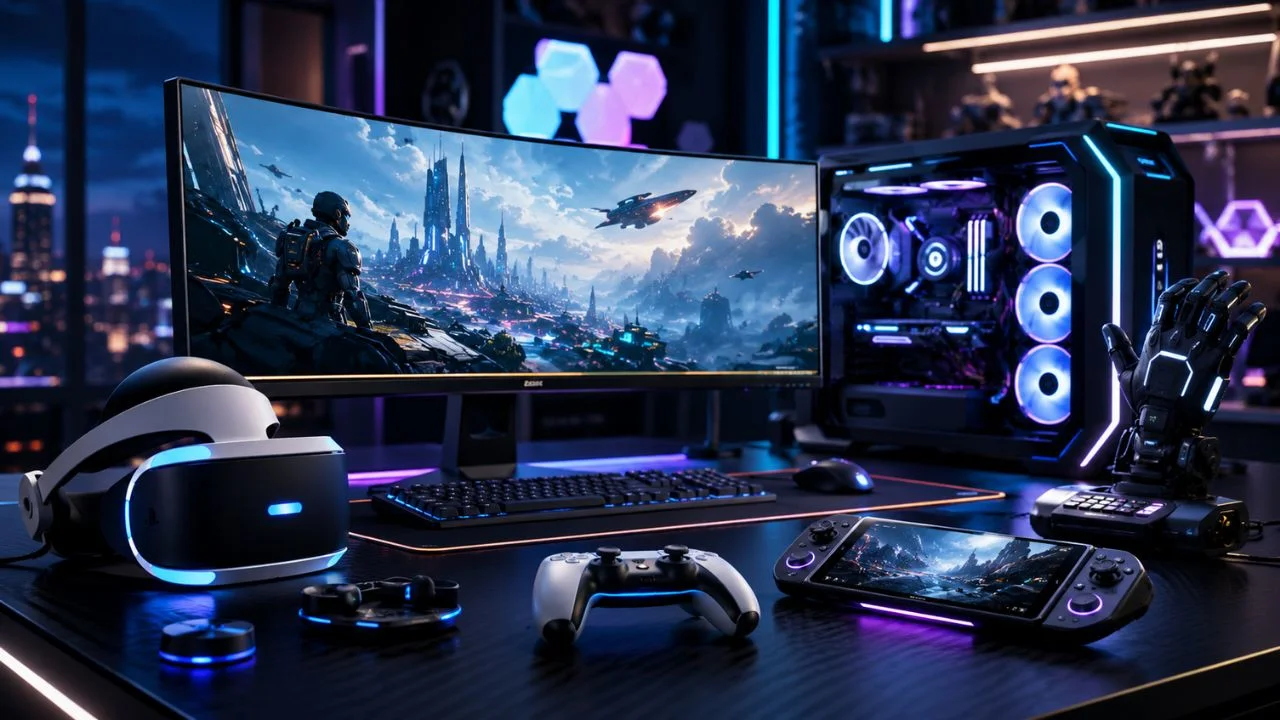

Gaming technology is changing how video games look, feel and respond to players. The latest innovations are not limited to sharper graphics or faster consoles. Artificial intelligence, cloud computing, handheld gaming PCs, virtual reality and advanced controllers are creating more flexible and immersive ways to play.
One of the biggest developments is the growing use of AI-powered rendering. Instead of relying entirely on traditional hardware processing, modern systems can reconstruct images, generate additional frames and improve visual quality through trained AI models. This helps developers balance realistic graphics with smoother frame rates.
Games are also becoming less dependent on a single device. Players can move between consoles, computers, handheld systems, mobile devices and cloud services while keeping their saves, friends and digital libraries connected. This shift is encouraging gaming companies to think in terms of platforms and ecosystems rather than one fixed gaming machine.
As of 2026, some technologies are already widely available, while others are still developing. AI upscaling, cloud gaming, advanced haptics and portable PC gaming are practical today. Fully conversational game characters and highly personalised game worlds are promising, but they still require careful development and testing.
The Biggest Gaming Technology Trends in 2026
The most visible trend is the use of artificial intelligence to improve graphics and performance. Technologies such as neural upscaling and frame generation allow compatible systems to create smoother images without rendering every pixel in the traditional way. This can help demanding games maintain higher frame rates while preserving visual detail.
Another major development is the expansion of gaming beyond consoles and desktop computers. Powerful handheld gaming PCs now run large PC titles, while cloud services stream console-quality games to phones, tablets, browsers and smart televisions. Players have more freedom to choose where and how they access their games.
Immersion is also improving through virtual reality, mixed reality, spatial audio, eye tracking and more detailed controller feedback. Instead of only seeing an action on a screen, players may feel different surfaces through haptic vibrations, experience resistance through adaptive triggers or locate sounds within a three-dimensional environment.
Behind the scenes, game engines are making it easier to create large worlds, realistic characters and detailed lighting. Epic Games has confirmed that Unreal Engine 6 is in development, with the goal of connecting traditional game development, Fortnite creation tools and scalable digital experiences through a shared development pipeline.
AI-Powered Graphics and Neural Rendering
AI-powered graphics are among the most important advances in modern gaming technology. Traditional rendering requires the graphics processor to calculate large amounts of visual information for every frame. Neural rendering uses trained models to reconstruct or enhance parts of an image, reducing some of that processing pressure.
NVIDIA’s DLSS technology uses artificial intelligence to improve image quality and increase gaming performance on compatible RTX graphics cards. DLSS 4 introduced transformer-based models and Multi Frame Generation, while DLSS 4.5 added further improvements to image reconstruction and dynamic frame generation.
Sony is using a similar AI-supported approach through PlayStation Spectral Super Resolution. The upgraded PSSR technology for PS5 Pro analyses frames pixel by pixel to improve image clarity, motion stability and fine detail while helping supported games maintain stronger performance.
These systems do not mean that graphics hardware is becoming unimportant. Powerful processors are still needed to create the original scene, calculate physics and manage complex effects. AI rendering works alongside the hardware, helping developers achieve a better balance between high resolution, realistic visuals and responsive gameplay.
Ray Tracing and Path Tracing Are Becoming More Realistic
Ray tracing simulates the behaviour of light as it reflects from surfaces, passes through materials and creates shadows. It can produce more convincing reflections and lighting than many traditional techniques. However, ray tracing requires substantial processing power, particularly when it is used across an entire game environment.
Path tracing is a more demanding form of light simulation that calculates multiple light interactions throughout a scene. It can create highly realistic global illumination, reflections and shadows. The challenge is maintaining a playable frame rate while calculating enough light paths to produce a stable and detailed image.
AI upscaling, frame generation and ray reconstruction are making these effects more practical. Instead of calculating every visual detail at full resolution, the system can render a lower-resolution frame and use AI to restore information. This allows developers to introduce advanced lighting without making performance completely inaccessible.
The result is a gradual move towards lighting that reacts naturally to changing environments. A room may become illuminated by light reflecting from a coloured wall, while wet streets can show accurate reflections from moving vehicles. NVIDIA describes its current RTX platform as combining path tracing with neural rendering to improve both realism and speed.
Smarter NPCs and AI-Driven Game Characters
Non-player characters traditionally follow scripts, dialogue trees and predetermined behavioural rules. These systems can create memorable characters, but players often discover their limitations after repeating conversations. Generative AI may allow future NPCs to respond more naturally to unexpected questions and changing situations.
NVIDIA ACE is one example of technology being developed for intelligent game characters. It combines models for speech, language, decision-making and animation, helping developers create characters that can hold conversations and respond to information within the game world.
AI-controlled companions may eventually remember previous events, understand player goals and adjust their behaviour. Enemies could also study common tactics and respond differently instead of repeating the same movements. NVIDIA has demonstrated ACE concepts involving characters that can perceive, plan and take actions based on gameplay conditions.
However, this technology remains more limited than some marketing claims suggest. Developers must control what characters can say, protect the story’s tone and prevent inappropriate responses. AI NPCs are more likely to support carefully designed experiences than replace professional writers, actors, animators and quest designers.
Cloud Gaming Is Becoming More Practical
Cloud gaming runs a video game on remote servers and streams the visual output to the player’s device. The player sends control inputs through the internet, while the server performs the demanding processing. This can allow high-quality games to run on devices that would not normally have enough local power.
Xbox Cloud Gaming currently supports game streaming across compatible phones, tablets, computers, browsers and smart televisions. Microsoft also describes cloud technology as part of a wider ecosystem in which a player’s games, progress, identity and friends can remain available across different devices.
The main advantage is convenience. Players do not always need to download a large game or purchase a powerful gaming computer. Cloud gaming can also make it easier to begin playing quickly, test a title before installing it or continue a game while travelling away from a primary console.
Internet quality remains the biggest limitation. Slow connections, unstable Wi-Fi and distant servers can create input delay, reduced image quality or interruptions. Cloud gaming works best when the player has a fast and consistent connection, meaning it has not yet replaced local gaming for every user or competitive situation.
Handheld Gaming PCs Continue to Grow
Handheld PC gaming has developed into one of the strongest hardware trends of recent years. These devices combine a built-in screen, controller inputs, computer processors and access to PC game libraries. Players can run large releases without remaining at a traditional desk or television.
Modern handhelds increasingly focus on a console-like experience. SteamOS provides gamepad-friendly navigation, quick suspend and resume, cloud saves and direct access to a Steam library. This can reduce the difficulty of navigating a desktop operating system on a smaller touchscreen.
At CES 2026, Lenovo announced a new Legion Go powered by SteamOS, featuring an OLED display, detachable controllers and hardware designed for demanding PC games. The device reflects the broader movement towards portable systems that offer PC flexibility with simplified console-style controls.
Handheld systems still involve compromises. Higher performance can reduce battery life, while powerful processors require cooling and add weight. Developers and hardware companies are therefore focusing on more efficient chips, variable power modes, OLED screens and software that automatically balances image quality with battery usage.
Virtual Reality and Mixed Reality Are Becoming More Natural
Virtual reality places players inside a digital environment through a headset and tracked controllers. Mixed reality adds virtual objects to a view of the physical room. Improvements in display quality, tracking, passthrough cameras and processing are making these experiences more comfortable and interactive.
Modern VR systems can track head movement, controller position and hand actions with increasing precision. The PlayStation VR2 platform combines eye tracking, headset feedback, controller haptics, adaptive triggers and finger-touch detection to create more detailed physical interaction.
Eye tracking can also support foveated rendering. The headset identifies where the player is looking and concentrates visual detail in that area while reducing detail in peripheral vision. This allows the system to use its processing resources more efficiently without making the complete image look noticeably lower in quality.
The next step is likely to include lighter headsets and better mixed-reality games. Spatial-computing platforms are encouraging developers to build digital experiences that interact with a player’s surroundings instead of hiding them completely. Apple, for example, provides visionOS tools for creating spatial games and applications for Vision Pro.
Haptic Feedback Makes Games Feel More Physical
Haptic technology uses vibration and physical resistance to communicate information through a controller or wearable device. Traditional controllers mainly provided basic rumble effects. Modern systems can create more detailed sensations based on movement, surface texture, weapon behaviour and environmental events.
Adaptive triggers can change resistance depending on an in-game action. Drawing a bow may require increasing pressure, while a damaged vehicle pedal may feel harder to press. Developers can use these effects to provide information that would otherwise depend only on sound or visual indicators.
Advanced haptic feedback can also create directional or layered sensations. Players may feel footsteps approaching, distinguish different weapons or notice changes in terrain. PlayStation VR2 and the DualSense controller use combinations of haptics and trigger resistance to strengthen the relationship between player actions and on-screen events.
Poorly implemented haptics can become tiring or distracting, so players usually need adjustable settings. The best implementations support the gameplay instead of constantly demanding attention. Haptic effects are particularly effective when they communicate useful information while also improving immersion.
Spatial Audio Is Changing How Players Hear Games
Spatial audio places sounds within a three-dimensional environment rather than only separating them into left and right channels. Players may hear whether footsteps are above, behind or beside them. This can improve immersion while also providing useful information during competitive and exploration-based games.
Audio technology is becoming important for accessibility as well as realism. Sound can guide players towards objectives, identify nearby objects and communicate changes that would normally appear visually. This gives game designers another way to make environments understandable without relying on a crowded user interface.
The upcoming PlayStation title Coloratura demonstrates how sound can become the foundation of gameplay. Its developers designed three-dimensional navigation, positional object sounds and audio-based objectives so that blind and sighted players can explore the same environment through listening.
Headphones provide the clearest spatial effect, but compatible speakers can also reproduce directional sound. The experience depends on careful sound design rather than hardware alone. Developers must position effects accurately and make important audio cues distinguishable from background music and environmental noise.
New Game Engines Are Building Larger Digital Worlds
Game engines provide the tools used to create graphics, physics, animation, audio and gameplay systems. Improvements to these engines allow developers to build more detailed environments without creating every technical system from the beginning. This can reduce production time while raising visual expectations.
Unreal Engine 5 introduced technologies such as Nanite for detailed geometry and Lumen for dynamic lighting. Epic has continued improving open-world creation, animation and performance, with recent engine versions focusing on large environments that can run more smoothly on current gaming hardware.
Epic has also revealed that Unreal Engine 6 is in development. Its long-term aim is to connect high-end game production with Fortnite development tools and online ecosystems. Developers may eventually create an experience once and distribute it across traditional platforms, Fortnite or their own connected products.
Better engines do not automatically make game development easy. Detailed worlds still require artists, programmers, designers, writers and testing teams. New tools can remove repetitive technical work, but they may also encourage larger projects that take more time, money and coordination to complete successfully.
Gaming Accessibility Technology Is Improving
Gaming accessibility focuses on allowing people with different visual, hearing, cognitive and motor needs to enjoy games. New technology is expanding beyond basic subtitles and difficulty options. Players can increasingly customise controls, text, audio, visual effects and physical input devices.
Microsoft has continued developing adaptive gaming hardware, including updates for the Xbox Adaptive Joystick and customisable thumbstick components. Modular controls allow players to create input arrangements that better match their range of movement and preferred playing position.
Console software also includes features such as screen readers, chat transcription, mono audio, text enlargement and controller remapping. Developers are introducing options such as reduced camera movement, high-contrast modes, navigation assistance and audio descriptions directly within their games.
Accessibility is increasingly being considered during the design process rather than added shortly before release. This approach can create better experiences for everyone. Adjustable controls, readable text and clear audio cues may help players with disabilities while also supporting beginners, older players and people using different screens or environments.
Cross-Platform Gaming Is Connecting More Players
Cross-platform gaming allows people using different devices to play together. A person on a console may join friends using a computer, handheld system or another console brand. Cross-progression can also preserve saved data, purchases or character progress when players move between supported devices.
This development is changing the meaning of a gaming platform. Companies are placing greater emphasis on accounts, subscriptions and digital libraries rather than requiring every experience to remain tied to one machine. Cloud services make this approach more practical by allowing the same game to reach several types of screen.
For players, the main benefit is a larger and less divided community. Friends do not always need to purchase the same hardware before playing together. Multiplayer games can maintain healthier populations because users from several systems participate in the same matchmaking environment.
Cross-platform systems still face challenges involving competitive balance, communication and account management. Keyboard and mouse controls may offer advantages over controllers in some games. Developers must decide how to handle input-based matchmaking, cheating protection and differences in performance between devices.
AI Is Also Changing How Games Are Developed
Developers can use artificial intelligence for tasks such as animation assistance, testing, dialogue prototyping and performance optimisation. AI tools may help identify technical problems, generate temporary assets or analyse how players move through a level. This can shorten repetitive stages of production.
Some gaming laptops and devices now use local AI to manage performance. These systems can adjust processor power, cooling and graphical settings according to the game being played. Lenovo’s 2026 gaming announcements, for example, included AI-assisted systems designed to optimise frame rates and hardware resources.
Generative AI can also help small development teams test more ideas before committing to final production. A designer might create temporary dialogue or concept variations while exploring a game mechanic. Professional artists and writers can then refine or replace this material according to the project’s creative direction.
The technology also raises concerns about copyright, employment and creative ownership. Studios need clear policies regarding training data, artist consent and the use of generated content. AI is most useful when it supports human creators transparently rather than hiding how a finished asset was produced.
What These Gaming Innovations Mean for Players
Players can expect better performance without always needing to choose between high frame rates and attractive graphics. AI reconstruction can help games appear sharper, while more efficient rendering may allow complicated effects to run on a wider range of hardware. Results will still vary by game and device.
Gaming will also become increasingly portable. Handheld PCs, cloud streaming and cross-device accounts allow a player to begin on one screen and continue on another. This flexibility may become more important than owning the most powerful individual gaming system.
Immersion will involve more than visual quality. Spatial audio, detailed haptics, adaptive controls and mixed reality can make digital environments feel more responsive. At the same time, accessibility options will allow more players to customise those effects according to their needs and comfort.
Not every new feature will be necessary for every gamer. Someone who enjoys strategy games may value better AI and portable play more than haptics or VR. The best gaming technology is therefore not simply the newest hardware, but the technology that makes a preferred type of game more enjoyable.
Challenges Facing New Gaming Technology
The cost of new gaming hardware remains a major concern. Advanced graphics cards, VR headsets and premium handheld PCs can be expensive, especially when their best features require additional accessories or subscriptions. Rapid product cycles may also make recent devices feel outdated sooner.
Internet access creates another divide. Cloud gaming, online updates and cross-platform features depend on reliable broadband. Players with slower connections may experience delays or be unable to use some services, even when they own a compatible screen and controller.
AI-generated content can introduce technical and ethical problems. Characters may provide inaccurate or inappropriate responses, while generated artwork may raise questions about ownership. Developers need safeguards, testing and clear disclosure before placing these systems inside commercial games.
There is also a risk that technology becomes more important than gameplay. Realistic lighting cannot repair weak controls, repetitive missions or an uninteresting story. Successful games use technology to strengthen the experience rather than expecting technical features to replace thoughtful design.
The Future of Gaming Technology
The next phase of gaming will probably combine local hardware with cloud and AI services. A console, computer or handheld may perform time-sensitive tasks locally while remote systems manage additional processing, character intelligence or persistent online worlds. This hybrid structure could provide flexibility without relying entirely on streaming.
AI-rendered graphics will continue developing. NVIDIA has announced DLSS 5 as a real-time neural-rendering system intended to improve lighting and material appearance, with its arrival planned for autumn 2026. The technology shows how AI may move from reconstructing frames towards generating more of their visual detail.
Intelligent characters may also become more common, but they will probably appear in controlled roles first. Shopkeepers, companions and background characters may respond more flexibly while major story scenes remain carefully written. This balance can create variety without losing narrative direction.
Ultimately, gaming technology is moving towards more responsive, portable and personalised experiences. Games will be available across more devices, adapt to more players and produce increasingly detailed worlds. The most successful innovations will be those that improve play without making the technology itself feel like an obstacle.
Final Thoughts
So, what is new in gaming technology? Artificial intelligence is improving graphics, performance and character behaviour. Cloud services and handheld PCs are making games more portable, while new engines are helping developers produce larger and more detailed environments.
Virtual reality, mixed reality, spatial audio and advanced haptics are also making games more immersive. Meanwhile, adaptive controllers and customisable software settings are giving more people the opportunity to participate in gaming according to their individual abilities.
Some of these developments are already part of everyday gaming, particularly AI upscaling, portable PC systems and cross-platform services. Others, such as fully conversational NPCs and neural-generated game visuals, remain in an earlier stage and may take time to become widely adopted.
New technology will continue shaping the gaming industry, but innovation should always serve the player. Faster hardware and smarter software are most valuable when they create enjoyable stories, responsive controls, fair competition and memorable experiences.
Frequently Asked Questions
What is the newest technology used in gaming?
The newest gaming technologies include AI-powered graphics, neural rendering, intelligent NPCs, cloud streaming, mixed reality and advanced haptic feedback. Many games also use spatial audio and accessibility-focused controls.
How is artificial intelligence changing video games?
AI can improve frame rates, reconstruct graphics, control characters and support game development. It may also allow NPCs to remember information and respond more naturally to player actions.
Will cloud gaming replace consoles?
Cloud gaming is unlikely to replace consoles completely in the near future. Local hardware still provides more consistent performance, while cloud services offer convenience across different devices.
Why are handheld gaming PCs becoming popular?
Handheld PCs allow players to access large computer-game libraries from a portable device. They combine console-style controls with PC features, cloud saves and flexible performance settings.
What will gaming technology look like in the future?
Future gaming will likely combine AI rendering, smarter characters, connected devices and more immersive interfaces. Games may adapt more closely to individual players while remaining available across several platforms.