

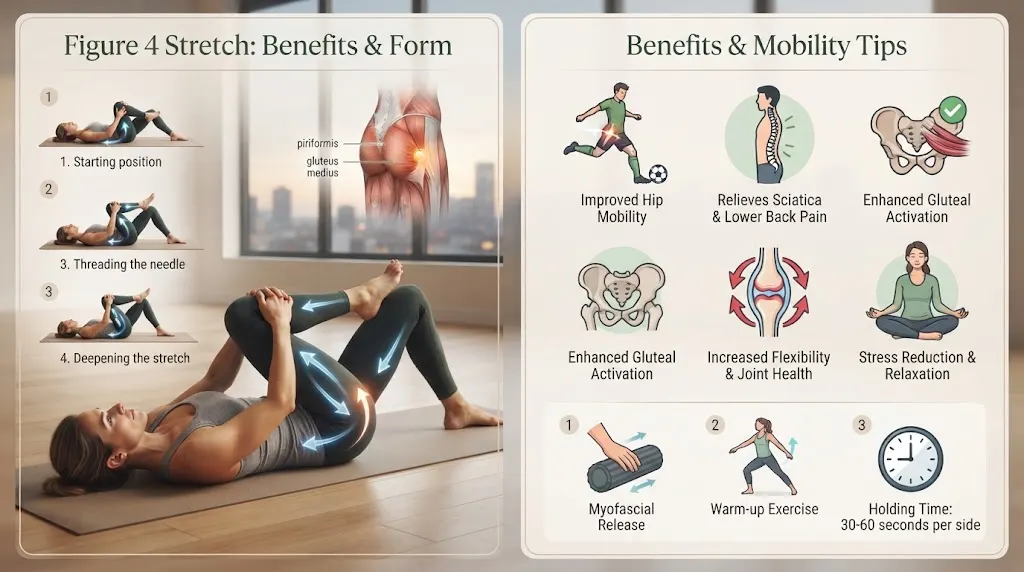

The figure 4 stretch is a popular mobility exercise for the hips, glutes, and surrounding muscles. It gets its name from the position of the legs, which resemble the number four when one ankle rests across the opposite thigh. The stretch can be performed lying down, sitting in a chair, or in several other modified positions.
Many people use the figure 4 stretch after workouts, during mobility routines, or after sitting for long periods. It can create a comfortable stretch through the buttocks and outer hip when performed correctly. However, forcing the position or allowing the knee to twist aggressively can turn a useful mobility exercise into an uncomfortable one.
Good technique matters more than pushing for maximum flexibility. The goal is to create controlled tension in the hip without sharp pain, numbness, or excessive pressure around the knee. Understanding the correct form, common mistakes, and appropriate modifications can help you include the figure 4 stretch safely in your routine.
What Is the Figure 4 Stretch?
The figure 4 stretch is a hip mobility movement where one ankle crosses over the opposite thigh, creating a shape similar to the number four. From this position, you gently increase hip flexion until a stretch is felt around the buttock or outer hip. The exact setup changes depending on whether you perform it lying down or seated.
The movement primarily places one hip into a combination of flexion and external rotation. This position can stretch muscles around the back and side of the hip while the opposite leg helps control the intensity. Many people prefer the lying version because the floor supports the back and makes it easier to relax into the movement.
Although it is often described as a piriformis stretch, the sensation may involve several tissues rather than one isolated muscle. Individual anatomy, hip mobility, and joint position all influence where the stretch is felt. You should generally feel gentle tension around the gluteal region rather than pressure directly inside the knee or sharp pinching in the hip.
What Muscles Does the Figure 4 Stretch Target?
The figure 4 stretch commonly produces tension through the gluteal muscles, particularly around the back and outer portion of the hip. The piriformis and other smaller external rotators may also be lengthened depending on your position. These muscles help control hip rotation and contribute to stability during walking, running, lifting, and other lower-body movements.
The gluteus maximus can also be involved because the hip moves into flexion while the crossed leg remains externally rotated. Some people feel the stretch higher in the buttock, while others notice more tension along the outside of the hip. Neither location is automatically wrong as long as the sensation is comfortable and does not feel like joint pain.
The stretch is not designed to directly lengthen every muscle around the hip. Tightness through the inner thighs, hip flexors, or hamstrings may require different mobility exercises. Combining the figure 4 position with movements such as an adductor stretch can create a more balanced routine when several areas of the hips feel restricted.
Benefits of the Figure 4 Stretch
One of the main benefits is improved comfort when moving the hip into flexion and external rotation. These positions appear during many everyday activities, including crossing the legs, squatting, getting in and out of a car, and certain sports. Regular mobility work may help these movements feel less restricted when stiffness rather than injury is the main limitation.
The stretch can also feel useful after long periods of sitting. Remaining seated for several hours may leave the hips and glutes feeling stiff even when no actual muscle shortening has occurred. Gentle movement and stretching provide a change of position that can make the hips feel more comfortable before returning to walking, exercise, or daily activity.
Athletes and gym users often include the figure 4 stretch as part of warm-up or cooldown routines. It can complement strength exercises that load the glutes, including squats, lunges, deadlifts, and running. Stretching should not replace strengthening, but it can be one useful component of a broader program that combines mobility, strength, and regular movement.
How to Do the Lying Figure 4 Stretch
Begin by lying comfortably on your back with both knees bent and your feet resting on the floor. Lift one foot and place the ankle across the opposite thigh just above the knee. Keep the crossed foot gently active rather than allowing the ankle to collapse inward, especially if your knee feels sensitive.
Next, lift the supporting leg and gently bring it toward your torso. You can hold behind the thigh or around the shin if your mobility allows, but avoid pulling directly on the knee joint. Continue until you feel comfortable tension through the buttock or outer hip of the crossed leg without sharp pain or pinching.
Keep your head, shoulders, and back relaxed as you hold the position. Breathe slowly and avoid bouncing or repeatedly forcing the leg closer to your body. After holding the stretch comfortably, release the legs slowly and repeat on the other side, noticing whether one hip feels noticeably different from the other.
How to Do the Seated Figure 4 Stretch
Sit toward the front of a stable chair with both feet flat on the floor. Place one ankle across the opposite thigh while keeping the crossed foot comfortable and supported. Allow the knee to move outward naturally rather than pushing it downward with your hand, which can create unnecessary pressure through the joint.
Keep your spine relatively tall and slowly hinge forward from the hips. A small forward movement is often enough to increase the stretch through the gluteal area. Avoid aggressively rounding the back because that can change the movement without necessarily increasing useful hip mobility.
The seated version is convenient for office workers, travelers, or anyone who cannot easily get onto the floor. It can be performed during short movement breaks after sitting for extended periods. Make sure the chair does not roll or move unexpectedly, and stop if you feel sharp hip pain, knee discomfort, tingling, or numbness.
Common Figure 4 Stretch Mistakes
One common mistake is pressing the crossed knee downward in an attempt to create a deeper stretch. The hip should control most of the movement rather than forcing rotation through the knee. Applying heavy pressure can be especially uncomfortable for people with limited hip mobility or previous knee problems.
Another mistake is pulling the supporting leg too aggressively toward the chest. Stretching harder does not automatically produce better mobility and may cause the muscles to tense instead of relax. Move gradually until you feel moderate tension, then maintain the position without trying to reach the largest possible range during every session.
Some people also hold their breath or create unnecessary tension through the neck and shoulders. Relaxed breathing can make the position easier to tolerate and encourage a more comfortable stretch. If you cannot maintain good positioning without straining, choose a gentler variation rather than forcing your body into the standard version.
Who Can Benefit From the Figure 4 Stretch?
People who spend much of the day sitting may find the figure 4 stretch useful as part of regular movement breaks. Desk work, driving, studying, and travel can all leave the hips feeling stiff after long periods in one position. A short stretch combined with walking can provide a simple way to move the joints through a different range.
Runners, cyclists, lifters, and recreational athletes may also include the stretch around their training. These activities place repeated demand on the glutes and other hip muscles, which can sometimes create a temporary feeling of tightness. Mobility work can help maintain comfortable movement when used alongside progressive strength training and appropriate recovery.
You do not need to be an athlete or particularly flexible to perform the stretch. Beginners can use a seated version or keep the supporting foot on the floor instead of pulling the leg upward. The best variation is the one that produces a gentle hip stretch while allowing you to remain relaxed and in control.
How to Add the Figure 4 Stretch to a Mobility Routine
A simple mobility routine can begin with a few minutes of walking or gentle lower-body movement before stretching. Follow with controlled hip circles, the figure 4 stretch, and movements targeting other areas that feel restricted. This approach encourages general movement rather than treating one stretch as a complete solution for every hip mobility problem.
You can also pair the figure 4 stretch with glute bridges, bodyweight squats, or other light strength exercises. Moving between mobility and controlled muscle activation can be useful before a workout. If stretching before training, keep the holds comfortable rather than spending long periods in an intense static position immediately before explosive activity.
For cooldowns or separate mobility sessions, you can spend slightly longer in the stretch as long as the position remains comfortable. Focus on slow breathing and controlled movement rather than chasing a specific depth. Over time, consistency usually matters more than trying to create a dramatic increase in range during one session.
When the Figure 4 Stretch May Not Be Appropriate
The figure 4 stretch should not cause sharp pain in the hip, groin, or knee. A strong pinching sensation in the front of the hip may indicate that the position is not appropriate for you at that moment. Moving the ankle lower, reducing hip flexion, or switching to another mobility exercise may be more comfortable.
People recovering from recent hip or knee surgery should follow guidance from their healthcare professional or physical therapist before adding new stretches. The same applies after significant injuries, fractures, or joint procedures. Individual restrictions can vary considerably, so a movement that is safe for one person may not be appropriate during another person’s recovery.
Stop the stretch if it causes numbness, tingling, burning, or symptoms traveling down the leg. These sensations are different from normal muscular tension and may suggest nerve irritation. Persistent hip or buttock pain should also be evaluated rather than repeatedly stretched, particularly when symptoms worsen, interfere with walking, or disturb sleep.
How Often Should You Do the Figure 4 Stretch?
Many people can include a gentle figure 4 stretch several times per week or even daily when it feels comfortable. There is no requirement to perform it every day to benefit from mobility work. Frequency should depend on your activity level, symptoms, and how your hips respond after stretching.
For general mobility, holding the position for a comfortable period and repeating it once or twice per side may be enough. Longer or more aggressive sessions are not necessarily better. If your hips feel irritated afterward, reduce the intensity, duration, or frequency and observe whether a gentler approach feels more productive.
Remember that flexibility is only one part of healthy hip function. Strength, coordination, regular walking, varied movement, and appropriate training loads also influence how your hips feel. Use the figure 4 stretch as one tool within a broader movement routine rather than treating it as the only exercise needed for hip comfort.
Conclusion
The figure 4 stretch is a simple and accessible way to work on mobility around the glutes, piriformis region, and outer hip. It can be performed lying down or seated, making it easy to adapt for home, gym, office, or travel routines. Good form should create gentle muscular tension without forcing the knee or producing sharp hip pain.
Its benefits are most meaningful when the stretch is used alongside regular movement and strength training. People who sit for long periods, exercise frequently, or simply feel stiff around the hips may find it particularly useful. However, stretching harder is not better, and controlled movement should always take priority over trying to reach an extreme position.
Listen to how your body responds before, during, and after the stretch. Modify the position when necessary and stop if symptoms include sharp pain, numbness, tingling, or significant joint discomfort. With sensible technique and consistent practice, the figure 4 stretch can become a practical addition to a balanced hip mobility routine.
FAQs About the Figure 4 Stretch
What is the figure 4 stretch good for?
The figure 4 stretch is commonly used to improve mobility around the glutes, outer hip, and deep hip rotators. It may also help the hips feel less stiff after prolonged sitting.
Where should I feel the figure 4 stretch?
You will usually feel the stretch through the buttock or outer hip of the crossed leg. Sharp pain in the knee, groin, or front of the hip is not the intended sensation.
How long should I hold a figure 4 stretch?
A comfortable hold of roughly 20–30 seconds can work well for many people, although there is no perfect duration. Focus on relaxed breathing and moderate tension rather than forcing a deeper stretch.
Can I do the figure 4 stretch every day?
Yes, many people can perform a gentle version daily if it feels comfortable. Reduce the frequency or intensity if the stretch causes lingering pain, joint irritation, or worsening symptoms afterward.
Is the figure 4 stretch good for piriformis tightness?
The position can create a stretch around the piriformis and other deep hip muscles. However, buttock pain has several possible causes, so persistent symptoms should not automatically be assumed to come from a tight piriformis.