

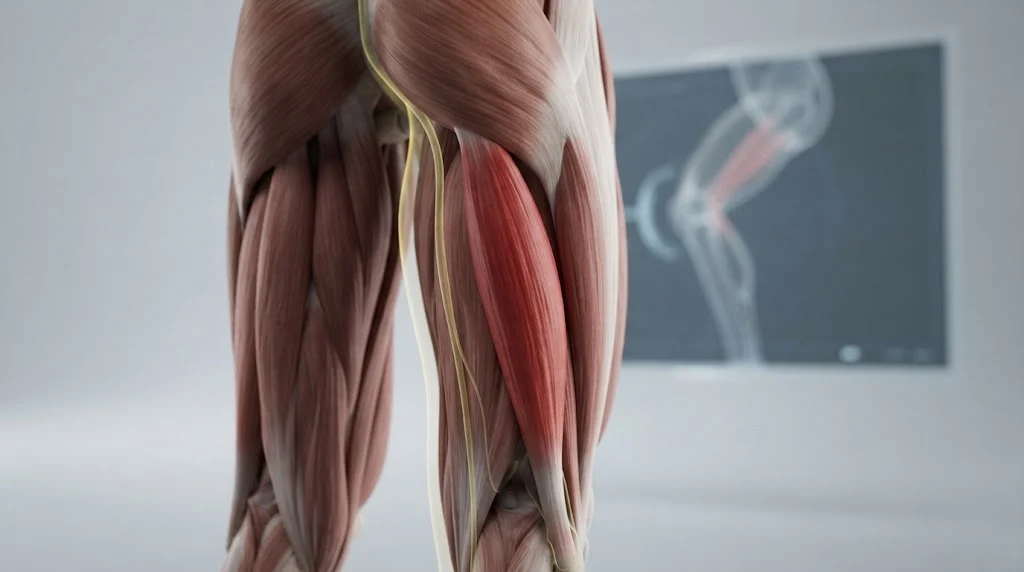

The biceps femoris is a major muscle on the back of the thigh and an important part of the hamstring muscle group. It helps control movements involving the hip and knee, making it essential for everyday activities such as walking, climbing stairs, bending the knee, and standing up. Athletes also rely heavily on this muscle during running, jumping, and rapid changes of direction.
Although the biceps femoris may seem like a single muscle, it actually contains two distinct sections known as the long head and short head. These portions begin at different locations in the body and have slightly different roles in movement. Understanding how they work together can make hamstring anatomy easier to understand and help explain why injuries often develop in this area.
Problems involving the biceps femoris can range from temporary muscle tightness to strains, tendon irritation, and more serious injuries. Because the muscle crosses important joints and supports powerful movements, discomfort can affect mobility and athletic performance. Learning its anatomy, function, and common injury patterns can help you better understand how the back of the thigh works.
What Is the Biceps Femoris Muscle?
The biceps femoris is one of the three main muscles that make up the hamstring group at the back of the thigh. The other two are the semitendinosus and semimembranosus muscles. Together, these posterior thigh muscles help produce hip extension, knee flexion, and controlled movement during walking, running, and many other lower-body activities.
The name “biceps” refers to the fact that the muscle has two heads rather than one. These are called the long head and short head of the biceps femoris. Although both eventually connect near the outside of the knee, their different origins and nerve supplies give each section slightly different responsibilities when the body moves.
The biceps femoris sits mainly along the outer or lateral portion of the back of the thigh. Because of this position, pain from the muscle is often felt toward the outer hamstring rather than directly in the middle of the leg. Its location also allows it to influence both knee movement and, through the long head, movement of the hip.
Anatomy of the Biceps Femoris
The biceps femoris extends from the pelvis and thigh bone toward the upper portion of the lower leg. Its long and short heads travel downward before joining and attaching primarily around the head of the fibula near the outside of the knee. This arrangement creates a strong muscular structure capable of producing and controlling movement across the lower limb.
The muscle lies close to several other important structures, including the sciatic nerve, hamstring muscles, femur, knee joint, and surrounding connective tissues. Its position makes proper muscle coordination important during demanding movements. When surrounding muscles become weak, stiff, or poorly coordinated, greater stress may be transferred to the biceps femoris during running or exercise.
Like other skeletal muscles, the biceps femoris contains muscle fibers that shorten when activated and lengthen when controlling movement. It is especially active during movements that require the hamstrings to slow down the leg. This eccentric muscle action becomes particularly important during sprinting, when the hamstrings must rapidly control the lower limb before the foot reaches the ground.
Long Head of the Biceps Femoris
The long head begins at the ischial tuberosity, a bony area located at the lower part of the pelvis. This is close to the attachment points of the other major hamstring muscles. From there, the long head runs down the back and outer side of the thigh before joining the short head near the lower portion of the femur.
Because the long head crosses both the hip and knee joints, it can influence movement at both locations. It contributes to hip extension, which moves the thigh backward, and knee flexion, which bends the knee. It also assists with outward rotation of the lower leg when the knee is bent, adding stability and control during complex movements.
The long head is especially important in activities involving powerful hip movement, including sprinting, jumping, climbing, and accelerating. It also experiences significant tension when the hip bends while the knee straightens. This combination places the muscle in a lengthened position, which helps explain why the long head is commonly involved in certain hamstring strains.
Short Head of the Biceps Femoris
The short head originates from the femur rather than the pelvis. Its attachment begins mainly along portions of the linea aspera and lateral region of the thigh bone. It travels downward before joining fibers of the long head, and the combined tendon attaches primarily to the fibular head on the outer side of the knee.
Unlike the long head, the short head does not cross the hip joint. This means it does not play a significant role in extending the hip. Its main responsibilities involve bending the knee and helping rotate the lower leg outward when the knee is flexed, particularly during movements that require precise control of the knee joint.
The short head also has a different nerve supply from the long head, which makes the biceps femoris somewhat unusual among hamstring muscles. Despite these anatomical differences, both heads normally work together during knee movement. Proper coordination between them supports smooth motion and helps the knee remain stable during demanding lower-body activities.
What Does the Biceps Femoris Do?
One of the primary functions of the biceps femoris is knee flexion. When the muscle contracts, it helps pull the lower leg backward and decreases the angle of the knee joint. This action happens during walking, running, cycling, climbing stairs, squatting, and many exercises that involve repeatedly bending and straightening the legs.
The long head also contributes to hip extension because it crosses the hip joint. Hip extension occurs when the thigh moves backward or when the body rises from a forward-bent position. Activities such as standing from a chair, climbing a hill, sprinting, deadlifting, and jumping require coordinated hip extension involving the hamstrings and gluteal muscles.
Another important function is external rotation of the lower leg when the knee is bent. This rotational ability helps control the position of the leg during movement rather than simply creating forward and backward motion. Combined with surrounding muscles, the biceps femoris contributes to knee stability and efficient movement during changing speeds, directions, and surfaces.
Role of the Biceps Femoris During Walking and Running
During normal walking, the biceps femoris helps control the swinging leg and prepares the foot for contact with the ground. Toward the end of the swing phase, the hamstrings contract to slow knee extension and forward movement of the thigh. This braking action allows the leg to transition smoothly into the next step without uncontrolled movement.
The demands become considerably greater during running because the legs move faster and generate higher forces. During sprinting, the biceps femoris rapidly lengthens while producing force as the lower leg moves forward. It must then contract powerfully during the transition toward ground contact, placing substantial mechanical stress on the muscle and surrounding tendon structures.
This combination of rapid lengthening and force production is one reason hamstring injuries frequently occur in sports involving high-speed running. Football, soccer, track, rugby, and similar activities can place significant loads on the posterior thigh. Good strength, flexibility, technique, and gradual training progression can help the muscle tolerate these demanding movements more effectively.
Biceps Femoris Nerve Supply and Blood Supply
The biceps femoris receives nerve signals primarily through branches associated with the sciatic nerve. However, the two muscle heads have different innervation. The long head is generally supplied by the tibial division of the sciatic nerve, while the short head is supplied by the common fibular division, also known as the common peroneal division.
These nerves allow the brain and spinal cord to control muscle contraction, timing, and coordination. Nerve irritation or injury can therefore influence strength and movement in the biceps femoris and surrounding muscles. Symptoms involving nerves may sometimes include weakness, tingling, numbness, or radiating discomfort rather than the localized soreness commonly associated with ordinary muscle fatigue.
Blood reaches the muscle through branches of arteries supplying the posterior thigh, particularly vessels associated with the profunda femoris circulation. A healthy blood supply provides oxygen and nutrients needed by active muscle tissue. Circulation also supports recovery after exercise by helping the body deliver nutrients and remove metabolic byproducts from working muscle fibers.
Common Biceps Femoris Injuries
A biceps femoris strain occurs when muscle fibers are stretched beyond their normal tolerance or experience excessive force. Mild strains may cause tightness or tenderness, while more significant injuries can create sharp pain, swelling, weakness, or difficulty walking. High-speed running is one of the most common situations associated with hamstring strains, particularly among competitive athletes.
Tendon problems can also develop where the biceps femoris connects to bone, especially around the outer portion of the knee. Repetitive loading, sudden increases in training volume, poor movement mechanics, or insufficient recovery may contribute to tendon irritation. Discomfort may become more noticeable during running, knee bending, jumping, or activities requiring repeated hamstring contraction.
Muscle discomfort can develop in many areas of the body depending on training habits and physical demands. Someone performing both upper- and lower-body exercise may experience hamstring symptoms alongside issues such as deltoid muscle pain. Identifying the specific muscle and movement causing pain can make it easier to choose appropriate recovery strategies.
Symptoms of a Biceps Femoris Problem
Pain along the outer back portion of the thigh is one of the more common signs of biceps femoris irritation. Symptoms may appear suddenly during running or develop gradually after repeated activity. Depending on the problem, the area may feel sore, tight, tender, weak, or painful when stretching or contracting the hamstring muscles.
More significant strains can cause sudden sharp pain that forces someone to stop exercising immediately. Swelling or bruising may develop afterward if muscle fibers have been damaged. Walking quickly, bending the knee against resistance, extending the hip, or stretching the hamstrings may reproduce discomfort, although symptoms vary considerably according to the severity and location of the injury.
Pain near the outer knee may sometimes involve the distal biceps femoris tendon rather than the muscle belly higher in the thigh. However, several other knee, nerve, and soft-tissue conditions can create similar symptoms. Persistent pain, substantial weakness, severe swelling, numbness, or difficulty walking should be assessed by a qualified healthcare professional rather than diagnosed from symptoms alone.
What Causes Biceps Femoris Strains?
Rapid sprinting is a common cause because the biceps femoris must generate significant force while changing length quickly. The muscle experiences particularly high stress during the later stages of the leg’s forward swing. When the force exceeds what the tissues can tolerate, muscle fibers or the muscle-tendon junction may become strained.
Training errors can increase the likelihood of problems. Suddenly increasing running speed, distance, training frequency, or resistance without allowing the body to adapt may overload the hamstrings. Fatigue can also reduce movement control, making the biceps femoris work harder to stabilize the leg during demanding exercise or repeated high-speed movements.
Several physical factors may also influence hamstring injury risk, including previous injury, inadequate strength, poor control, limited mobility, or strength imbalances between muscle groups. No single factor causes every injury, however. Hamstring problems usually involve a combination of training load, movement demands, individual anatomy, previous injury history, and the physical capacity of the muscle.
How to Keep the Biceps Femoris Strong and Healthy
Strength training can improve the biceps femoris’s ability to tolerate everyday activities and athletic demands. Exercises involving hip extension and knee flexion can both be useful because the muscle performs both types of movement. Romanian deadlifts, hamstring curls, bridges, controlled hip hinges, and progressively introduced eccentric hamstring exercises are common examples used in lower-body training programs.
Exercise intensity should increase gradually rather than changing dramatically from one session to another. Building strength over time gives muscles, tendons, and surrounding tissues an opportunity to adapt to greater demands. Warm-ups involving progressive movement and sport-specific preparation can also help prepare the hamstrings before sprinting, jumping, or performing exercises requiring powerful lower-body contractions.
Recovery matters as much as training. Adequate rest, sleep, nutrition, and sensible scheduling can help muscles recover between demanding sessions. If soreness changes into persistent or sharp pain, repeatedly training through the discomfort may worsen the problem, so adjusting activity and getting professional advice when needed can be more effective than simply trying to push through symptoms.
Why the Biceps Femoris Matters for Lower-Body Movement
The biceps femoris contributes to far more than simply bending the knee. It helps coordinate the hip, knee, and lower leg during movement while working alongside other hamstrings, gluteal muscles, quadriceps, and calf muscles. This coordinated action becomes essential whenever the body needs to produce force while remaining balanced and controlled.
Strong hamstrings also help manage forces passing through the lower body. During running or landing, the biceps femoris contributes to controlling how quickly the knee extends and how the leg moves relative to the hip. Rather than acting independently, it forms part of a muscular system that continuously adjusts movement according to speed, surface, direction, and physical demands.
Understanding its role can also improve exercise selection and injury awareness. Training only the front of the thighs while ignoring posterior-chain muscles may leave important movement patterns underdeveloped. A balanced lower-body program that includes knee-flexion and hip-extension exercises can help build stronger, better-coordinated muscles for daily activity, recreational exercise, and athletic performance.
Conclusion
The biceps femoris is an important hamstring muscle positioned along the outer portion of the back of the thigh. Its two components, the long head and short head, have different origins and nerve supplies but combine near the knee. Together, they contribute strongly to knee flexion, external rotation, movement control, and lower-body stability.
The long head also crosses the hip, allowing it to assist with hip extension during activities such as walking, running, climbing, and jumping. Because the muscle handles substantial force during high-speed movement, it is also vulnerable to strains and tendon problems. Gradual training, adequate strength, appropriate recovery, and good movement control can help manage these physical demands.
Pain around the biceps femoris does not always mean a serious injury, but persistent or severe symptoms deserve attention. Understanding where the muscle is located and what movements activate it can help identify potential sources of discomfort. Anyone experiencing major weakness, bruising, swelling, numbness, or continuing pain should consider professional assessment for an accurate diagnosis and treatment plan.
FAQs
Where is the biceps femoris located?
The biceps femoris is located along the back and outer side of the thigh. It forms part of the hamstring group and extends toward the fibular head near the outside of the knee.
What is the main function of the biceps femoris?
Its main functions include bending the knee and externally rotating the lower leg when the knee is flexed. The long head also helps extend the hip during walking, running, and other movements.
Why does the biceps femoris commonly get injured?
The muscle experiences high forces during sprinting, particularly while lengthening and slowing the moving leg. Sudden training increases, fatigue, previous hamstring injuries, and inadequate strength may also contribute to strain risk.
How can you strengthen the biceps femoris?
Exercises such as hamstring curls, Romanian deadlifts, bridges, hip hinges, and appropriately progressed eccentric hamstring exercises can strengthen it. Resistance and training volume should increase gradually to allow the muscle to adapt safely.
Is biceps femoris pain the same as hamstring pain?
Biceps femoris pain is a type of hamstring pain because the muscle forms part of the hamstring group. However, hamstring discomfort can also involve the semitendinosus, semimembranosus, surrounding tendons, or nearby structures.