
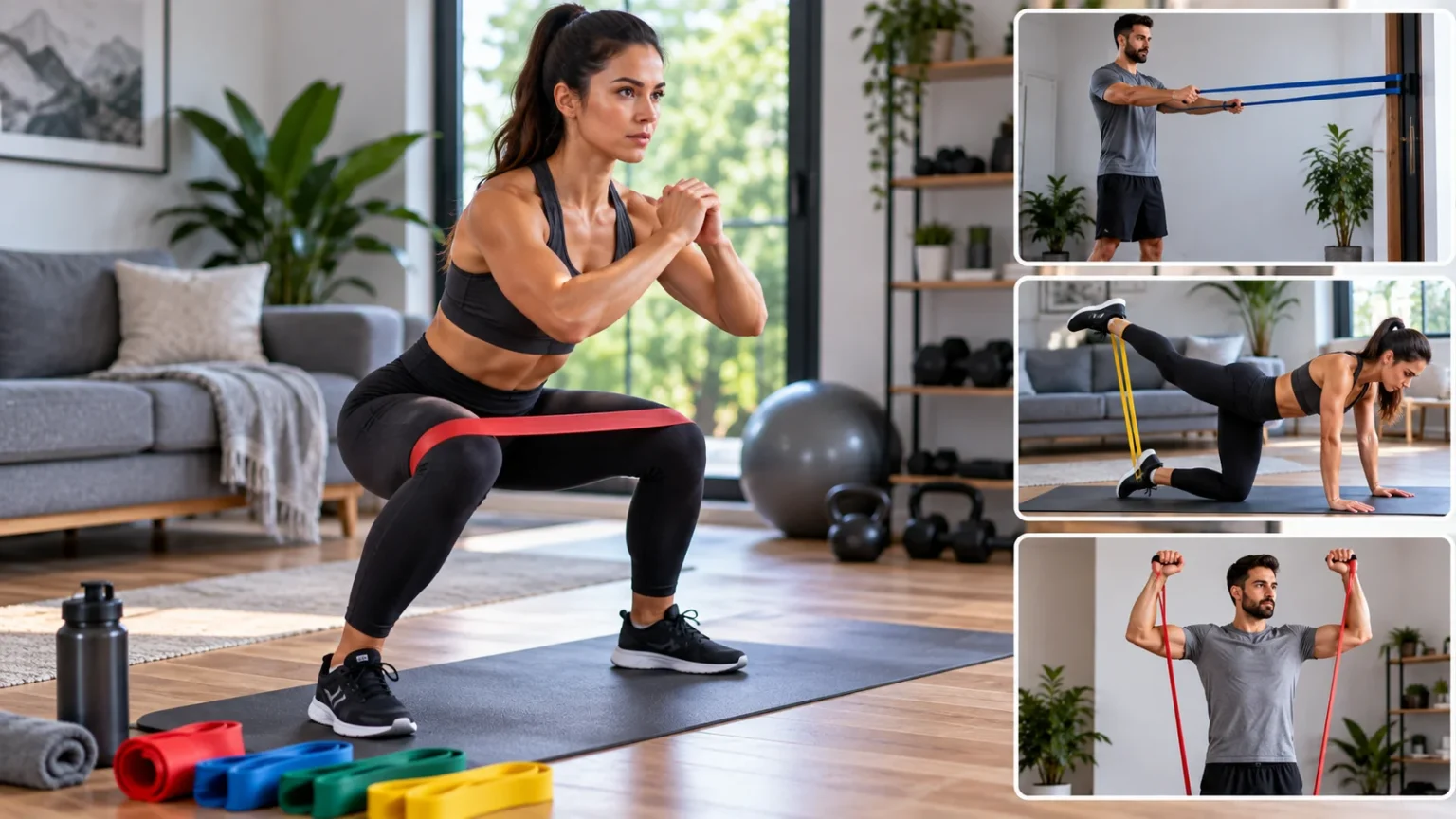

Resistance bands are one of the simplest tools for building strength, improving mobility, and adding variety to home or gym workouts. They are lightweight, portable, and available in different resistance levels, making them useful for beginners as well as experienced exercisers. With the right technique, resistance-band exercises can target nearly every major muscle group without requiring bulky equipment.
Unlike free weights, bands create tension that generally increases as the material stretches. This changing resistance can challenge muscles throughout different parts of an exercise while encouraging controlled movement. Whether your goal is strength, general fitness, rehabilitation, or better movement quality, learning proper resistance-band form can make your workouts safer and more effective.
What Are Resistance Band Exercises?
Resistance-band exercises use elastic bands to create tension while you push, pull, squat, press, or rotate. Bands may come as flat therapy bands, closed-loop bands, mini bands, or tube-style bands with handles. Each style can be used for different exercises depending on your training goals, available space, and current strength level.
The resistance increases as the band stretches farther, which means the muscles often work harder toward the end of the movement. This is different from many free-weight exercises, where resistance remains relatively constant. The progressive tension can be useful for strengthening muscles while encouraging controlled movement through a comfortable range.
Resistance bands can train the upper body, lower body, and core while also supporting mobility and warm-up routines. They are commonly used in strength training, physical therapy, athletic conditioning, and home fitness programs. Choosing an appropriate resistance level is important because a band that is too heavy can make proper technique difficult to maintain.
Benefits of Exercises with Resistance Bands
One of the main benefits of resistance bands is convenience. They are easy to store, carry, and use in small spaces, making them practical for home workouts, travel, or quick training sessions. A few bands with different resistance levels can provide enough variety for a complete strength routine without requiring a large collection of equipment.
Bands also allow you to adjust exercises easily by changing your grip, stance, band length, or resistance level. Moving farther from an anchor point or shortening the band can increase tension, while creating more slack reduces the challenge. This flexibility makes resistance-band training suitable for gradual progression and different fitness levels.
Another advantage is that bands can encourage slow, controlled movement because the resistance pulls continuously throughout the exercise. This makes it easier to focus on muscle engagement and joint positioning rather than momentum. Resistance training with bands may help improve muscular strength, endurance, stability, and movement confidence when performed consistently.
Resistance Band Squats for Lower-Body Strength
Resistance band squats target the quadriceps, glutes, hamstrings, and supporting muscles around the hips. Place a loop band above your knees or stand on a longer band while holding the ends near your shoulders. Position your feet comfortably apart and keep your chest relaxed while preparing to lower your hips.
Push your hips slightly backward and bend your knees as you lower into a comfortable squat. Keep your knees tracking in the same general direction as your toes rather than allowing the band to pull them inward. Descend only as far as you can maintain good balance and control, then push through your feet to return to standing.
Start with a light band until the movement feels natural. Adding too much resistance can cause you to lean excessively, lose balance, or change your knee position. As your strength improves, increase the resistance gradually or add repetitions while maintaining the same controlled squat mechanics.
Resistance Band Glute Bridges
Band-assisted glute bridges strengthen the glutes, hamstrings, and muscles that help stabilize the pelvis. Place a mini band around your thighs just above your knees, then lie on your back with your knees bent and feet resting on the floor. Keep gentle outward pressure against the band so your knees remain aligned throughout the movement.
Tighten your abdominal muscles and squeeze your glutes as you lift your hips away from the floor. Avoid pushing the hips so high that your lower back becomes excessively arched. Pause briefly at the top while maintaining tension against the band, then lower your hips slowly until they return to the starting position.
Focus on feeling the movement primarily through your glutes rather than your lower back. If the exercise feels too difficult, use a lighter resistance band or reduce your lifting height. Progress can come from additional repetitions, stronger bands, or longer pauses at the top instead of simply moving faster.
Resistance Band Rows for Back Strength
Resistance band rows strengthen the upper back, rear shoulders, and arm muscles involved in pulling movements. Secure a long resistance band around a stable anchor at approximately chest height, or wrap it around your feet while seated. Hold the band securely and begin with your arms extended while keeping your shoulders relaxed.
Pull your elbows backward while gently bringing your shoulder blades toward each other. Keep your chest upright and avoid shrugging your shoulders toward your ears during the movement. Pause when your hands reach a comfortable position near your torso, then slowly extend your arms again while maintaining control of the returning band.
Rows can help strengthen several muscles involved in shoulder positioning, including areas around the upper back. Understanding the trapezius muscle can also provide useful context for how the upper back contributes to posture and shoulder movement. Use moderate resistance that allows smooth repetitions without excessive neck tension.
Resistance Band Chest Press
The resistance band chest press targets the chest, shoulders, and triceps while providing an alternative to push-ups or weight-based presses. Secure a long band behind you at approximately chest height and hold one end in each hand. Step forward carefully until the band has light tension before beginning the pressing motion.
Position your elbows slightly below shoulder height and press your hands forward until your arms are nearly straight. Avoid aggressively locking your elbows or allowing your lower back to arch as the resistance increases. Slowly return your hands toward your chest while controlling the band rather than letting it pull your arms backward quickly.
Choose an anchor point that is strong enough to handle the band tension safely. Inspect the band before each workout because damaged material can snap when stretched. If the resistance feels too intense near the end of the press, move slightly closer to the anchor or switch to a lighter band.
Resistance Band Shoulder Press
A resistance band shoulder press strengthens the shoulders, triceps, and supporting upper-body muscles. Stand on the middle of a long band with one foot or both feet depending on the resistance required. Hold the handles or ends near shoulder level with your wrists in a comfortable, neutral position.
Press your hands upward while keeping your ribs controlled and avoiding excessive arching through the lower back. Your arms do not need to move into an uncomfortable range to make the exercise effective. Once your hands reach a comfortable overhead position, lower them slowly toward your shoulders while continuing to resist the band’s downward pull.
If standing presses are difficult, the exercise can sometimes be performed from a seated position using lighter resistance. Avoid forcing overhead movements if they cause sharp shoulder or neck discomfort. Maintaining control and comfortable joint positioning is more important than stretching the band as far as possible.
Resistance Band Lateral Walks
Lateral band walks target the glutes, particularly the muscles that help control sideways movement and hip stability. Place a mini band above your knees or around your lower legs, depending on your strength and experience. Bend your knees slightly and keep your hips back in a shallow athletic stance.
Step sideways while maintaining tension in the band, then bring the other foot toward the first without letting the band become completely loose. Keep your feet generally facing forward and avoid allowing your knees to collapse inward. Take several controlled steps in one direction before returning the same distance in the opposite direction.
The movement should come primarily from the hips rather than swaying the upper body from side to side. Start with a lighter resistance band and shorter steps until you can maintain consistent control. Strong hip muscles can support balance and lower-body alignment during walking, running, squatting, and other everyday movements.
Resistance Band Biceps Curls
Resistance band biceps curls provide a simple way to strengthen the front of the upper arms. Stand on the middle of a long band and hold one end in each hand with your palms facing forward. Keep your elbows close to your sides and begin with light tension in the band.
Bend your elbows and bring your hands toward your shoulders without allowing the elbows to drift significantly forward. Pause briefly near the top of the curl, then lower your hands slowly until your arms return toward the starting position. The controlled lowering phase is important because the band continues pulling against your muscles as it shortens.
Avoid using your hips or upper body to swing the band upward. If you need momentum to complete each repetition, the resistance is probably too heavy. Reduce tension and focus on a smooth range of motion before progressing to a stronger band or adding more repetitions.
Resistance Band Triceps Extensions
Triceps extensions target the muscles along the back of the upper arm and can be performed in several ways with resistance bands. One option is to secure the band above your head and hold the ends with your elbows bent. Another variation involves standing on one end while extending the opposite arm overhead.
Keep your upper arm relatively stable as you straighten the elbow against the resistance. Move slowly and avoid forcing the joint into a hard lock at the end of the repetition. Return to the starting position under control, allowing the elbow to bend while continuing to resist the band’s pull.
Use enough resistance to challenge the triceps without causing your shoulder position to change significantly. If you feel discomfort around the elbow or shoulder, reduce the resistance or adjust your setup. Proper alignment matters more than using the strongest band available, especially when training smaller muscle groups.
Resistance Band Core Exercises
Resistance bands can add useful resistance to core exercises because they challenge your trunk to resist rotation, extension, or sideways movement. The Pallof press is a common example that uses a band anchored beside the body. Stand perpendicular to the anchor, hold the band near your chest, and maintain a stable stance.
Press your hands slowly away from your body while resisting the band’s attempt to rotate your torso. Keep your shoulders, hips, and chest facing forward rather than turning toward the anchor point. Hold briefly with your arms extended, then return your hands to your chest while maintaining the same stable trunk position.
Core training with bands does not require aggressive twisting or large ranges of motion. Controlled anti-rotation exercises can train the abdominal and trunk muscles while maintaining a relatively stable spine. Start close to the anchor point with light resistance, then move farther away gradually as your control improves.
How to Choose the Right Resistance Band
Resistance bands are typically available in several tension levels ranging from very light to heavy. Beginners should usually start with lighter resistance so they can learn proper form without struggling against excessive tension. The correct band should make the exercise challenging while still allowing you to complete every repetition smoothly and with good control.
Different muscle groups may require different resistance levels. Your legs and back can often handle stronger bands than smaller muscles in your shoulders or arms. Keeping multiple band strengths available allows you to choose appropriate resistance for each exercise rather than forcing one band to work for every movement.
Band length and style also influence exercise selection. Mini loops work well for hip and lower-body drills, while longer bands are more versatile for rows, presses, curls, and anchored movements. Tube bands with handles can feel comfortable for upper-body exercises, while flat bands are commonly used for mobility and rehabilitation work.
Resistance Band Safety and Best Practices
Always inspect resistance bands before beginning a workout. Look for cracks, small tears, worn areas, or damaged handles and attachment points because weakened bands can break under tension. Avoid using a damaged band, and make sure any door anchor or fixed attachment point is secure before pulling strongly against it.
Control both the lifting and returning portions of every exercise. Allowing a stretched band to snap back quickly can reduce training quality and may increase the risk of losing control. Keep movements smooth, breathe naturally, and position your body so the resistance pulls in the intended direction rather than creating awkward joint angles.
Progress gradually by increasing repetitions, band tension, sets, or exercise difficulty rather than changing everything at once. Muscles need time to adapt to additional resistance just as they do with traditional weight training. Stop an exercise if it causes sharp pain, unusual numbness, or joint discomfort that does not feel like normal muscular effort.
Conclusion
Exercises with resistance bands can provide an effective full-body workout using minimal equipment. Squats, glute bridges, rows, presses, lateral walks, curls, triceps extensions, and core exercises can train most major muscle groups. Because bands are portable and versatile, they work particularly well for home workouts, travel, warm-ups, and supplemental strength sessions.
Good form should remain the priority regardless of which resistance level you choose. Use smooth movements, maintain comfortable joint alignment, and control the band as it stretches and returns. Gradually increasing resistance is more effective than immediately using a heavy band that forces you to compensate with poor technique.
Resistance bands can be used by beginners and experienced exercisers when exercises are selected appropriately. Building a consistent routine and progressing gradually can improve strength, muscular endurance, stability, and overall movement quality. With careful setup and proper technique, a small set of bands can become a highly practical training tool.
FAQs
Can resistance bands actually build muscle?
Yes, resistance bands can challenge muscles enough to support strength and muscle development when resistance and training volume are progressively increased. Consistent workouts, adequate recovery, and appropriate nutrition also influence results.
How often should I do resistance band exercises?
Many people can perform resistance-band strength workouts two to four times per week depending on intensity and training goals. Give heavily trained muscle groups sufficient recovery before challenging them again.
Are resistance bands good for beginners?
Yes. Resistance bands are beginner-friendly because resistance levels can be adjusted easily and many exercises require minimal equipment. Beginners should start with lighter bands while learning proper form and movement control.
How many repetitions should I do with resistance bands?
A common starting range is around 8 to 15 controlled repetitions per set, although the ideal number depends on resistance and goals. The final repetitions should feel challenging without causing form to break down.
Can I use resistance bands every day?
Light mobility or activation work may be suitable daily for some people, but challenging strength sessions require recovery. Avoid heavily training the same muscles every day if they remain sore, fatigued, or uncomfortable.