

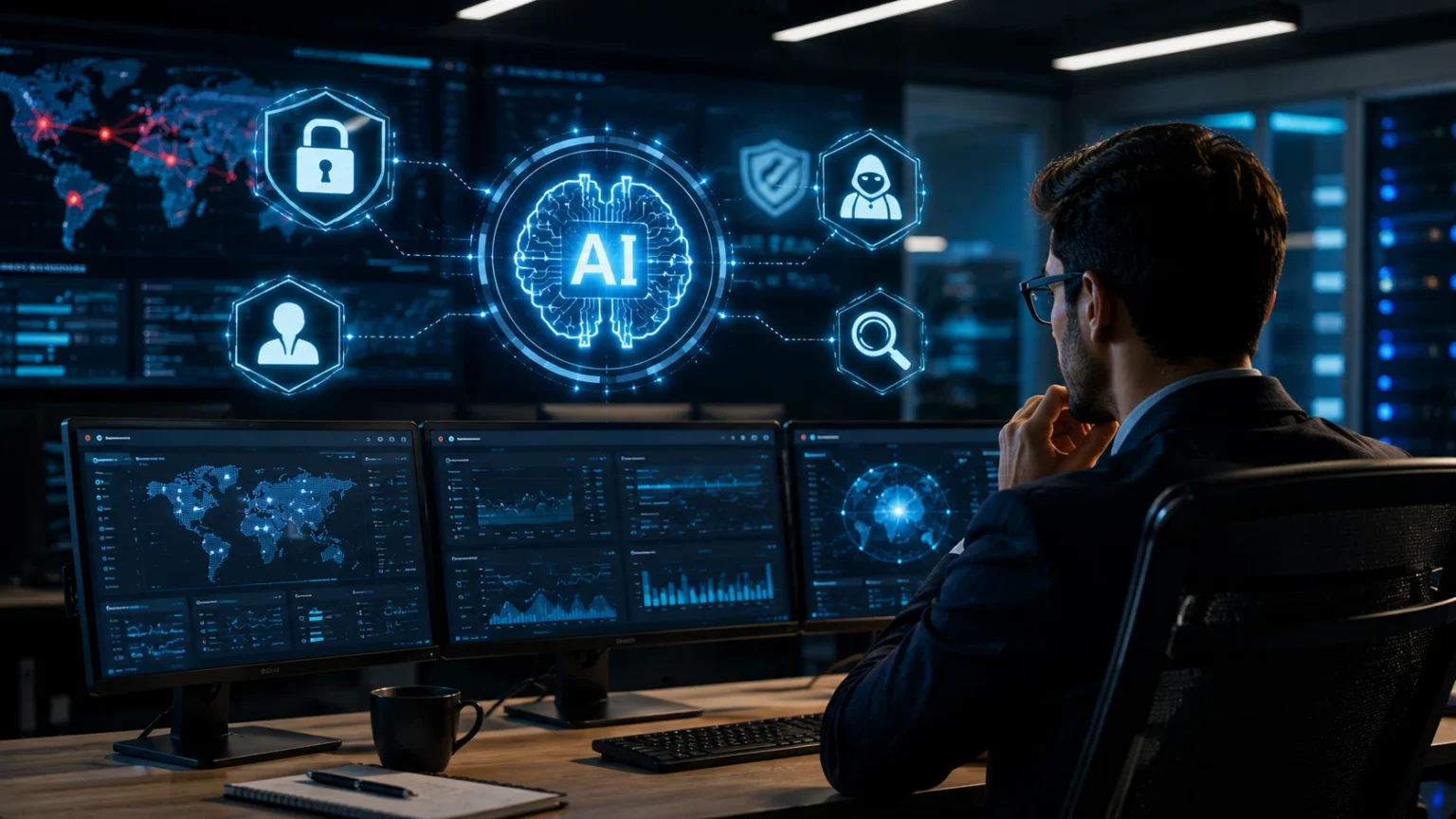

How Artificial Intelligence Improves Cybersecurity
Artificial intelligence is becoming an important part of modern cybersecurity because organizations now generate far more security data than human analysts can review manually. Networks, cloud platforms, employee devices, applications, identities, and APIs continuously produce logs and alerts that may contain early signs of malicious activity. AI can help security teams analyze this information quickly, identify unusual patterns, and prioritize events that deserve immediate attention.
The value of artificial intelligence in cybersecurity comes largely from speed and scale. Traditional security tools often depend on known signatures or manually defined rules, while AI and machine learning can help identify behavior that looks abnormal even when it does not exactly match a previously documented threat. This can provide security teams with additional visibility when attackers use new tactics, stolen credentials, or subtle techniques designed to avoid conventional detection.
AI is also changing the work performed inside security operations centers. Analysts can use AI to summarize alerts, correlate information from multiple security tools, investigate suspicious behavior, prioritize vulnerabilities, and accelerate parts of incident response. These capabilities can reduce repetitive work and allow experienced cybersecurity professionals to concentrate on decisions that require deeper context, judgment, and understanding of the organization.
However, AI does not make cybersecurity automatic or risk-free. Attackers can also use artificial intelligence to create convincing phishing messages, accelerate reconnaissance, and improve malicious operations. Organizations therefore need a balanced approach that combines AI-powered security tools with strong identity controls, secure configurations, employee awareness, vulnerability management, and human oversight. Used responsibly, AI can strengthen cybersecurity without replacing the fundamentals that already matter.
What Is Artificial Intelligence in Cybersecurity?
Artificial intelligence in cybersecurity refers to the use of machine learning, generative AI, behavioral analytics, natural language processing, and related technologies to help identify, investigate, prevent, and respond to digital threats. These systems can process security information at a scale that would be difficult for human analysts to manage continuously, particularly in large or highly distributed environments.
Machine learning models can examine historical and real-time data to identify patterns associated with legitimate and suspicious activity. For example, an AI system may learn how employees normally access applications and then flag unusual behavior such as unexpected login locations, abnormal data downloads, or access attempts involving resources a person rarely uses.
Generative AI introduces another layer of assistance by helping analysts interact with complicated security information using natural language. Instead of manually reviewing numerous alerts, an analyst might ask a security assistant to summarize what happened, identify affected systems, explain suspicious behavior, and suggest which evidence should be reviewed next.
The goal is not to remove cybersecurity professionals from the process. AI provides additional analytical power while humans remain responsible for validating findings, understanding business context, and making important response decisions. This combination of automation and expertise is one reason AI-powered cybersecurity is becoming increasingly important within modern security programs.
Why Cybersecurity Needs Artificial Intelligence
Modern organizations operate across increasingly complicated technology environments. Employees may access cloud applications from different devices and locations, while businesses connect with third-party platforms, APIs, mobile services, and remote infrastructure. Each connection produces information that security teams need to monitor, expanding the number of possible attack paths and making manual analysis increasingly difficult.
Security tools can also generate enormous numbers of alerts. Many of these alerts turn out to be harmless, but analysts still need to investigate enough of them to determine which represent genuine threats. Excessive alert volume can create fatigue and make it easier for an important signal to become lost among thousands of routine events.
Artificial intelligence can help by ranking alerts according to context and potential risk. Instead of treating every event equally, AI systems can examine factors such as user behavior, device activity, asset importance, vulnerability exposure, and known threat indicators. This can help analysts decide where limited investigative time should be focused first.
AI is especially valuable because cyber threats can move quickly. Attackers may automate scanning, credential attacks, phishing, and exploitation attempts, reducing the time organizations have to respond. Faster detection and analysis can help security teams contain suspicious activity before attackers move deeper into the environment or cause more serious damage.
AI Improves Threat Detection
Threat detection is one of the most important applications of AI in cybersecurity. Traditional security systems often look for predefined indicators associated with known malware, malicious addresses, or attack patterns. These methods remain valuable, but they may be less effective when attackers modify techniques or use legitimate credentials and tools in unusual ways.
AI can complement rule-based detection by analyzing behavior. A system may recognize that an employee account suddenly begins downloading unusual amounts of data, accessing unfamiliar resources, or connecting at unexpected times. None of these actions automatically proves malicious activity, but the combination may justify investigation.
Machine learning models can also correlate signals that appear unrelated when viewed individually. A failed login, endpoint alert, unusual cloud access, and new administrative permission might not look severe on their own. When analyzed together, they may reveal a broader attack sequence that deserves immediate attention.
This broader context can help organizations identify threats earlier. Instead of waiting for a known malware signature or confirmed compromise, security teams can investigate suspicious deviations from expected behavior. AI threat detection therefore strengthens cybersecurity by helping defenders recognize subtle patterns across large and complex datasets.
AI Strengthens Anomaly Detection
Anomaly detection focuses on identifying activity that differs significantly from normal behavior. This can be particularly useful when attackers avoid obvious malicious actions and attempt to imitate legitimate users. AI models can establish behavioral baselines and highlight changes that may indicate compromised accounts, insider threats, or unauthorized activity.
For example, an employee who normally accesses a limited number of applications during standard working hours may suddenly request privileged resources late at night. An AI system can evaluate whether that behavior is unusual relative to the person, department, device, and wider organization rather than applying one universal rule to everyone.
Anomaly detection can also apply to network traffic, endpoints, cloud infrastructure, and applications. Unexpected communication between systems, unusual process execution, large data transfers, or sudden changes in API activity can all provide useful security signals when compared against historical patterns.
The challenge is avoiding excessive false positives. Normal business activity changes, especially during travel, product launches, organizational changes, or unusual workloads. AI models must therefore be tuned and combined with contextual information so security teams receive meaningful warnings rather than endless alerts triggered by legitimate variation.
AI Helps Detect Phishing Attacks
Phishing remains a major cybersecurity problem because attackers frequently target people rather than attempting to break through technical defenses directly. Messages may imitate executives, suppliers, banks, cloud services, or coworkers in an effort to steal passwords, deliver malware, or convince employees to transfer money.
AI can support phishing detection by analyzing message content, sender behavior, domains, links, attachments, and communication patterns. Natural language processing can help identify suspicious urgency, unusual wording, impersonation attempts, or requests that differ from how a sender typically communicates.
Behavioral analysis can provide additional context. A message from a legitimate account may still be suspicious if that account suddenly begins contacting unusual recipients or requesting financial information. AI can combine identity and communication signals rather than relying only on whether the email address appears familiar.
This capability is increasingly important as attackers use generative AI themselves to produce more professional and personalized phishing messages. Poor spelling and obvious grammar mistakes are becoming less reliable warning signs. AI phishing detection can help security teams examine deeper behavioral and contextual signals that employees may not notice immediately.
AI Can Identify Malware More Effectively
Malware detection traditionally depends heavily on signatures that identify known malicious files. Signature-based protection remains useful, but attackers frequently modify malware so that the resulting file no longer matches an existing signature. Machine learning can help identify suspicious characteristics even when a specific malicious sample has not been seen before.
AI models can examine how a file behaves rather than relying entirely on its appearance. Suspicious processes, unusual file changes, attempts to modify security settings, unexpected network communication, and credential-access behavior can all contribute to a risk assessment.
Endpoint security systems can also use AI to compare activity against millions of legitimate and malicious examples. This helps identify patterns that may indicate ransomware, spyware, credential theft, or other harmful behavior. Faster analysis can allow suspicious processes to be isolated before they cause greater damage.
No detection system is perfect, which means AI-based malware protection should work alongside application controls, patching, backups, segmentation, and endpoint monitoring. Combining different layers of protection reduces dependence on one technology and provides more opportunities to interrupt an attack.
AI Improves Security Operations Centers
A security operations center, or SOC, monitors technology environments for signs of cyber threats and coordinates investigation and response. Analysts working inside SOCs may receive alerts from endpoint tools, firewalls, cloud systems, identity platforms, email security products, and many other technologies.
AI can help organize this information by correlating events and summarizing what appears to have happened. Instead of manually opening multiple consoles to understand one suspicious account, analysts may receive a combined view showing related login activity, device alerts, access changes, and network behavior.
Generative AI can also help explain technical information in natural language. A junior analyst might receive a complex alert and use an AI assistant to understand why it was generated, what evidence is important, and which additional systems should be checked. This can accelerate investigations while helping less experienced team members learn.
The result is a more efficient AI-powered security operations center where analysts spend less time collecting basic information and more time evaluating genuine risk. Human expertise remains essential, especially when incidents involve incomplete evidence, business context, or decisions that could disrupt important operations.
AI Reduces Alert Fatigue
Alert fatigue occurs when cybersecurity professionals receive so many warnings that reviewing all of them becomes difficult. Many alerts are low priority or false positives, yet analysts still need to determine which deserve attention. Over time, constant low-value notifications can reduce focus and increase the risk that serious activity is overlooked.
AI can help by prioritizing alerts according to contextual risk. An event involving a public test server may require less urgency than similar activity involving a privileged administrator account or a system containing sensitive customer information. Risk-aware prioritization helps analysts focus on alerts with greater potential business impact.
AI can also combine multiple related alerts into one broader incident. Instead of presenting five separate warnings for activity involving the same account, device, and time period, a security platform may connect them into one investigation. This reduces duplication and gives analysts a clearer understanding of the possible attack sequence.
Reducing alert volume does not mean hiding security events. The objective is to organize information more intelligently so analysts can work efficiently. Well-designed AI systems can help security teams spend less time investigating noise and more time responding to genuine threats.
AI Accelerates Incident Investigation
When a security incident occurs, analysts need to understand what happened as quickly as possible. They may need to identify the initial entry point, affected accounts, compromised devices, accessed information, persistence mechanisms, and whether the attacker moved between different systems.
AI can accelerate this investigation by searching large amounts of security telemetry and highlighting related events. Instead of manually reviewing days of logs, analysts can use AI-supported systems to identify suspicious sequences and narrow the timeframe requiring deeper investigation.
Generative AI can also summarize findings into understandable incident narratives. This can help responders communicate what is known, what remains uncertain, and which systems deserve immediate attention. Faster understanding is especially valuable when teams are under pressure during active attacks.
Analysts still need to verify these summaries against original evidence. AI may misinterpret events or connect signals incorrectly, particularly in complex environments. The safest approach uses AI to accelerate evidence discovery while keeping cybersecurity professionals responsible for final conclusions.
AI Makes Incident Response Faster
Detection matters most when organizations can respond before attackers cause serious damage. AI can help automate selected response actions, including isolating endpoints, disabling suspicious accounts, blocking malicious indicators, or creating investigation tickets.
Automation can reduce response time dramatically when the threat is clear. If an endpoint begins exhibiting behavior strongly associated with ransomware, immediately isolating it from the network may prevent the malware from spreading while analysts continue investigating.
Not every decision should be automatic. Disabling an important executive account, blocking production infrastructure, or isolating a critical server can create major operational consequences. Organizations should determine which actions can happen automatically and which require human authorization.
This combination of automated containment and human decision-making creates more effective AI incident response. The objective is to use machines where speed matters while preserving human oversight where business context and consequences need careful evaluation.
AI Improves Identity and Access Security
Modern cybersecurity increasingly depends on identity because employees, contractors, applications, and automated services access cloud resources from many different locations. Attackers who obtain legitimate credentials may be able to bypass defenses that focus primarily on malware or network boundaries.
AI can analyze login behavior to identify unusual access patterns. Unexpected locations, unfamiliar devices, impossible travel, abnormal login times, repeated authentication failures, or unusual application usage can all influence a risk score.
Identity systems can use these signals to trigger additional security controls. A suspicious login may require stronger authentication, while a high-risk session could be blocked or restricted. This allows access decisions to reflect current behavior rather than relying only on a correct password.
AI can also help identify excessive or unusual permissions. If a user rarely accesses a particular resource but suddenly requests administrative privileges, the activity may deserve additional review. Combining identity analytics with least-privilege access can reduce the damage caused by compromised accounts.
AI Helps Detect Account Takeovers
Account takeover occurs when attackers gain control of legitimate user accounts. Because the attacker may use valid credentials, traditional security systems can have difficulty distinguishing malicious activity from normal user behavior.
Behavioral AI provides another layer of protection. It can compare current activity with historical patterns such as login times, devices, geographic locations, applications, file access, and transaction behavior. Significant deviations can trigger alerts or additional authentication.
An attacker might successfully enter an account but then behave very differently from the real user. Rapidly downloading large amounts of information, creating forwarding rules, changing security settings, or accessing privileged systems may indicate that the account has been compromised.
Early detection is critical because account takeover can lead to data theft, fraud, lateral movement, and additional credential compromise. AI-supported identity monitoring can shorten the time between unauthorized access and security intervention.
AI Supports Zero Trust Security
Zero Trust security operates on the principle that users, devices, and applications should not receive automatic trust based only on their network location. Access decisions should instead consider identity, device health, permissions, context, and current risk.
AI can strengthen Zero Trust by continuously analyzing these signals. A user may authenticate successfully, but later behavior might increase risk enough to justify additional verification or reduced permissions. This makes access more dynamic than a simple one-time login decision.
Device behavior can also influence trust. A laptop missing critical security updates or showing suspicious processes may receive limited access even when the employee’s credentials are valid. Combining identity and endpoint information provides a stronger picture of risk.
This continuous evaluation is particularly useful in cloud and remote-work environments where traditional network boundaries are less meaningful. AI-driven Zero Trust allows organizations to adjust access according to changing conditions instead of treating trust as permanent once granted.
AI Improves Vulnerability Management
Organizations may have thousands or even millions of software vulnerabilities across servers, applications, endpoints, cloud infrastructure, and network equipment. Fixing everything immediately is impossible, so security teams must decide which weaknesses present the greatest risk.
AI can support prioritization by combining vulnerability severity with additional context. Internet exposure, active exploitation, asset value, available attack paths, existing security controls, and known threat activity can all influence whether a vulnerability deserves urgent attention.
This is more useful than relying only on technical severity scores. A critical vulnerability on an isolated test system may present less actual risk than a moderate vulnerability affecting a customer-facing application that attackers can reach directly.
AI-assisted vulnerability management helps organizations focus remediation resources where they can reduce the most meaningful risk. Security professionals still need to understand operational constraints and business priorities, but better prioritization can reduce overwhelming vulnerability backlogs.
AI Helps Discover Attack Paths
Attackers often combine several weaknesses rather than exploiting one vulnerability in isolation. A compromised employee account might provide access to one application, which exposes another credential, which then provides administrative access to a more sensitive system.
AI can help security teams model these relationships and identify potential attack paths. By analyzing vulnerabilities, permissions, network connections, identities, and asset relationships, security systems can highlight combinations that may allow attackers to move toward high-value targets.
This can reveal risks that individual security findings fail to capture. A minor configuration weakness may become much more serious when combined with excessive permissions or an exposed service. Understanding these connections helps organizations prioritize security improvements more accurately.
Attack-path analysis can also support proactive defense. Instead of waiting for an attacker to discover the easiest route, security teams can identify and break those pathways in advance through segmentation, permission changes, patching, or configuration improvements.
AI Strengthens Cloud Security
Cloud environments can change rapidly as developers create resources, modify permissions, deploy applications, and connect new services. This flexibility is valuable for businesses but can also introduce configuration errors and excessive permissions that create security risks.
AI can help analyze cloud configurations and identify unusual relationships or changes. A storage resource that suddenly becomes publicly accessible, a service account receiving unexpected privileges, or a new internet-facing workload may require immediate investigation.
Behavioral monitoring can also identify suspicious activity after attackers enter a cloud environment. Large data transfers, unusual API calls, unexpected administrative actions, or access between services that rarely communicate may indicate malicious behavior.
AI does not replace secure cloud architecture, least-privilege permissions, or configuration management. Instead, it provides additional visibility across environments that are too dynamic and complex for security teams to monitor manually at all times.
AI Can Improve Network Security
Networks generate enormous amounts of traffic, making manual monitoring impractical. AI can help analyze communication patterns and identify unusual activity that could indicate malware, unauthorized access, data exfiltration, or lateral movement.
A machine learning model may learn that two servers normally exchange small amounts of data and then identify a sudden large transfer as unusual. It may also detect connections to previously unseen destinations or unexpected communication between internal systems.
These anomalies provide investigative clues even when the traffic does not match a known malicious signature. This can help organizations detect attackers who use legitimate protocols and tools while attempting to blend into normal network activity.
Network AI works best alongside segmentation, firewalls, encryption, secure configuration, and endpoint protection. Each layer provides different visibility, making it harder for an attacker to move through the environment without producing detectable signals.
AI Enhances Endpoint Security
Endpoints such as laptops, desktops, and servers remain frequent targets because they provide access to applications, credentials, and business information. AI-enhanced endpoint security can continuously evaluate processes, files, network connections, and user activity for signs of malicious behavior.
Instead of relying entirely on known malware signatures, behavioral models can identify suspicious sequences. A document application unexpectedly launching a command interpreter, modifying security settings, and contacting an unfamiliar external server may indicate malicious activity even if the file itself is new.
AI can also help prioritize endpoint alerts according to device importance. Suspicious behavior on a privileged administrator workstation may require faster attention than the same activity on a low-risk test device.
When integrated with response tools, suspicious endpoints can be isolated automatically or placed under additional monitoring. These capabilities help organizations move from passive detection toward faster containment when risk becomes significant.
AI Improves Fraud Detection
Cybersecurity and fraud prevention often overlap because attackers may use stolen credentials, compromised accounts, or manipulated transactions for financial gain. AI can help identify activity that differs from normal customer or account behavior.
Banks, ecommerce businesses, payment companies, and online platforms can analyze transaction size, location, timing, device information, account history, and other signals to estimate whether an activity appears suspicious.
Machine learning is particularly useful because fraud patterns change constantly. Models can adapt as new examples become available and identify relationships that would be difficult to capture through simple rules alone.
Human review remains important for significant decisions. Incorrectly blocking legitimate customers can create frustration and financial consequences. AI should help prioritize suspicious transactions while organizations maintain appropriate processes for verification and appeal.
AI Supports Threat Intelligence
Threat intelligence involves collecting and analyzing information about attackers, malicious infrastructure, vulnerabilities, malware, and emerging attack techniques. Security teams may receive information from numerous feeds, reports, vendor advisories, and research sources.
AI can help summarize and categorize this information quickly. Instead of manually reading hundreds of documents, analysts can identify the threats most relevant to their organization’s technologies, industry, and geographic exposure.
Natural language processing can also extract indicators, vulnerability references, malware names, and attack techniques from unstructured reports. This makes intelligence easier to connect with security monitoring systems.
The greatest value comes from relevance. Security teams do not need every available threat report; they need information that affects their environment. AI can help filter large intelligence collections so analysts focus on threats that could realistically affect their systems.
AI Can Improve Security Awareness Training
Employees remain an important part of cybersecurity because phishing, social engineering, credential theft, and accidental data exposure frequently involve human decisions. AI can help make security awareness training more personalized and relevant.
Instead of giving every employee identical generic lessons, organizations can adapt training according to role and risk. Finance teams might receive more examples involving payment fraud, while developers receive guidance related to credentials, source code, and secure development.
AI can also generate realistic simulated phishing scenarios based on current attack patterns. More relevant simulations can help employees practice recognizing sophisticated messages rather than outdated examples filled with obvious mistakes.
Training should remain supportive rather than punitive. The objective is to help employees recognize suspicious activity and report it quickly. AI can improve personalization, but strong organizational culture and simple reporting processes remain essential.
AI Can Help Secure Software Development
Software vulnerabilities can become entry points for attackers, making secure development an important part of cybersecurity. AI coding tools can help developers identify suspicious patterns, explain potential vulnerabilities, suggest safer implementations, and create tests.
AI can also analyze source code at scale and highlight areas requiring human review. Potential injection vulnerabilities, insecure authentication logic, exposed secrets, unsafe dependencies, or permission problems may be identified earlier in the development lifecycle.
Developers should not automatically accept every AI-generated fix. Secure coding requires understanding application architecture, business logic, dependencies, and potential side effects. A suggested correction may introduce new problems if applied without review.
Used responsibly, AI can help move security earlier into software development. Finding vulnerabilities before deployment is usually less expensive and less disruptive than discovering them after an attacker has begun exploiting the application.
AI Helps Protect APIs
APIs connect applications, cloud services, mobile platforms, and business systems, making them attractive targets for attackers. AI can help analyze API traffic and identify patterns that differ from legitimate application behavior.
Unusual request volumes, access to unexpected endpoints, abnormal sequences of API calls, or attempts to retrieve excessive amounts of data may indicate abuse. Behavioral analysis can highlight suspicious activity even when individual requests appear technically valid.
AI can also help security teams discover undocumented or forgotten APIs by analyzing network traffic and application activity. These shadow APIs may create risk because they are not always protected by the same controls as documented services.
AI should complement strong API authentication, authorization, rate limiting, input validation, and monitoring. Behavioral detection provides another layer that can identify misuse when attackers successfully pass basic technical controls.
AI Supports Insider Threat Detection
Insider threats can involve malicious employees, contractors, or trusted users, but they can also result from compromised accounts. Because these users may already have legitimate access, detecting suspicious behavior can be difficult.
AI can analyze changes in user activity and identify unusual patterns. Large file downloads, unusual access to sensitive information, repeated attempts to reach restricted resources, or sudden use of unfamiliar applications may justify investigation.
Context is extremely important. An employee transferring large amounts of data may be performing legitimate work. Security teams should consider job responsibilities, projects, and organizational changes before assuming malicious intent.
Privacy and governance also matter. Insider threat monitoring should follow appropriate legal, ethical, and organizational policies. AI can highlight risk signals, but consequential decisions about employees require careful human investigation.
AI Helps Security Teams Work Faster
Cybersecurity professionals frequently spend time gathering logs, researching indicators, documenting incidents, writing queries, and preparing reports. Generative AI can reduce some of this administrative workload.
Analysts can use AI to summarize complex incidents, translate technical findings for business stakeholders, create investigation queries, or explain unfamiliar security concepts. This can improve productivity across both technical and communication tasks.
Junior analysts may also benefit from guided explanations that help them understand why certain activity is suspicious. This can accelerate learning when combined with mentorship and access to original evidence.
However, teams should avoid becoming dependent on AI-generated explanations. Security professionals still need foundational knowledge so they can recognize incorrect recommendations and investigate independently when automated systems fail.
AI Improves Cybersecurity Decision-Making
Cybersecurity decisions often involve prioritizing limited time and resources. Organizations cannot patch every system immediately, investigate every alert equally, or purchase every available security product. AI can help combine data and provide additional context for these decisions.
Risk models can evaluate asset value, threat activity, vulnerabilities, identities, and existing controls to help teams determine which issues deserve attention first. This can make security programs more closely aligned with actual business risk.
AI can also support scenario analysis. Security leaders may use it to summarize how a particular vulnerability, vendor compromise, or identity attack could affect different parts of the organization.
Human leaders still need to make the final decision because risk involves financial, operational, legal, and strategic factors that cannot always be captured by technical data alone. AI improves the information available for decision-making rather than replacing accountability.
The Limits of AI in Cybersecurity
Artificial intelligence can produce false positives, miss genuine threats, misunderstand context, and generate incorrect conclusions. Security teams should therefore avoid treating AI output as unquestionable evidence.
Attackers may also attempt to manipulate AI systems. Adversarial techniques can be designed to evade machine learning detection or influence models into making incorrect classifications. Defensive AI itself becomes another technology that needs to be secured and monitored.
Data quality creates another challenge. Machine learning systems trained or operated on incomplete, biased, or outdated information may produce weak results. Organizations need appropriate data management and evaluation processes to understand whether security models remain effective.
Explainability also matters. Analysts need to understand why a system considers an event suspicious, especially before taking disruptive actions. AI that produces a risk score without useful supporting evidence may be harder to trust in high-stakes environments.
AI Can Also Create New Cybersecurity Risks
Artificial intelligence is a dual-use technology. The same capabilities that help defenders analyze information can help attackers automate reconnaissance, write more convincing phishing messages, identify vulnerabilities, or accelerate parts of malicious campaigns.
Generative AI can make social engineering more believable by improving language, personalization, and scale. Attackers may use publicly available information to create messages tailored to specific employees or organizations.
AI agents can create additional risk when they receive access to company systems, data, or applications. An overprivileged agent that behaves incorrectly or becomes manipulated could potentially perform harmful actions automatically.
Organizations therefore need to secure both their traditional technology and their AI systems. Strong permissions, monitoring, data governance, human approval, and secure AI development practices should become part of broader cybersecurity strategy.
Why Human Cybersecurity Experts Still Matter
AI excels at processing large amounts of information, but cybersecurity involves uncertainty, creativity, business context, and adversarial behavior. Human professionals remain essential because attackers deliberately attempt to behave in ways security systems do not expect.
Analysts can evaluate whether suspicious activity makes sense within the organization’s operations. An unusual login may indicate compromise, but it could also involve an employee traveling. Understanding this context helps prevent unnecessary disruption.
Humans are also required when incidents involve tradeoffs. Security teams may need to choose between shutting down a system immediately or keeping it available while additional evidence is collected. These decisions can affect revenue, customers, safety, or essential services.
The strongest security model is therefore human plus AI rather than human versus AI. Machines provide speed, scale, and pattern recognition, while people contribute judgment, creativity, accountability, and understanding of business consequences.
How Businesses Can Start Using AI for Cybersecurity
Organizations should begin with clearly defined cybersecurity problems rather than adopting AI simply because it is popular. Identify where teams experience the greatest difficulty, such as alert volume, phishing detection, identity monitoring, vulnerability prioritization, or incident investigation.
Evaluate whether existing security products already contain AI capabilities that can address those problems. Many modern endpoint, email, identity, cloud, SIEM, and detection platforms increasingly include machine learning or generative AI features, reducing the need to build custom systems.
Start with use cases where humans can easily review the results. Alert summarization, threat intelligence analysis, investigation assistance, and vulnerability prioritization can provide meaningful efficiency while maintaining analyst oversight.
Measure outcomes such as investigation time, false-positive rates, detection improvements, analyst workload, and response speed. AI adoption should improve security operations measurably rather than simply adding another expensive technology to the stack.
Best Practices for AI-Powered Cybersecurity
Use AI as one layer within a broader security architecture. Identity controls, patching, backups, segmentation, endpoint security, encryption, employee awareness, and incident response planning remain essential even when advanced AI tools are deployed.
Keep humans involved in high-impact actions. Automatic responses may be appropriate for clearly malicious activity, but decisions affecting critical servers, customer accounts, privileged users, or business operations often deserve additional review.
Protect the AI systems themselves. Limit access to models, training data, prompts, integrations, and connected applications. Monitor how AI tools are being used and prevent employees from exposing sensitive information through unauthorized AI services.
Finally, evaluate performance continuously. Attackers change their behavior, technology environments evolve, and models can become less effective over time. Regular testing and monitoring help ensure AI cybersecurity solutions remain useful rather than creating a false sense of security.
Final Thoughts
Artificial intelligence improves cybersecurity by helping organizations detect threats faster, analyze larger amounts of data, identify unusual behavior, prioritize vulnerabilities, reduce alert fatigue, and accelerate incident investigations. These capabilities are increasingly valuable as technology environments become more complex and attackers use greater automation.
AI can strengthen phishing detection, malware analysis, identity protection, cloud security, endpoint monitoring, fraud prevention, API security, threat intelligence, and security operations. Generative AI can also help analysts summarize incidents and understand complicated technical information more efficiently.
However, AI is not a replacement for cybersecurity fundamentals. Strong access controls, employee awareness, secure configuration, software patching, backups, segmentation, testing, and incident response remain essential. Artificial intelligence works best when it strengthens these practices rather than becoming the only line of defense.
The future of cybersecurity is likely to involve deeper collaboration between people and intelligent systems. AI can process information and respond at machine speed, while cybersecurity professionals provide judgment, context, creativity, and accountability. Together, these strengths can help organizations detect threats earlier and build more resilient digital environments.
Frequently Asked Questions
How does artificial intelligence improve cybersecurity?
AI improves cybersecurity by analyzing large amounts of security data, detecting unusual behavior, prioritizing threats, identifying malware and phishing, and helping analysts investigate incidents faster.
Can AI detect cyberattacks automatically?
AI can detect many suspicious patterns and automate selected responses, but it cannot identify every attack perfectly. Human review remains important for complex or high-impact incidents.
Is AI better than traditional cybersecurity?
AI complements traditional cybersecurity rather than replacing it. Firewalls, encryption, access controls, patching, backups, and other established protections remain necessary alongside AI-powered detection.
Can hackers use artificial intelligence too?
Yes. Attackers can use AI for phishing, reconnaissance, social engineering, vulnerability research, and automation, which is one reason organizations are also adopting AI-powered defensive technologies.
Will AI replace cybersecurity professionals?
AI is more likely to change cybersecurity jobs than eliminate them. It can automate repetitive analysis, while professionals remain essential for investigation, strategy, risk decisions, and complex incident response.