

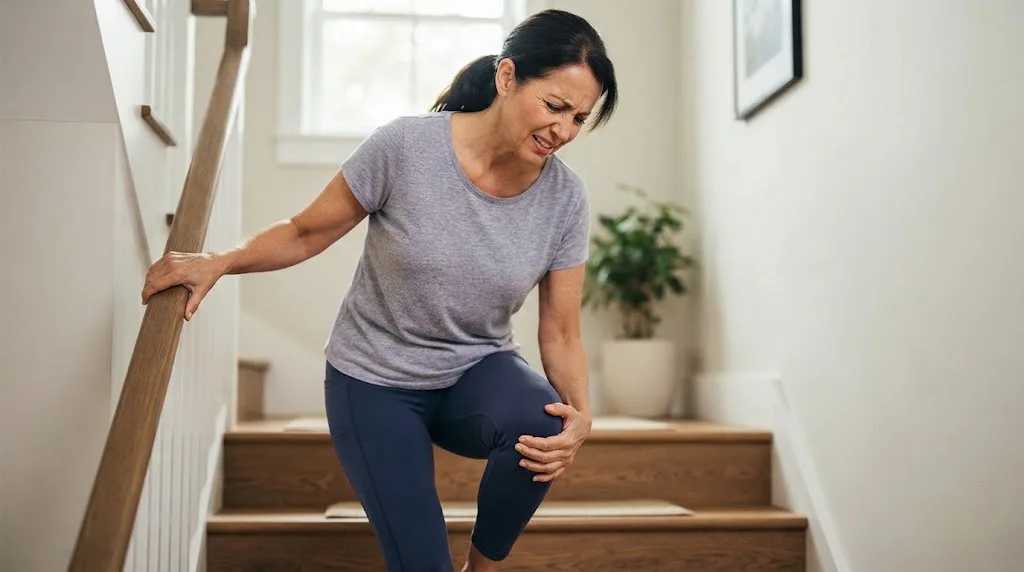

Knee pain when going down stairs is common because descending places more demand on the knee than walking on flat ground. Your quadriceps must control the body as you lower from one step to the next, while the kneecap and surrounding tissues handle increased pressure. Pain can appear in the front, inside, outside, or back of the knee depending on the cause.
The movement also requires good coordination between the hips, knees, ankles, and core. If one area lacks strength, mobility, or control, the knee may take on more stress than it can comfortably tolerate. Sudden increases in activity, previous injuries, muscle weakness, or irritation around the kneecap can all make stairs more uncomfortable.
Not every painful step means serious damage is present. Mild overuse problems often improve with activity modification, gradual strengthening, and better movement control. However, swelling, locking, instability, severe pain, or symptoms following a significant injury should be assessed by a qualified healthcare professional.
Patellofemoral Pain Syndrome
Patellofemoral pain syndrome is one of the most common causes of pain at the front of the knee when going down stairs. The kneecap moves along a groove in the thigh bone as the knee bends and straightens. Descending stairs increases pressure through this area, which can make an already sensitive joint feel painful.
Symptoms may also occur during squats, running, prolonged sitting, or getting up from a low chair. The pain is often described as aching around or behind the kneecap rather than one sharp point. Some people also notice clicking or grinding, although these sounds do not automatically mean serious joint damage.
Treatment often focuses on reducing painful loading temporarily while strengthening the quadriceps, hips, and glutes. Improving the knee’s ability to handle force can make stairs more comfortable over time. The goal is usually to rebuild tolerance rather than avoiding knee bending completely for long periods.
Quadriceps Weakness and Stair Pain
The quadriceps are especially important when walking downstairs because they slow the body as the knee bends. If these muscles are weak or poorly conditioned, controlling each step can become harder. The knee may feel painful, shaky, or less stable even when walking up the same stairs feels relatively manageable.
Weakness can develop after inactivity, injury, surgery, or simply from not doing enough lower-body strength work. People who spend long periods sitting may also notice reduced leg endurance. Once the quadriceps fatigue, movement quality can change and more stress may be placed on sensitive tissues around the knee.
Exercises such as sit-to-stands, wall sits, controlled step-downs, and knee extensions can help rebuild strength. Start with a range and resistance that feels manageable, then progress gradually. Consistency is usually more useful than trying to make one workout extremely difficult.
Knee Osteoarthritis
Knee osteoarthritis can make stairs uncomfortable, especially when descending. The condition involves changes in cartilage, bone, and surrounding joint tissues over time, and symptoms may include aching, stiffness, swelling, or reduced movement. Going down stairs can increase pressure through parts of the knee that are already sensitive.
Osteoarthritis does not mean the knee must stop moving. Regular strengthening and appropriate physical activity can help maintain function and reduce stiffness. Some people find that shorter stair use, using a railing, or stepping more slowly makes movement easier during painful periods.
If symptoms are persistent, a healthcare professional can help confirm whether osteoarthritis is contributing. Treatment may include exercise, weight management when relevant, physical therapy, medication, or other strategies. Imaging findings alone do not determine how much pain someone will feel, so function and symptoms matter as well.
Patellar Tendon Irritation
The patellar tendon connects the kneecap to the shinbone and helps transfer force when the knee straightens. Repetitive jumping, running, heavy squatting, or sudden increases in training can irritate this tendon. Pain is usually felt just below the kneecap and may become noticeable during stairs, especially when controlling the body downward.
Patellar tendon symptoms often develop gradually rather than after one dramatic injury. Athletes may notice discomfort during jumping or sprinting, while others feel pain after repeated stair climbing or strength training. The tendon may also feel stiff after rest and become temporarily more comfortable once the body warms up.
Treatment generally involves adjusting load rather than stopping all activity. Progressive resistance exercises can help rebuild tendon capacity when introduced at a tolerable level. If pain continues worsening despite sensible activity changes, professional evaluation can help determine whether the tendon or another structure is responsible.
Meniscus Problems
The menisci are cartilage structures inside the knee that help distribute pressure and improve stability. A meniscus can become irritated through repetitive bending or injured during twisting movements when the foot is planted. Pain may occur along the inner or outer joint line and can become more noticeable when descending stairs.
Some meniscus problems cause swelling, clicking, catching, or a sensation that the knee briefly sticks during movement. A significant tear may make it difficult to fully bend or straighten the knee. However, painless clicking is common and does not automatically mean the meniscus is damaged.
Mild symptoms may improve with strengthening and temporary activity modification when there is no locking or major instability. Repeated catching, swelling, or difficulty fully moving the knee deserves clinical assessment. A clinician can examine joint-line tenderness and movement before deciding whether additional testing is necessary.
Hip Weakness and Poor Leg Control
The hip muscles help control the position of the thigh during walking, running, and stair descent. If the glutes and hip stabilizers are weak or fatigue quickly, the knee may move inward excessively during each step. This can increase stress around the kneecap and make descending stairs feel more uncomfortable.
Exercises such as bridges, side steps, clamshells, and split squats can improve hip strength. These movements help the pelvis and thigh stay more controlled during weight-bearing activity. Stronger hips do not guarantee that knee pain disappears, but they can improve overall lower-body mechanics and reduce unnecessary compensation.
Single-leg exercises are especially useful once basic strength improves because stair descent is largely a one-leg-at-a-time task. Step-downs and supported split squats can help practice controlled lowering. Start with a low step and increase the challenge gradually as strength and confidence improve.
Ankle Mobility and Stair Mechanics
Ankle mobility influences how the knee moves over the foot during stair descent. If the ankle cannot bend forward comfortably, the body may compensate by turning the foot outward, shifting the hip, or reducing knee bend. These changes can alter how force travels through the leg and may contribute to discomfort.
Tight calves, previous ankle injuries, or joint stiffness can limit available movement. Gentle calf stretching and ankle mobility exercises may help when stiffness is present. Heel raises and controlled lower-leg strengthening can also improve the ankle’s ability to support stair movement.
Mobility work should stay comfortable. Forcing the ankle into painful positions is unlikely to improve movement faster and may create additional irritation. If ankle stiffness remains significant after a previous injury, a physical therapist can assess whether joint or soft-tissue restrictions are contributing.
Nerve-Related Pain Around the Knee
Not all knee pain comes directly from the knee joint. Nerve irritation in the lower back or elsewhere along the leg can sometimes create pain, burning, tingling, or numbness around the knee. Symptoms may become more noticeable during stairs because the spine, hip, and leg move through changing positions.
Nerve pain often feels different from ordinary joint soreness. You may notice electric sensations, numbness, weakness, or pain that travels into the thigh, calf, or foot. Similar patterns can happen in other parts of the body, and this guide to pinched nerve symptoms explains how nerve irritation can create pain away from its original source.
Progressive weakness or persistent numbness should be evaluated rather than treated only with knee exercises. A clinician can examine strength, reflexes, sensation, and spinal movement to determine whether the knee is the primary source. This helps avoid spending weeks strengthening the wrong area without addressing the underlying problem.
How to Relieve Knee Pain Going Down Stairs
The first step is usually to reduce the amount of stair use that clearly aggravates symptoms without becoming completely inactive. Use a railing, move more slowly, and take one step at a time during painful periods if necessary. These changes can reduce load while allowing you to maintain everyday movement.
Cold packs may help when the knee feels swollen or sore after activity, while warmth can feel better when stiffness is the main complaint. Use either for short periods and protect the skin with a cloth barrier. These methods provide temporary relief but do not replace strengthening or other treatment aimed at the underlying cause.
Over-the-counter pain medication may be appropriate for some people, but health conditions and other medications affect what is safe. A pharmacist or healthcare professional can provide guidance if needed. Long-term improvement usually depends more on building strength, managing training load, and improving movement tolerance.
Exercises That May Help
Step-down exercises are useful because they closely resemble the movement that causes pain. Stand on a low step, slowly lower one heel toward the floor, and return to the starting position. Use support if needed and keep the movement controlled rather than dropping quickly onto the lower leg.
Wall sits and sit-to-stands can strengthen the quadriceps without requiring repeated stair use. Choose a knee angle that feels manageable and gradually increase the challenge. The goal is to create muscle effort without causing a large or lasting increase in knee symptoms afterward.
Glute bridges, side steps, and calf raises can complement knee-focused exercises by strengthening surrounding muscles. A balanced program improves control from the hip to the foot. Progress one variable at a time, such as repetitions, resistance, or step height, so the body has time to adapt.
When Knee Pain Going Down Stairs Is More Concerning
Seek medical attention if knee pain follows significant trauma and you cannot bear weight normally. Rapid swelling, visible deformity, or a loud pop followed by instability can indicate ligament, meniscus, or other internal injury. These symptoms require assessment rather than repeated attempts to test the knee on stairs.
Locking is another important warning sign. If the knee becomes physically stuck and cannot fully straighten or bend, a mechanical problem may be present. Repeated giving way or a progressive loss of movement should also be evaluated because these symptoms are not typical of simple muscle weakness.
A hot, red, swollen knee accompanied by fever or feeling seriously unwell requires prompt medical care. Sudden calf swelling, chest pain, or shortness of breath also needs urgent assessment. Persistent pain that continues for several weeks despite sensible activity changes should be professionally reviewed.
Conclusion
Knee pain going down stairs can come from several causes, including patellofemoral pain, quadriceps weakness, osteoarthritis, tendon irritation, meniscus problems, hip weakness, ankle stiffness, or nerve-related symptoms. Descending stairs places substantial demand on the knee because the muscles must control the body as it lowers.
Relief often starts with temporary activity modification and progressive strengthening. Step-downs, wall sits, sit-to-stands, glute exercises, and lower-leg strengthening can improve the knee’s ability to tolerate stair movement. Mobility work may also help when the hip or ankle is limiting comfortable mechanics.
Seek professional evaluation for major swelling, locking, instability, severe trauma, progressive weakness, or persistent symptoms that fail to improve. When serious causes are excluded, gradual loading and better lower-body control can often make going downstairs more comfortable and confident again.
FAQs
Why does my knee hurt going down stairs but not up?
Going downstairs requires the quadriceps to control your body as the knee bends, increasing pressure around the kneecap. This can make patellofemoral pain or muscle weakness more noticeable during descent.
Is knee pain on stairs a sign of arthritis?
It can be, especially when pain is accompanied by stiffness or swelling. However, patellofemoral pain, tendon irritation, muscle weakness, and other problems can also cause stair-related discomfort.
What exercises help knee pain going downstairs?
Step-downs, wall sits, sit-to-stands, bridges, side steps, and calf raises can help build lower-body strength. Begin with comfortable ranges and progress gradually as symptoms improve.
Should I avoid stairs if my knee hurts?
You may temporarily reduce stair use if symptoms are significant, but complete avoidance is usually unnecessary. Use a railing, move slowly, and rebuild strength so stairs become easier over time.
When should I see a doctor for stair-related knee pain?
Seek care for severe pain, rapid swelling, locking, instability, inability to bear weight, or symptoms after major trauma. Persistent pain that does not improve with reasonable self-care also deserves evaluation.