

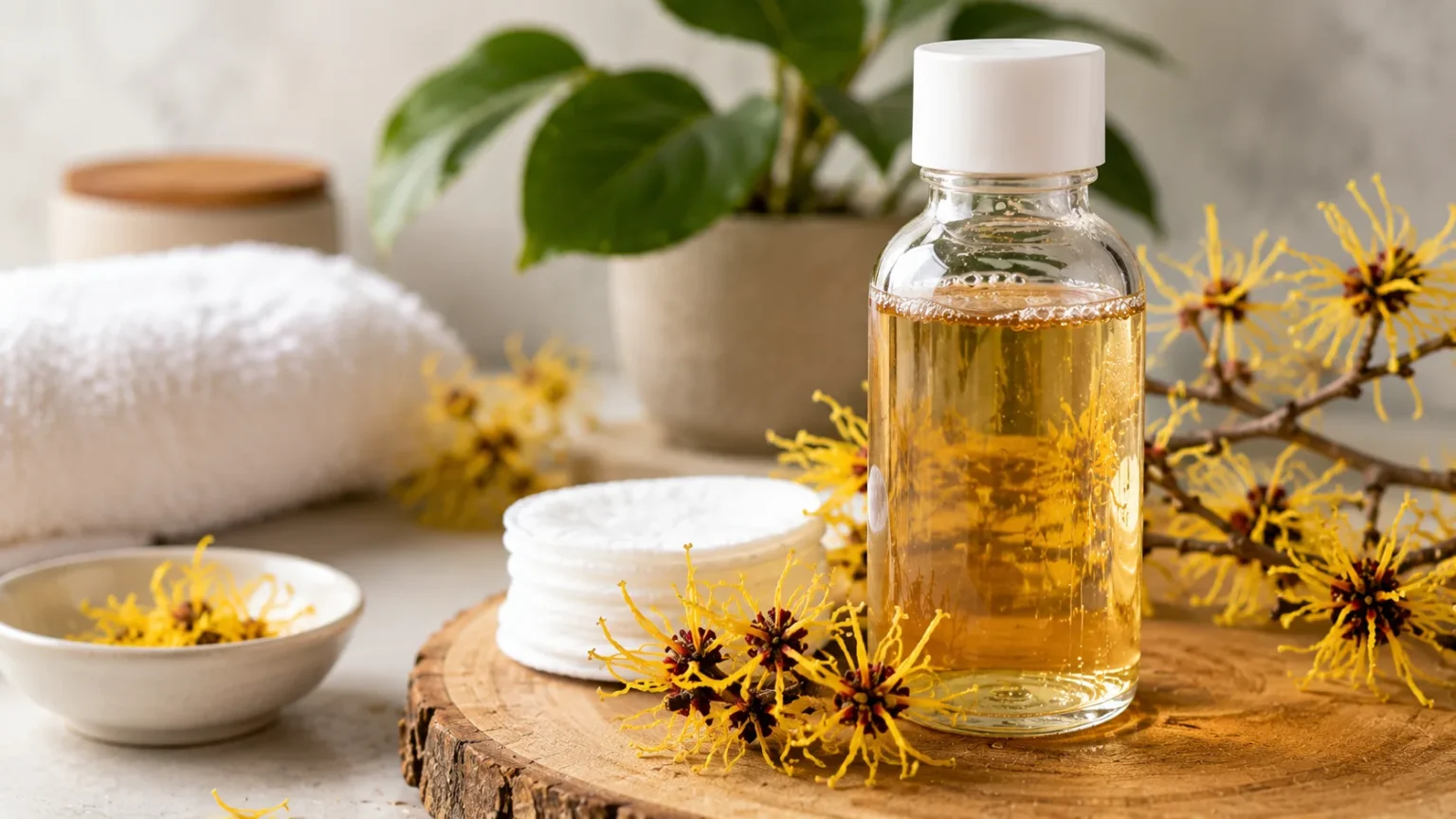

Witch Hazel Uses: 10 Benefits for Skin & More
Witch hazel has been used in skin-care products for generations, and it remains a familiar ingredient in toners, cleansing solutions, after-shave products, wipes, and hemorrhoid preparations. It comes from plants in the Hamamelis genus, particularly Hamamelis virginiana, and contains naturally occurring compounds called tannins that contribute to its astringent properties. Applied topically, witch hazel can temporarily tighten surface tissues, remove excess oil, and provide a cooling or soothing sensation. However, many benefits promoted online go much further than the available evidence supports. Witch hazel is not a cure-all for acne, eczema, infections, enlarged pores, or chronic inflammatory skin diseases. The way it performs also depends heavily on the formulation and a person’s skin type.
For some people, a gentle alcohol-free witch hazel product fits comfortably into a simple skin-care routine, while others find it drying, stinging, or irritating. Products containing substantial alcohol may be especially harsh on dry, sensitive, or already damaged skin. Witch hazel can also appear in medicated pads and other products designed for temporary external relief of hemorrhoid-related discomfort. Understanding what the ingredient can realistically do helps prevent unnecessary irritation and exaggerated expectations. This guide explains 10 practical witch hazel benefits and uses, including oily skin, pore appearance, minor irritation, shaving discomfort, acne-prone skin, insect bites, hemorrhoids, scalp care, and temporary puffiness. It also explains how to choose a product, use witch hazel safely, and recognize when another treatment is more appropriate.
What Is Witch Hazel and How Does It Work?
Witch hazel is a shrub or small tree whose bark, leaves, and twigs have traditionally been used to prepare topical products. Commercial witch hazel is commonly produced by distilling plant material, although the precise formulation differs between manufacturers. The finished product may contain witch hazel distillate along with water, alcohol, moisturizers, fragrance, or other skin-care ingredients. This means two bottles labeled witch hazel can behave very differently when applied to the same person’s skin. A simple alcohol-free toner may feel gentle, while an alcohol-rich formula can create noticeable tightness or dryness. Reading the full ingredient list is therefore more useful than judging a product only by the words “witch hazel” on the front.
Witch hazel is best known as an astringent, meaning it can temporarily contract or tighten surface tissues and reduce the oily feeling on skin. Tannins and other plant compounds contribute to this effect, although distillation and manufacturing methods influence how much of each compound remains in the final product. After application, skin may feel cleaner, less greasy, or temporarily tighter. That sensation is sometimes interpreted as pores physically closing, but pores do not contain tiny muscles that permanently open and close. Instead, removing surface oil and slightly tightening the surrounding skin can make pores appear less noticeable for a while. This distinction matters because witch hazel cannot permanently change genetically determined pore size.
The ingredient also has laboratory-demonstrated antioxidant and anti-inflammatory characteristics, which help explain why it is frequently marketed for irritated or reddened skin. Laboratory effects, however, do not automatically prove that every commercial witch hazel toner will successfully treat an inflammatory skin condition. Concentration, extraction method, additional ingredients, frequency of use, and individual skin sensitivity all influence real-world results. A product that feels calming on mildly irritated oily skin may sting badly when applied to a damaged skin barrier. It is therefore more accurate to describe witch hazel as a potentially soothing topical ingredient than as a medication for every form of inflammation. Persistent skin conditions deserve diagnosis and treatment based on their actual cause.
Witch hazel also appears in over-the-counter anorectal products because its astringent properties can provide temporary external relief around hemorrhoidal tissue. Pads or wipes containing witch hazel are convenient because they combine gentle cleansing with a cooling sensation and temporary reduction of discomfort. This is different from claiming that witch hazel permanently removes hemorrhoids or corrects the underlying enlarged veins. Symptoms can improve while the underlying condition still remains. Severe pain, substantial bleeding, recurring symptoms, or an unexplained rectal lump should not simply be treated indefinitely at home. Understanding the difference between temporary symptom relief and treatment of an underlying condition is important whenever witch hazel is used medicinally.
Witch hazel is primarily a topical ingredient, and cosmetic or skin-care products should not be swallowed simply because the plant is natural. Natural ingredients can still cause irritation, allergies, or other unwanted effects when used incorrectly. Avoid getting witch hazel into the eyes, and rinse with water if accidental eye contact occurs. Broken, deeply injured, infected, or severely inflamed skin also deserves more careful treatment than repeatedly applying an astringent. If a product creates persistent burning, itching, rash, or increasing redness, stop using it rather than assuming discomfort means it is working. The best witch hazel routine is usually modest, targeted, and adapted to the condition of the skin.
Benefits 1 & 2: Controlling Excess Oil and Improving the Look of Pores
One of the most practical witch hazel uses is temporarily removing excess surface oil from oily skin. Sebum is a natural substance produced by sebaceous glands and plays an important role in supporting the skin barrier. Problems arise when oil combines with sweat, cosmetics, sunscreen, and environmental debris, leaving the face feeling greasy or shiny. A gentle witch hazel toner can remove some of this surface residue after cleansing. People with naturally oily skin may appreciate the cleaner, less shiny finish, particularly around the forehead, nose, and chin. The goal should be balancing comfort rather than trying to strip every trace of oil from the face.
Using increasingly strong witch hazel products does not necessarily create better oil control. When a formula contains substantial alcohol or is applied repeatedly throughout the day, it can remove too much surface lipid and leave skin tight, flaky, or irritated. A damaged skin barrier can feel uncomfortable and may make an existing skin-care routine more difficult to tolerate. People with combination skin can apply witch hazel mainly to oilier regions instead of automatically covering the entire face. Starting once every day or every few days can also reveal how the skin responds before increasing frequency. Oil control should make skin more comfortable, not leave it feeling painfully dry or stripped.
The second commonly discussed benefit is the temporary appearance of smaller or less obvious pores. Pores can look more noticeable when they contain oil and debris or when surrounding skin becomes very oily. Removing surface oil with an astringent may give the skin a smoother-looking appearance, particularly immediately after application. Witch hazel can also create a temporary tightening sensation that contributes to this visual effect. However, it does not permanently shrink pores or eliminate them because pores are normal anatomical structures associated with hair follicles and oil glands. Genetics, age, sun exposure, oil production, and skin condition all influence how visible pores appear.
People who want longer-term improvement in clogged or prominent pores may need ingredients that address the underlying reasons they are visible. Salicylic acid can help clear oil and debris from inside pores, while retinoids can support cell turnover and address several factors involved in acne and skin texture. Sunscreen can help reduce cumulative sun damage that contributes to changes in skin structure over time. Witch hazel can still complement a routine when it is well tolerated, but it should not replace ingredients with stronger evidence for a particular concern. Using too many active products together can also create irritation. A simple routine that the skin tolerates consistently is usually more useful than repeatedly adding products promising instant pore tightening.
For oily skin, apply a small amount of an appropriate witch hazel product after gentle cleansing and before moisturizer or sunscreen. A cotton pad can be used, although clean hands can reduce unnecessary rubbing and product waste when the formula allows direct application. Observe how the skin feels several minutes later rather than judging only the immediate cooling sensation. Persistent tightness, burning, or flaky patches suggest that the product or frequency may be too harsh. An alcohol-free and fragrance-free formula may be a better starting option for someone concerned about irritation. Used conservatively, witch hazel can provide temporary oil and shine control without becoming the most aggressive step in the routine.
Benefits 3 & 4: Soothing Minor Irritation and Temporary Redness
Another possible witch hazel benefit is soothing mild, temporary skin irritation. A cool witch hazel preparation can feel refreshing after heat, sweating, friction, or minor everyday discomfort when the skin surface remains intact. Its astringent properties may contribute to the sensation that irritated tissue feels calmer or less swollen. However, irritation has many causes, ranging from simple friction to allergic dermatitis, infection, eczema, or damage from overusing exfoliating acids. Witch hazel cannot treat every one of these conditions. If the skin is severely painful, blistered, oozing, infected, or worsening quickly, identifying the cause is more important than continuing to experiment with home skin-care products.
Formulation becomes especially important when irritated skin is involved because alcohol and fragrance can worsen the problem. A product that works well on an oily forehead may sting intensely on skin that has been over-exfoliated or rubbed repeatedly. Alcohol-free witch hazel containing relatively few additional ingredients is generally a more cautious option when the goal is soothing rather than degreasing. Even then, patch testing is sensible for people with reactive skin. Apply a small amount to a limited area and observe for burning, itching, rash, or persistent redness. If irritation increases, discontinue use rather than applying more in an attempt to force the skin to adapt.
Temporary redness is the fourth potential benefit frequently associated with witch hazel. Mild redness related to heat, surface irritation, or recent friction may appear less noticeable after a cool compress or gentle topical application. Some of that improvement may come from the cooling effect and evaporation rather than witch hazel alone. More importantly, chronic facial redness can have causes such as rosacea, eczema, contact dermatitis, acne inflammation, or sun damage. These conditions require different approaches and may actually become worse with irritating astringents. Witch hazel should therefore be viewed as an optional soothing step for minor temporary redness, not a universal redness treatment.
People with rosacea or very sensitive skin should be particularly cautious because a product that produces a pleasant tightening sensation in someone else may create burning or flushing for them. Alcohol, fragrance, essential oils, and multiple botanical extracts can make a seemingly simple toner much more complicated. A damaged moisture barrier also tends to react strongly to ingredients that previously caused no problem. When redness repeatedly returns, simplifying the routine to gentle cleansing, moisturizing, and sun protection may be more useful than adding another active ingredient. A dermatologist can help identify persistent redness that has no obvious explanation. Treating the diagnosis is more reliable than repeatedly attempting to suppress the visible color.
Witch hazel is most useful for minor irritation when expectations remain modest. Apply a small amount to clean skin and give the area time to respond rather than repeatedly saturating it. Avoid combining it immediately with strong exfoliating acids, scrubs, retinoids, or other potentially irritating products when the skin already feels uncomfortable. If symptoms improve, there is no need to increase frequency simply because the product appears to work. If symptoms continue for several days or steadily worsen, reconsider the cause instead of relying indefinitely on witch hazel. Skin irritation is a signal, and sometimes the smartest response is reducing products rather than trying to treat every sensation with another ingredient.
Benefits 5 & 6: Supporting Acne-Prone Skin and Easing Post-Shave Discomfort
Witch hazel is widely used for acne-prone skin because its astringent effect can remove excess surface oil that contributes to a greasy feeling. This can make it a useful supporting product for some people, particularly those with oily complexions who tolerate astringents well. However, witch hazel is not one of the primary evidence-based acne medications used to prevent clogged pores or reduce acne-causing processes. It should not be expected to replace treatments such as salicylic acid, benzoyl peroxide, retinoids, or prescription therapies when those are appropriate. Acne can involve clogged follicles, oil production, inflammation, hormones, and microorganisms simultaneously. Removing surface oil addresses only one part of that much larger process.
People sometimes apply strong witch hazel repeatedly because pimples feel oily, but aggressive drying can create another set of problems. Excessive astringent use can lead to tightness, peeling, burning, and an impaired skin barrier, making proven acne treatments harder to tolerate. A better strategy is integrating a gentle witch hazel product only if it adds something useful to the routine. For example, someone might use it occasionally after cleansing while continuing an acne treatment recommended for their skin. Moisturizer remains important even for oily or acne-prone skin because hydration and oil production are not the same thing. Noncomedogenic moisturizers can support the barrier without automatically making acne worse.
Witch hazel should also not be used as a substitute for treating deep, painful, cystic, or scarring acne. These forms of acne can cause permanent marks and emotional distress if effective treatment is delayed. A dermatologist can recommend therapies based on severity, location, previous treatment, pregnancy considerations, and other health factors. Someone with a few occasional blemishes has very different needs from someone experiencing widespread inflammatory nodules. If witch hazel causes burning around active pimples, stop applying it to those areas. Skin-care products should support acne management rather than turning every lesion into a painful test of how much irritation the skin can tolerate.
The sixth potential benefit is temporary relief of mild discomfort after shaving. Shaving creates friction and can leave tiny areas of surface irritation, particularly when blades are dull, skin is dry, or repeated passes are made over the same area. A gentle witch hazel product may provide a cooling, astringent sensation after shaving and remove small amounts of residual oil. Some traditional after-shave preparations use witch hazel for this reason. However, alcohol-heavy products can sting freshly shaved skin and may worsen dryness. If post-shave burning happens regularly, improving shaving technique can often provide more benefit than repeatedly treating the irritation afterward.
Use a clean, sharp razor, adequate lubrication, and gentle pressure to reduce shaving-related irritation before it begins. Shaving in a direction that minimizes pulling and avoiding unnecessary repeated passes can also help, although technique varies with hair type and body area. After shaving, rinse away remaining shaving product and pat the skin dry instead of rubbing aggressively. If witch hazel is used, apply a small amount of a gentle formula and follow with moisturizer when needed. Persistent razor bumps may represent ingrown hairs or pseudofolliculitis rather than simple irritation. Those conditions may respond better to targeted prevention and treatment than to astringent products alone.
Benefits 7 & 8: Minor Bite Discomfort and Hemorrhoid Relief
Witch hazel is sometimes used on minor insect bites because its cooling and astringent qualities can make itchy or mildly irritated skin feel more comfortable. The evidence for treating insect bites specifically is limited, so it should be regarded as a supportive comfort measure rather than an antidote or proven anti-itch medication. A cool compress alone can also reduce the sensation of itching and temporary swelling. Avoid scratching whenever possible because broken skin creates additional irritation and increases the chance of secondary infection. If witch hazel stings the bite significantly, rinse it away and choose another approach. Products containing alcohol may be particularly uncomfortable on skin damaged by scratching.
Not every insect reaction should be handled with witch hazel or home skin care. Rapidly increasing swelling, difficulty breathing, swelling of the lips or tongue, widespread hives, dizziness, or other signs of a serious allergic reaction require emergency medical attention. Increasing warmth, spreading redness, pus, or worsening pain several days after a bite may suggest infection. Tick bites also carry considerations that have nothing to do with temporary skin irritation, depending on geography and circumstances. When symptoms are limited to a small itchy area, simple measures such as cool compresses and appropriate over-the-counter treatments may be sufficient. The severity and pattern of the reaction should determine the response.
The eighth and much more established use of witch hazel is temporary external relief associated with hemorrhoids. Witch hazel appears in medicated pads, wipes, and liquids designed for the anorectal area because it acts as an astringent. Applied externally according to product directions, it can provide cooling and temporary relief from irritation, burning, or discomfort. These products are convenient after bowel movements because they can also provide gentle cleansing when ordinary toilet paper feels uncomfortable. Use only products designed and labeled appropriately for the area rather than assuming every facial witch hazel toner is suitable. Added fragrance, alcohol, or cosmetic ingredients may be unnecessarily irritating on sensitive tissue.
Witch hazel does not eliminate the underlying factors that contribute to hemorrhoids. Constipation, straining, prolonged sitting on the toilet, pregnancy, and other sources of pressure can contribute to swollen hemorrhoidal veins. Increasing dietary fiber, drinking appropriate fluids, maintaining regular bowel habits, and avoiding prolonged straining may help address some contributing factors. Other treatments can be appropriate depending on whether hemorrhoids are internal, external, thrombosed, recurrent, or significantly symptomatic. Witch hazel provides symptom relief rather than repairing enlarged veins permanently. That distinction helps prevent someone from using wipes continuously while an underlying bowel or anorectal problem remains unaddressed.
Rectal bleeding should never automatically be assumed to come from hemorrhoids, particularly when it is new, recurrent, substantial, or unexplained. Other digestive and colorectal conditions can also cause bleeding and may require medical evaluation. Severe anal pain, fever, a rapidly enlarging lump, black stools, dizziness, or heavy bleeding deserves prompt professional attention. If an over-the-counter hemorrhoid product does not improve symptoms within the period stated on its label, follow the instructions about seeking medical advice. Witch hazel can be useful when the problem truly is minor hemorrhoidal irritation. It becomes less useful when it delays evaluation of symptoms that need a more specific diagnosis.
Benefits 9 & 10: Oily Scalp Care and Temporary Puffiness Relief
The ninth potential witch hazel use is managing an oily-feeling scalp. Just as the face produces sebum, the scalp contains numerous sebaceous glands that can leave hair roots feeling greasy between washes. A diluted or specifically formulated scalp product containing witch hazel may help remove some surface oil and residue. This can be useful for people who experience oily roots but do not want to shampoo repeatedly throughout the day. However, the scalp is still skin and can become dry or irritated when strong alcohol-based astringents are applied too often. Using a product designed for scalp application is generally more predictable than pouring ordinary facial toner directly through the hair.
Witch hazel should not be expected to treat every cause of an itchy, flaky, or uncomfortable scalp. Dandruff and seborrheic dermatitis often respond better to shampoos containing ingredients specifically designed to control the processes involved. Psoriasis, fungal infections, allergic reactions to hair products, and other scalp disorders can require different treatments entirely. Applying witch hazel may temporarily reduce greasy residue without correcting any of these conditions. If the scalp becomes persistently red, painful, heavily scaled, crusted, or associated with unusual hair loss, professional evaluation is appropriate. A clean-feeling scalp and a healthy scalp are related goals, but they are not always achieved with the same ingredients.
When experimenting with witch hazel on the scalp, start conservatively and avoid soaking the entire head. Apply a small amount to an oily area, allow it to dry, and monitor for itching, tightness, or burning. Avoid using it directly after aggressive scratching, chemical treatments, bleaching, or other procedures that have left the scalp irritated. Products that contain fragrance or high amounts of alcohol may increase sensitivity in susceptible people. If the scalp feels cleaner without becoming uncomfortable, occasional use may be reasonable. Regular shampooing with a product suited to hair and scalp type should still provide the foundation of hygiene rather than relying primarily on an astringent.
The tenth possible benefit is temporary relief of mild facial puffiness when witch hazel is used as part of a cool compress or refreshing skin-care routine. The cooling effect can make tired skin feel more comfortable and may temporarily improve the appearance of mild surface swelling. However, much of this effect may come from the cool temperature and gentle compression rather than from witch hazel itself. It should not be presented as a treatment for persistent facial or eye swelling. Avoid placing witch hazel directly into the eyes or applying it so close to the eyelids that the liquid can easily enter them. Eye-area skin is thin and especially vulnerable to irritation.
Persistent or sudden facial swelling needs a different approach because it can be associated with allergies, infection, medication reactions, dental problems, kidney or thyroid conditions, or other medical causes. Swelling accompanied by breathing difficulty, throat tightness, tongue swelling, or rapidly spreading hives is an emergency. Mild morning puffiness related to sleep, salt intake, or temporary fluid distribution usually resolves without intensive treatment. A clean cool compress may be enough for many people. Witch hazel can be an optional addition when the skin tolerates it, but it should not become the reason serious swelling is overlooked. Cosmetic benefit and medical treatment should always be kept clearly separate.
How to Use Witch Hazel Safely on Your Skin
The first step is choosing a formulation that matches your skin rather than assuming all witch hazel products are interchangeable. Look at the complete ingredient list and pay particular attention to alcohol, fragrance, essential oils, exfoliating acids, and other active ingredients. Someone with oily resilient skin may tolerate a stronger formulation than someone with dry or sensitive skin. Alcohol-free and fragrance-free options are generally reasonable starting points when avoiding irritation is a priority. Products marketed for hemorrhoids should be used according to their specific directions and should not automatically be substituted for facial toner. Product category and intended body area matter because formulations are designed with different uses in mind.
Patch testing can help identify obvious sensitivity before applying a new product across the entire face. Place a small amount on a limited area of intact skin and observe how it responds over the following day or two. Mild evaporation or a brief cooling sensation is different from persistent burning, itching, swelling, or an expanding rash. People with a history of contact dermatitis or multiple cosmetic allergies should be particularly cautious when trying botanical ingredients. Plants can contain naturally occurring compounds capable of triggering reactions just as synthetic ingredients can. If the patch test causes a significant reaction, discontinue the product rather than attempting to slowly build tolerance.
When using witch hazel as a facial toner, cleanse gently first and then apply only the amount needed to lightly cover the intended area. There is no requirement to soak a cotton pad until the skin is dripping. Allow the product to dry and follow with moisturizer if your skin benefits from additional hydration. During daytime routines, sunscreen remains important because witch hazel does not provide meaningful ultraviolet protection. If you also use retinoids, exfoliating acids, benzoyl peroxide, or prescription acne treatments, monitor carefully for cumulative irritation. A dermatologist can help simplify a routine when several active ingredients are making the skin persistently dry or uncomfortable.
Frequency should be based on tolerance rather than an assumption that twice-daily application is necessary for everyone. Someone with oily skin may tolerate daily witch hazel, while a person with combination skin may prefer occasional application only to the T-zone. Dry or sensitive skin may do better without it altogether. If the skin becomes progressively tight, shiny from dehydration, flaky, itchy, or unusually reactive to other products, reduce or stop use. Skin care should not become an endurance test in which irritation is accepted as evidence that an ingredient is effective. Consistency with gentle products usually produces better long-term results than repeatedly damaging and repairing the skin barrier.
Never use cosmetic witch hazel as a treatment for deep wounds, serious burns, infected skin, or conditions requiring medical attention. Avoid swallowing it, and keep cosmetic products where children cannot accidentally ingest them. Do not intentionally place witch hazel inside the eyes, nose, vagina, or other sensitive internal tissues unless a properly labeled medical product specifically provides instructions for that use. For hemorrhoids, follow the directions on the anorectal product rather than improvising with unrelated formulas. Stop using a product when symptoms become worse or persist beyond the period described on the label. Safe use depends as much on knowing when to stop as knowing when to apply it.
Side Effects, Skin Types and When Witch Hazel May Not Be a Good Choice
Dryness is probably the most familiar unwanted effect of witch hazel, particularly when it is combined with alcohol. The temporary tight feeling that makes oily skin seem refreshed can become uncomfortable when the skin already lacks sufficient moisture. Repeated applications may contribute to roughness, peeling, sensitivity, or stinging when moisturizer and other products are applied. People with naturally dry skin often gain little from aggressive oil removal because excess shine was not their primary problem in the first place. A hydrating toner or simple moisturizer may serve them better. Choosing products according to actual skin needs is more useful than using witch hazel merely because it is a popular traditional ingredient.
Sensitive skin can also react with burning, redness, itching, or a rash. Witch hazel itself may be irritating to some people, while alcohol, fragrance, preservatives, or other botanical ingredients in the formula may be responsible in others. This makes it difficult to conclude that every reaction represents an allergy specifically to witch hazel. Stop the product and allow the skin to settle rather than repeatedly testing it on the irritated area. Severe swelling, blistering, widespread hives, or breathing symptoms require more urgent attention. A dermatologist or allergy professional can help investigate recurrent reactions when identifying the responsible ingredient becomes important.
People with eczema or a severely disrupted skin barrier should approach astringents cautiously. Eczema-prone skin often benefits from minimizing irritating products and supporting barrier function with gentle cleansing and appropriate moisturization. The cooling sensation of witch hazel may initially feel pleasant but can be followed by dryness or increased stinging in some individuals. Alcohol-containing formulas are particularly questionable when skin is cracked, inflamed, or intensely dry. If a clinician has recommended a specific eczema treatment plan, introducing extra astringents may complicate the routine unnecessarily. Products that are useful for oily skin are not automatically appropriate for inflammatory conditions in which barrier protection is the priority.
People with rosacea should also be careful because triggers differ substantially between individuals. Some may tolerate a simple alcohol-free witch hazel product, while others experience immediate burning or flushing. Fragrance and alcohol frequently make already reactive routines harder to manage, so checking the ingredient list is essential. Rosacea can also involve visible blood vessels, acne-like bumps, eye symptoms, or persistent inflammation that witch hazel cannot adequately treat. Effective medical and skin-care strategies are available depending on the subtype and severity. If facial redness is persistent rather than occasional, establishing the diagnosis provides a better foundation than repeatedly experimenting with toners.
The overall rule is simple: witch hazel is optional, not essential. A person can maintain healthy skin without ever using it, while someone with oily resilient skin may enjoy its cleansing and astringent qualities. Its strongest role is providing temporary topical effects rather than permanently changing pores, curing acne, eliminating hemorrhoids, or treating serious inflammatory disease. Use the lowest frequency that achieves the desired cosmetic or comfort benefit, and stop when irritation outweighs that benefit. Be especially skeptical of products that promise detoxification, permanent pore closure, instant acne cures, or treatment of infections. Witch hazel can be useful precisely because its realistic role is modest and easy to understand.
Frequently Asked Questions
What is witch hazel mainly used for?
Witch hazel is mainly used topically as an astringent in skin-care products and certain over-the-counter hemorrhoid preparations. It can temporarily remove excess oil, create a tightening sensation, and soothe some forms of minor external irritation.
Is witch hazel good for acne?
Witch hazel may help remove excess surface oil from acne-prone skin, but it is not a primary proven acne treatment. Persistent, inflammatory, cystic, or scarring acne usually benefits more from established acne therapies and professional guidance when needed.
Can you use witch hazel on your face every day?
Some people with oily, resilient skin tolerate daily use, particularly with a gentle alcohol-free formula. Dry, sensitive, eczema-prone, or rosacea-prone skin may become irritated, so frequency should depend on how your individual skin responds.
Does witch hazel actually shrink pores?
Witch hazel does not permanently shrink pores. Its astringent effect and removal of excess surface oil can temporarily make pores look less noticeable.
Is alcohol-free witch hazel better for skin?
Alcohol-free witch hazel is often a gentler option, especially for dry, sensitive, or easily irritated skin. However, the entire ingredient list still matters because fragrance, acids, botanical extracts, or other ingredients can also cause irritation.